
The Application Gallery features COMSOL Multiphysics® tutorial and demo app files pertinent to the electrical, structural, acoustics, fluid, heat, and chemical disciplines. You can use these examples as a starting point for your own simulation work by downloading the tutorial model or demo app file and its accompanying instructions.
Search for tutorials and apps relevant to your area of expertise via the Quick Search feature. Note that many of the examples featured here can also be accessed via the Application Libraries that are built into the COMSOL Multiphysics® software and available from the File menu.
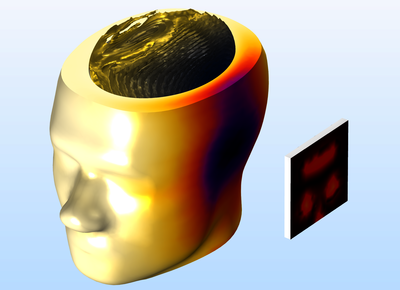
Users of consumer electronics with radiating devices are exposed to radio frequency (RF) emission. The amount of exposure is defined as the specific absorption rate (SAR). That is, the SAR value represents the radio frequency (RF) energy rate absorbed by a body. This model computes local ... Read More
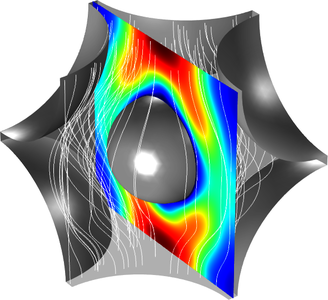
This example shows how to estimate the permeability of a porous material by creating a detailed fluid flow model in a small unit cell. The result of the model is a lumped permeability of the material, which can be used in homogenized models using Darcy's law or the Brinkman equations. ... Read More
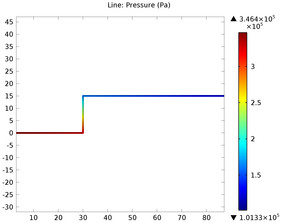
This tutorial model illustrates how to calculate the pressure drop and initial flow rate in a pipe system connected to water tank. The Pipe Flow interface contains ready to use friction models accounting for the surface roughness of pipes as well as pressure losses in bends and valves. Read More
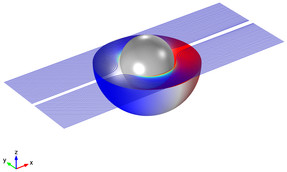
This model demonstrates the use of optical tracing for studying optically large gradient-index structures with anisotropic optical properties. Additionally, the model introduces a smoothing technique for handling discontinuities of refractive index on curved surfaces, which are typical ... Read More
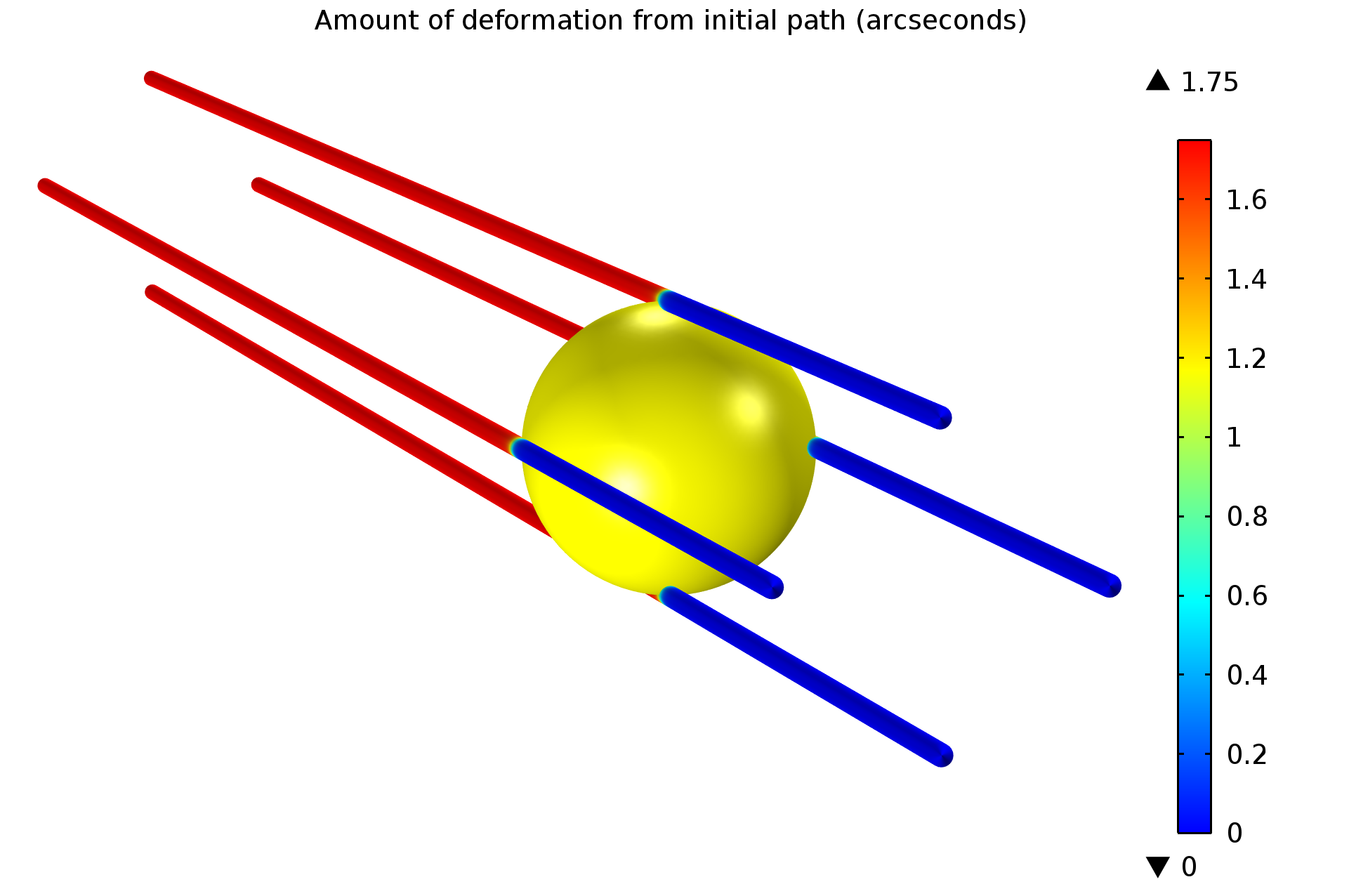
This model demonstrates how the sun causes 1.75 arcseconds of deflection for rays grazing the sun's surface as observed from the earth. Einstein predicted this value after refining his theory of relativity during World War I. Read More
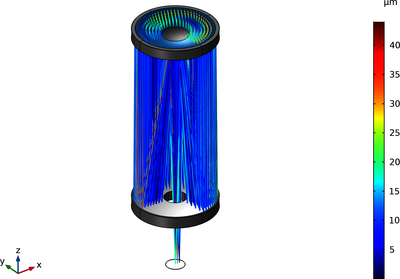
The Gregory-Maksutov telescope is a simple catadioptric telescope comprising a spherical corrector lens and a spherical primary mirror. In this example the corrector lens and mirror are formed using the 'Spherical Lens 3D' and 'Spherical Mirror 3D' parts respectively from the Ray Optics ... Read More
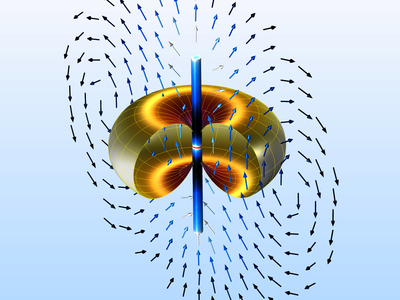
The dipole antenna is one of the most straightforward antenna configurations. It can be realized with two thin metallic rods that have a sinusoidal voltage difference applied between them. The length of the rods is chosen such that they are quarter wavelength elements at the operating ... Read More
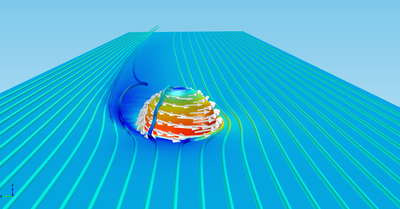
The Magnus effect explains the curl that soccer players can give the ball, resulting in the enjoyable goals that we can see in every FIFA World Cup™. This model looks at the Magnus effect in the laminar and turbulent flow regimes for transient and stationary flows. It also discusses ... Read More


