
The Application Gallery features COMSOL Multiphysics® tutorial and demo app files pertinent to the electrical, structural, acoustics, fluid, heat, and chemical disciplines. You can use these examples as a starting point for your own simulation work by downloading the tutorial model or demo app file and its accompanying instructions.
Search for tutorials and apps relevant to your area of expertise via the Quick Search feature. Note that many of the examples featured here can also be accessed via the Application Libraries that are built into the COMSOL Multiphysics® software and available from the File menu.
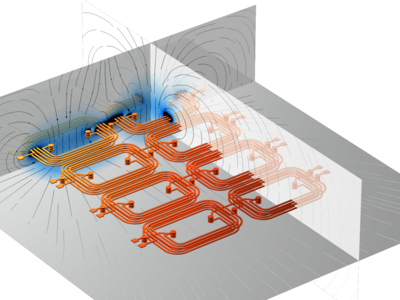
This model demonstrates how to use the Magnetic Fields, Currents Only interface together with the Stationary Source Sweep with Initialization study to compute the inductance matrix of PCB coils with a number of 12. Read More
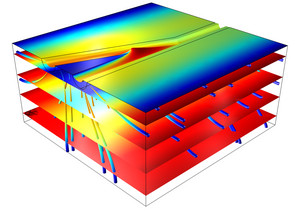
Multilateral wells—those with multiple legs that branch off from a single well—can produce oil efficiently because the legs can tap multiple productive zones and navigate around impermeable ones. Unfortunately, drilling engineers must often mechanically stabilize multilateral wells with ... Read More
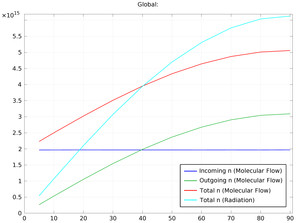
This model computes the particle flux, number density and pressure on the surface of a plate that rotates in a highly directional molecular flow. The results obtained are compared with those from other, approximate, techniques for computing molecular flows. Read More
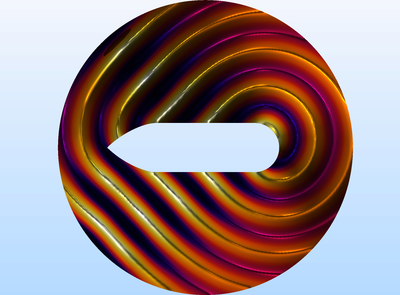
This tutorial model demonstrates the use of a background field in an electromagnetic scattering problem. Although this example is a boat hit by a radar, this same technique can be used in any situation where an isolated object meets electromagnetic waves from a distant source. For ... Read More
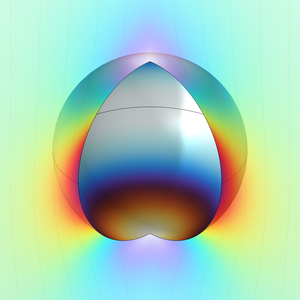
Electroporation is a technique where a localized electric field is used to generate nanometric pores in cell membranes, improving the cell permeability for ions and pharmaceuticals. This model shows the electroporation of a spherical cell by means of a nanosecond electric pulse. The ... Read More
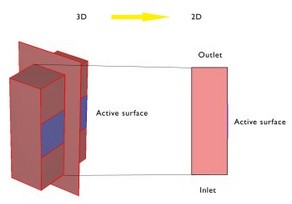
This model demonstrates how to model phenomena defined in different dimensions in a fully coupled manner using COMSOL Multiphysics. Whereas in most cases the reaction rate expression is defined as a function of the concentrations of the reactants and products, in adsorption reactions ... Read More
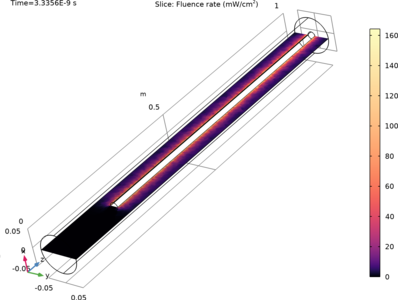
This model demonstrates how to compute the volumetric fluence rate in an ultraviolet (UV) reactor. The geometry is the annular fluid region surrounding a cylindrical lamp. The effect of reflection at the reactor walls on the radial fluence rate distribution is considered. Read More
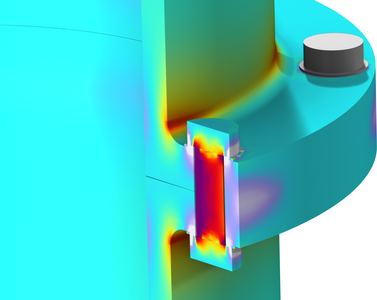
A tube connection consisting of a flange with eight prestressed bolts is subjected to a set of loads: an internal pressure, an axial force, and an external bending moment. Due to two symmetry planes, it is sufficient to only consider one quarter of the full geometry. The study ... Read More
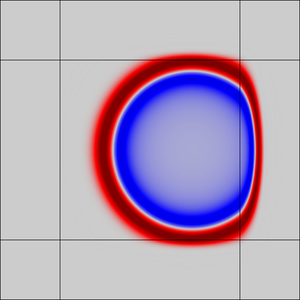
This tutorial simulates a standard test and benchmark model for nonreflecting conditions and sponge layers for linearized Euler-like systems. It involves the propagation of a transient Gaussian pulse in a 2D uniform flow. The Convected Wave Equation, Time Explicit interface solves the ... Read More
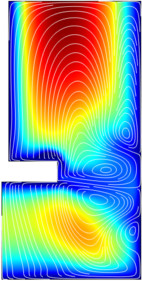
Swirl flow is an application that involves steady rotational flow around an axis. Rather than modeling this process in 3D, COMSOL Multiphysics provides a 2D axisymmetric interface where the flow in the rotational direction is still included in the equations. This example shows the ... Read More


