
The Application Gallery features COMSOL Multiphysics® tutorial and demo app files pertinent to the electrical, structural, acoustics, fluid, heat, and chemical disciplines. You can use these examples as a starting point for your own simulation work by downloading the tutorial model or demo app file and its accompanying instructions.
Search for tutorials and apps relevant to your area of expertise via the Quick Search feature. Note that many of the examples featured here can also be accessed via the Application Libraries that are built into the COMSOL Multiphysics® software and available from the File menu.
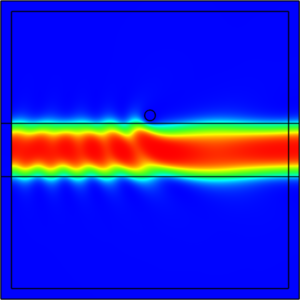
This model includes a dielectric slab waveguide with a small lossy metallic object nearby. The object causes light to be scattered, absorbed, and both reflected and transmitted along the waveguide. Learn more in this accompanying blog post: Modeling a Scatterer Near an Optical Waveguide Read More
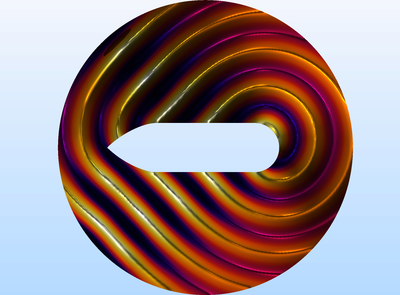
This tutorial model demonstrates the use of a background field in an electromagnetic scattering problem. Although this example is a boat hit by a radar, this same technique can be used in any situation where an isolated object meets electromagnetic waves from a distant source. For ... Read More
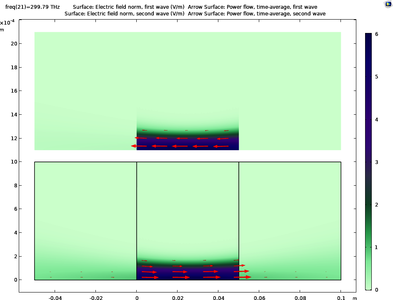
A Fabry-Perot resonator is one of the fundamental optical devices and has a broad range of applications. A few examples are that it can be used to measure length, frequency/wavelength or to filter specific spatial modes. This model uses the Beam Envelopes Interface in the bidirectional ... Read More
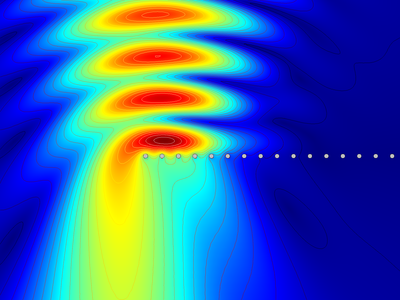
A Gaussian electromagnetic wave is incident on a dense array of very thin wires (or rods). The distance between the rods and, thus, the rod diameter is much smaller than the wavelength. Under these circumstances, the rod array does not function as a diffraction grating (see the Plasmonic ... Read More
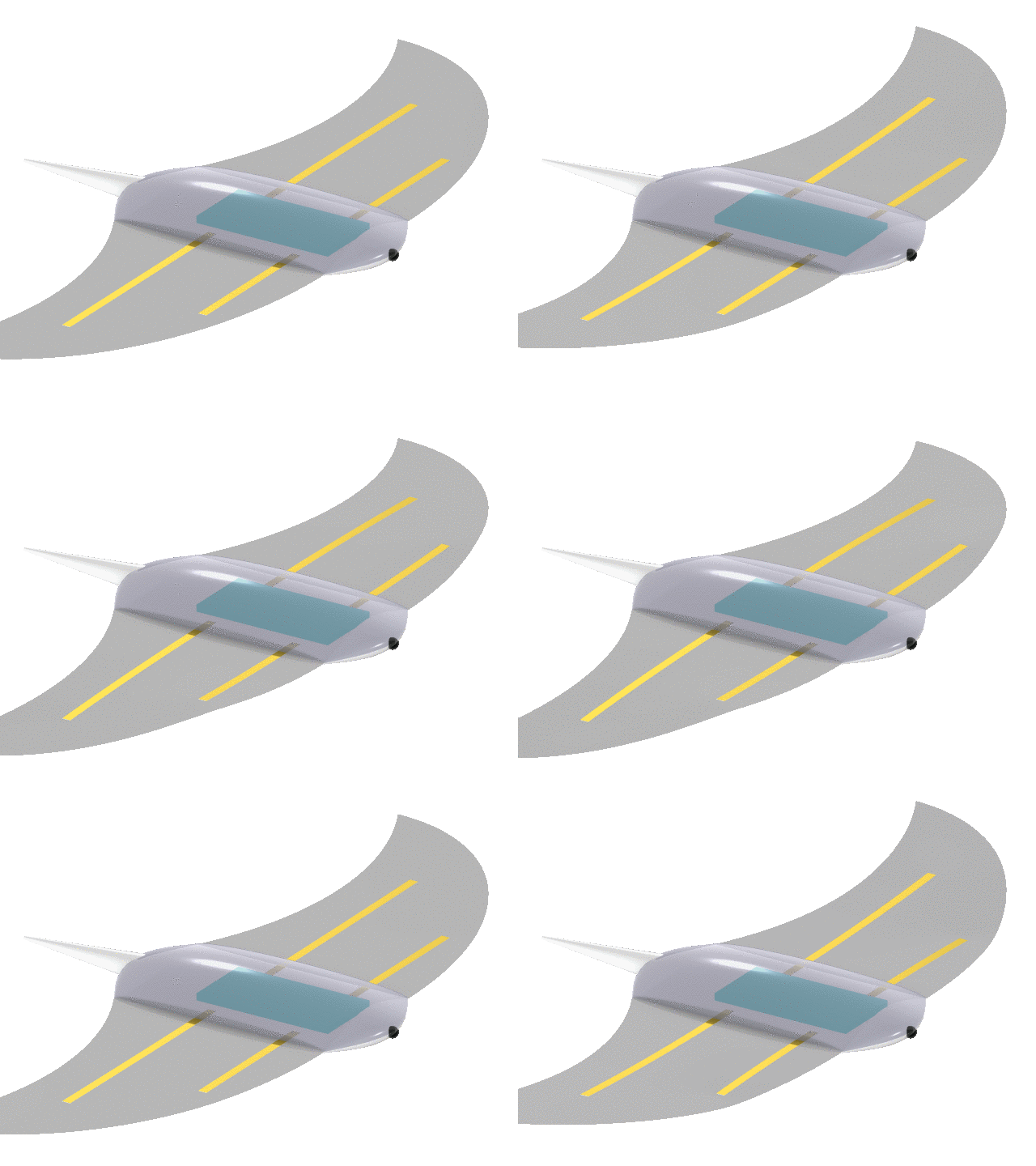
This example shows how to set up an ionic polymer-metal composite (IPMC) as an actuator for a robotic manta ray. Two IPCM beams are integrated into the fin and can be controlled independently. The chemomechanical effect is achieved with the Shrinkage and Swelling multiphysics ... Read More
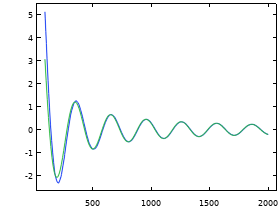
In this tutorial model, the far-field radiation pattern of a dipole antenna is computed in a 2D axisymmetric model component. Then, in a separate 3D model component, a ray is released using the far-field radiation pattern to initialize the ray's intensity, polarization, and phase. Read More
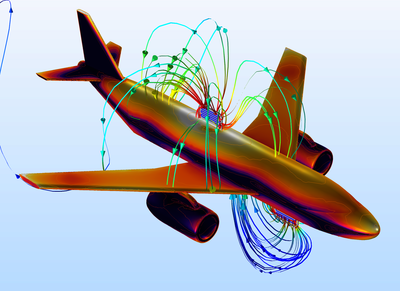
Antenna crosstalk, or co-site interference, is problematic when multiple antennas are used on a single large platform. In this model, the interference between two identical antennas at VHF frequency is studied with an S-parameter analysis of different configurations of a receiving ... Read More
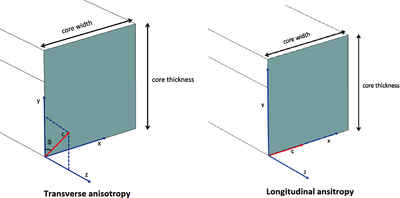
In this model, a modal analysis is performed while parametrically sweeping the length of a waveguide from 0.5 um to 4 um to derive the dispersion curve for the anisotropic core. Both transverse and longitudinal anisotropy are considered in two different models. These models are ... Read More
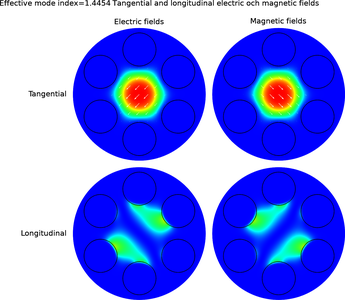
A mode analysis study is used to find the complex effective indices for a microstructured optical fiber (MOF), consisting of air holes in a silica host. As the effective index is smaller than the refractive index of the silica background material, the modes are leaky. The model ... Read More

A plane TE-polarized electromagnetic wave is incident on a gold nanoparticle on a dielectric substrate. The absorption and scattering cross-sections of the particle are computed for a few different polar and azimuthal angles of incidence. The model first computes a background field from ... Read More


