
The Application Gallery features COMSOL Multiphysics® tutorial and demo app files pertinent to the electrical, structural, acoustics, fluid, heat, and chemical disciplines. You can use these examples as a starting point for your own simulation work by downloading the tutorial model or demo app file and its accompanying instructions.
Search for tutorials and apps relevant to your area of expertise via the Quick Search feature. Note that many of the examples featured here can also be accessed via the Application Libraries that are built into the COMSOL Multiphysics® software and available from the File menu.
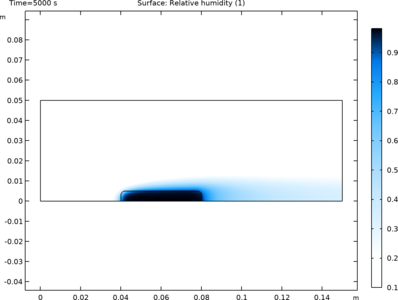
Drying of porous media is an important process in the food and paper industry among others. Many physical effects must be considered: fluid flow, heat transfer with phase change, and transport of participating liquids and gases. All of these effects are strongly coupled, and predefined ... Read More
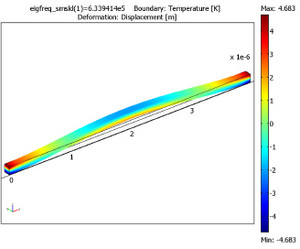
Thermoelastic damping, which arises when you subject a material to cyclic stress, is an important factor when designing MEMS resonators. The stress brings about deformation, where materials heat under compressive stress and cool under tensile stress. Thus, due to the resulting heat flux, ... Read More
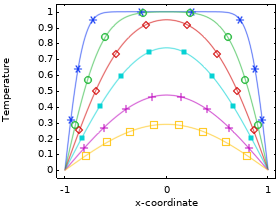
This simple example covers the heating of a finite slab and how the temperature varies with time. We will set up the problem in COMSOL Multiphysics after which we compare the solution to the analytical solution. Read More
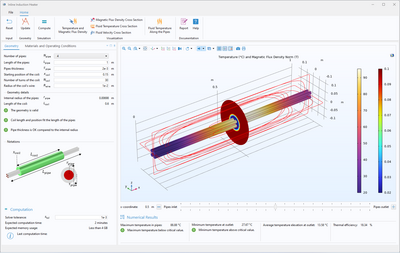
This app demonstrates the following: A model using symmetry while the results are visualized in full 3D Provides info if the results are above or below certain critical values Selecting predefined or user-defined materials Error control of geometry parameters using methods and ... Read More
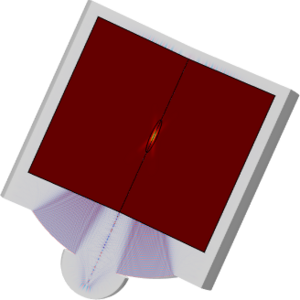
This model analyzes the uncertainty in focused ultrasound induced tissue heating. The material properties for the tissue mimicking material, including the uncertainty, are taken from the FDA Medical Device Development Tool: Tissue Mimicking Material (TMM) for Preclinical Acoustic ... Read More
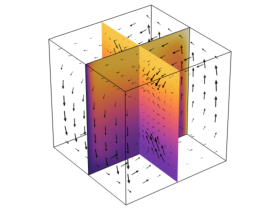
This example studies the stationary state of free convection in a cavity filled with air and bounded by two vertical plates. To generate the buoyancy flow, the plates are heated at different temperatures, set in a range to keep the flow laminar. Read More
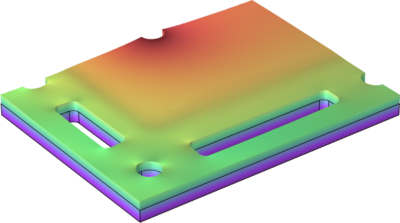
A fuel cell stack operates at temperatures just below 100 °C, which means that it has to be heated at start-up. The fuel cell stack consists of unit cell of anode, membrane, and cathode connected in series through bipolar plates. This study presents a model that couples the thermal and ... Read More
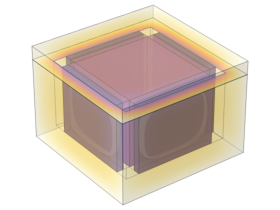
This example solves the heat transfer in an isothermal box aimed at transporting refrigerated articles such as medical materials for 24 hours. In this case, the box has to keep the contents cold for a long period of time while respecting storage temperature restrictions between 2°C and 8 ... Read More
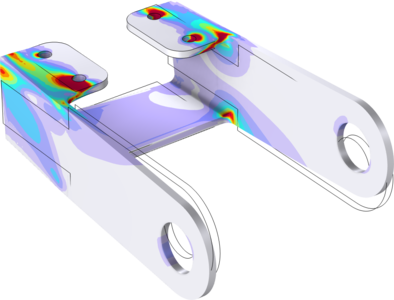
The bracket model tutorials are used as an introduction to the features and functionality within the Structural Mechanics Module. The following features are introduced: The following features are introduced: The fundamentals: static linear analysis Parametric study Including initial ... Read More

This is a conceptual model illustrating how to couple fluid-structure interaction, heat transfer, and thermal expansion. A bimetallic strip in an air channel is heated so that it bends. After some time, an airflow with an inlet temperature which varies in time is introduced. As a ... Read More


