
The Application Gallery features COMSOL Multiphysics® tutorial and demo app files pertinent to the electrical, structural, acoustics, fluid, heat, and chemical disciplines. You can use these examples as a starting point for your own simulation work by downloading the tutorial model or demo app file and its accompanying instructions.
Search for tutorials and apps relevant to your area of expertise via the Quick Search feature. Note that many of the examples featured here can also be accessed via the Application Libraries that are built into the COMSOL Multiphysics® software and available from the File menu.
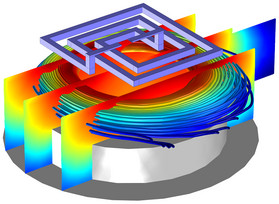
The COMSOL® software includes capabilities for 3D plasma modeling. In this example, a square coil is placed on top of a dielectric window and is electrically excited at 13.56 MHz. A plasma is formed in the chamber beneath the dielectric window, which contains argon gas at low ... Read More
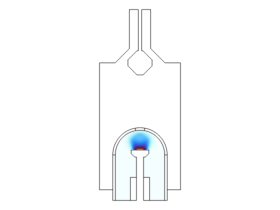
This tutorial model solves for a hydrogen plasma created in a microwave cavity. The model computes the fluid flow and gas heating self-consistently. Read More
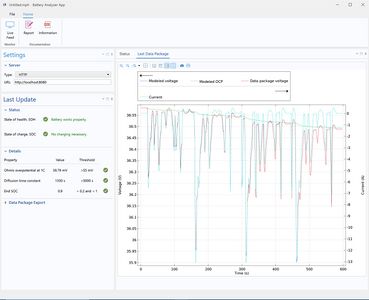
These two apps can be run to set up a digital twin of an electric scooter battery. The Digital Twin Simulator of an Electric Scooter Battery (the "simulator" app) simulates the use of an electric scooter and generates battery current and voltage data over time. The Digital Twin ... Read More
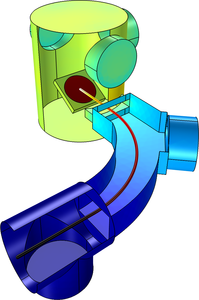
Ion implantation is used extensively in the semiconductor industry to implant dopants into wafers. Within an ion implanter, ions generated within an ion source are accelerated by an electric field to achieve the desired implant energy. Ions of the correct charge state are selected by ... Read More

This tutorial computes the transfer matrix of a tube and coupler measurement test setup. This type of setup is used for standardized testing, for example, for miniature loudspeakers or hearing aids. The Port boundary condition in Pressure Acoustics, Frequency Domain is used together ... Read More
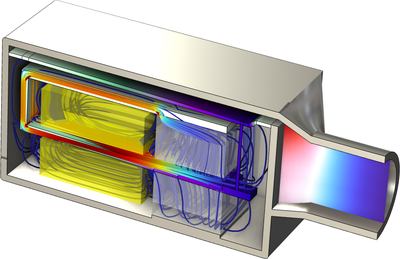
This is a full vibro-electroacoustic simulation of a balanced armature transducer (BAT also known as a receiver in some industries) which is a high performance miniature loudspeaker often used in hearing aids and other in-ear audio products. The model is set up using a linear frequency ... Read More
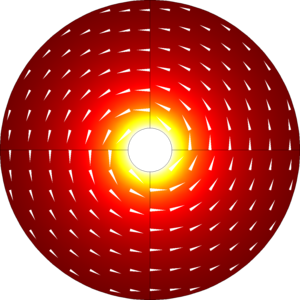
The coaxial cable (coax) is one of the most ubiquitous transmission line structures. It is composed of a central circular conductor, surrounded by an annular dielectric, and shielded by an outer conductor. This model computes the electric and magnetic field distribution inside of the ... Read More
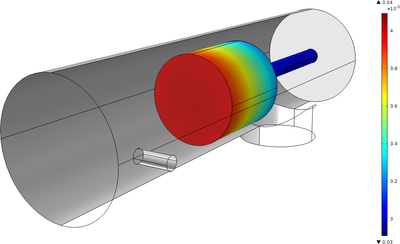
Chemical vapor deposition (CVD) is a process often used in the semiconductor industry to grow layers of high-purity solid material on top of a wafer substrate. CVD is achieved using many different techniques and across a range of pressures from atmospheric to ultrahigh vacuum (UHV/CVD). ... Read More
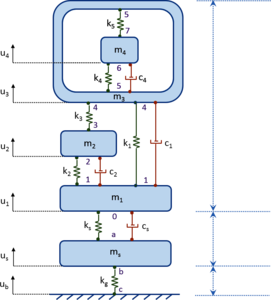
Several mass–spring–damper models have been developed to study the response of a human body where mass, spring, and damper elements represent mass of different body parts, stiffness, and damping properties of various tissues. In this example, a lumped model of a human body having five ... Read More
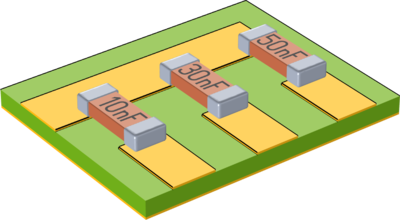
These models demonstrate the usage of the user defined lumped port and lumped elements to introduce excitations and lumped circuit elements between volumetric conductors. Additional models show how to use impedance and transition boundary conditions to model the conductors, instead of ... Read More


