
The Application Gallery features COMSOL Multiphysics® tutorial and demo app files pertinent to the electrical, structural, acoustics, fluid, heat, and chemical disciplines. You can use these examples as a starting point for your own simulation work by downloading the tutorial model or demo app file and its accompanying instructions.
Search for tutorials and apps relevant to your area of expertise via the Quick Search feature. Note that many of the examples featured here can also be accessed via the Application Libraries that are built into the COMSOL Multiphysics® software and available from the File menu.
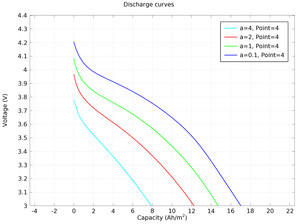
This model demonstrates the Lithium-Ion Battery interface for studying the discharge and charge of a lithium-ion battery for a given set of material properties. The geometry is in one dimension and the model is isothermal. Battery developers can use the model to investigate the influence ... Read More
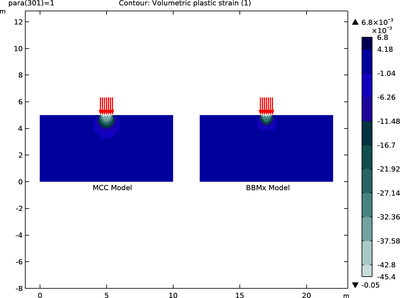
In this example, a settlement and heave analysis of a shallow foundation resting on an unsaturated soil stratum is conducted with the Modified Cam-Clay and Extended Barcelona Basic soil models. The effect of pore suction due to movements in the phreatic line and the resulting settlement ... Read More

This tutorial models the thermal management of a polymer electrolyte membrane (PEM) fuel cell stack. Operating the stack with a similar temperature profile for all cells is important since an uneven temperature distribution may otherwise result in nonuniform water vapor condensation and ... Read More
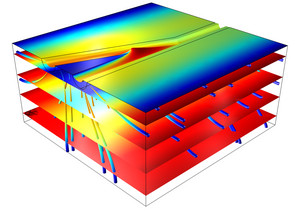
Multilateral wells—those with multiple legs that branch off from a single well—can produce oil efficiently because the legs can tap multiple productive zones and navigate around impermeable ones. Unfortunately, drilling engineers must often mechanically stabilize multilateral wells with ... Read More

This tutorial shows how to simulate coupled heat and moisture transport in a wall made of a load bearing and an insulation layer. Moisture and temperature conditions vary with time on both sides of the wall and rain loading is included. The 1D model is a benchmark test defined in ... Read More
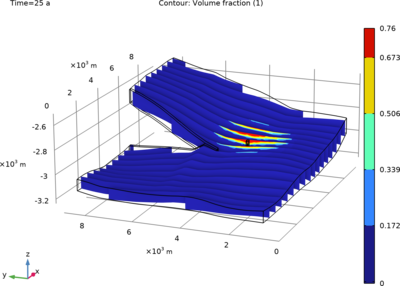
This example simulates the underground storage of CO2 in a part of the Johansen formation off the coast of Norway. The CO2 is injected using an injection well at a rate of 15 kg/s over a period of 25 years, after which the well is closed. The model is used to compute the spreading of CO2 ... Read More
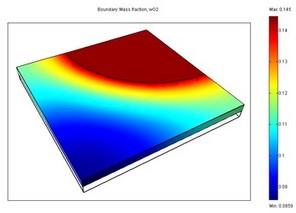
A stationary 3D model of a generic fuel cell cathode describing the mass fraction distribution of oxygen, water, and nitrogen, as well as the current distribution. The model uses Darcy's Law to describe convection, and couples this to Maxwell-Stefan diffusivities to also describe mass ... Read More

In a lithium metal battery, lithium metal is deposited during charging on the negative electrode. Mass transport and ohmic effects in the electrolyte cause small protrusions on the metal surface to be subjected to accelerated growth during charging. In worst case scenarios, this leads to ... Read More

A slope stability analysis is performed and the Factor of Safety of the dam embankment is calculated by using the Shear Strength Reduction Technique. The pore pressure in the soil is computed based on Darcy’s law, and the Mohr–Coulomb constitutive model is used to describe the ... Read More

The present model example is based on Copper Deposition in a Trench model available in Electrodeposition Application Library. The nonuniform deposition along the trench surface leads to formation of a cavity/void. Since the Deformed Geometry interface cannot handle topological changes, ... Read More


