
The Application Gallery features COMSOL Multiphysics® tutorial and demo app files pertinent to the electrical, structural, acoustics, fluid, heat, and chemical disciplines. You can use these examples as a starting point for your own simulation work by downloading the tutorial model or demo app file and its accompanying instructions.
Search for tutorials and apps relevant to your area of expertise via the Quick Search feature. Note that many of the examples featured here can also be accessed via the Application Libraries that are built into the COMSOL Multiphysics® software and available from the File menu.
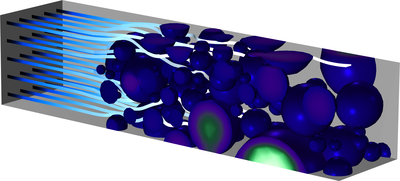
In this example, a heterogeneous NMC (Nickel-Manganese-Cobalt) electrode structure is generated from tomography data using a Model Method. Time-dependent discharge and electrochemical impedance spectroscopy (EIS) simulations are then made on the full 3D geometry. A solid mechanics ... Read More
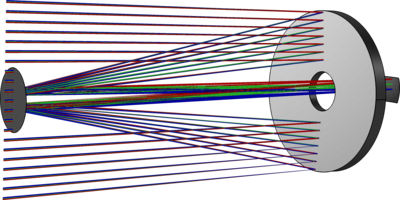
The Hubble Space Telescope (HST) is an example of a standard Cassegrain telescope. The Conic Mirror On Axis 3D part from the COMSOL part library is used to construct the HST Ritchey-Chretien geometry. Multiple release features are used to generate on and off-axis ray and spot diagrams. Read More
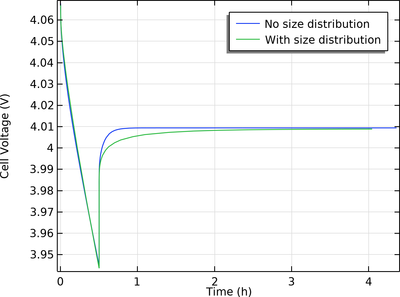
Battery electrodes featuring large heterogeneities in terms of particle sizes may sometimes not be adequately described by homogenized models using one single particle size only. As an alternative to adding multiple instances of the Additional Porous Electrode material node, this ... Read More
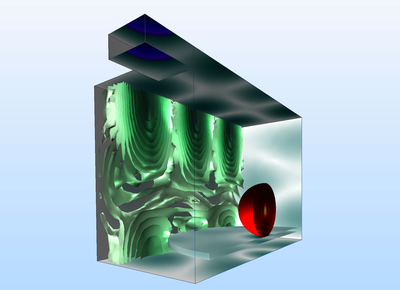
This is a model of the heating process in a microwave oven. The distributed heat source is computed in a stationary, frequency-domain electromagnetic analysis. This is followed by a transient heat transfer simulation showing how the heat redistributes in the food. Read More
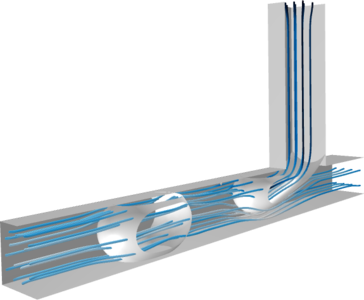
Emulsions consist of small liquid droplets immersed in an immiscible liquid and widely occur in the production of food, cosmetics, fine chemicals, and pharmaceutical products. The quality of the product is typically dependent on the size of the droplets. Simulating these processes can ... Read More
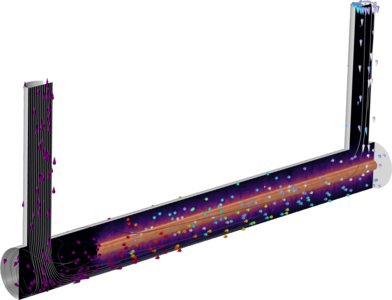
In this example, a simple ultraviolet (UV) water purification reactor is modeled using a combination of ray tracing, computational fluid dynamics, and Lagrangian particle tracking. First, the volumetric fluence rate is accumulated along rays released from the surface of the UV lamp using ... Read More
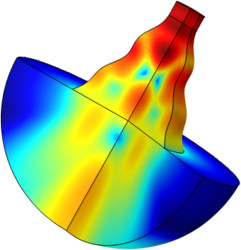
A plane-wave mode feeds an axisymmetric horn radiating from an infinite baffle toward an open half space. The radius of the waveguide attached to the horn throat is assumed to be fixed, as well as the depth of the horn and the size of the horn mouth attached to the baffle. By varying the ... Read More
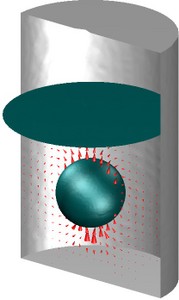
The level set method is well suited for problems with moving boundaries in which the geometry’s topology changes with time. A bubble of oil that travels up through water and finally merges with oil at the top causes this kind of topology change. For problems where the topology is ... Read More
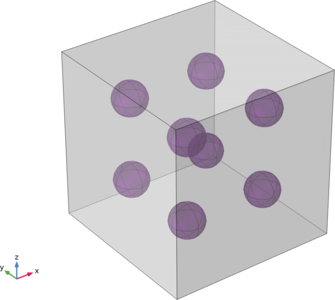
In this example, the homogenized elastic and viscoelastic properties of a particulate composite are computed based on the individual properties of elastic particles embedded in a viscoelastic matrix. Periodic boundary conditions are applied to a unit cell of the particulate composite ... Read More
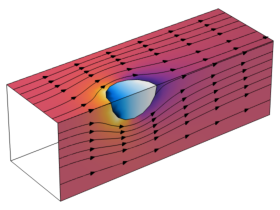
This model demonstrates the use of the Heat and Moisture Flow features for the simulation of superheated steam drying of a wood particle. A nonequilibrium formulation is used to compute the transport of the liquid water and vapor phases in the wood particle. Reference: Le, K. H., ... Read More


