
The Application Gallery features COMSOL Multiphysics® tutorial and demo app files pertinent to the electrical, structural, acoustics, fluid, heat, and chemical disciplines. You can use these examples as a starting point for your own simulation work by downloading the tutorial model or demo app file and its accompanying instructions.
Search for tutorials and apps relevant to your area of expertise via the Quick Search feature. Note that many of the examples featured here can also be accessed via the Application Libraries that are built into the COMSOL Multiphysics® software and available from the File menu.
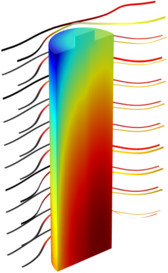
This example simulates the heat profile in an air-cooled cylindrical battery in 3d. The battery is placed in a matrix in a battery pack. The thermal model is coupled to a 1d-battery model that is used to generate a heat source in the active battery material. The model requires the ... Read More
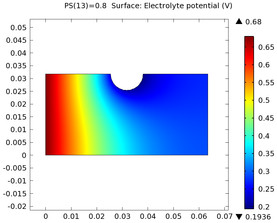
This example models cathodic protection of a steel reinforcing bar in concrete. Three different electrochemical reactions are considered on the steel surface. Charge and oxygen transport are modeled in the concrete domain, where the electrolyte conductivity and oxygen diffusivity depend ... Read More
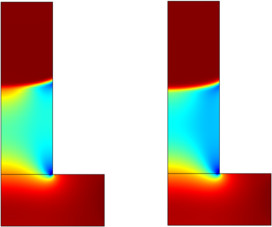
This example studies a narrow vertical cylinder placed on top of a reservoir filled with water. Because of wall adhesion and surface tension at the air/water interface, water rises through the channel. Surface tension and wall adhesive forces are often used to transport fluid through ... Read More
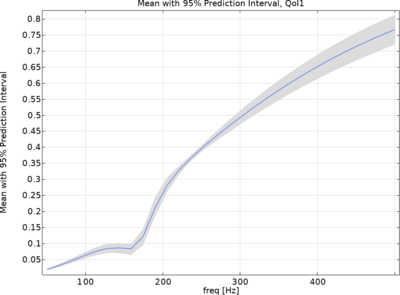
It can in many cases be difficult to get accurate material properties for porous materials. Measuring the properties to high precision can involve lengthy measurements using different techniques. It can therefore be interesting to understand how uncertainties in different material ... Read More
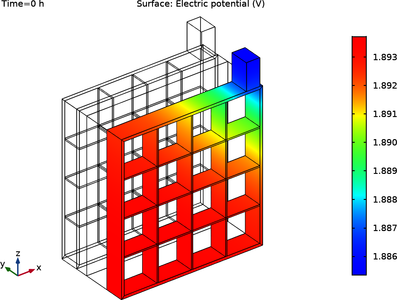
This 3D model example demonstrates the use of the Lead-Acid Battery interface for modeling current distribution in full cell employing a lead-acid battery chemistry. The lead acid battery chemistry uses PbO2 as the positive porous electrode and Pb as the negative porous electrode and ... Read More
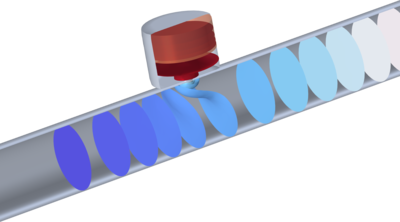
This tutorial model shows a system consisting of a Helmholtz resonator on the side of a main duct. The resonator volume is partly filled with a porous material. The model computes the reflection, transmission, and absorption of the system. Thermoviscous losses are included in the model ... Read More
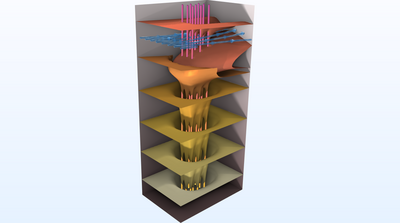
This model shows how to compute an array of borehole heat exchangers (BHEs) for shallow geothermal energy production. The BHEs are simplified as line heat sinks with a uniform heat extraction rate. The array is embedded into a layered subsurface model with groundwater flow in one of the ... Read More
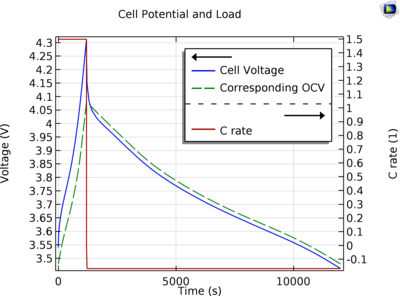
This app can be used as a design tool to develop an optimized battery configuration for a specific application. The application computes the capacity, energy efficiency, heat generation, and capacity losses due to parasitic reactions of a battery for a specific load cycle. Various ... Read More
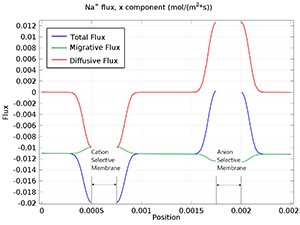
Electrodialysis is a separation process for electrolytes based on the use of electric fields and ion selective membranes. Some common applications of the electrodialysis process are: Desalination of process streams, effluents, and drinking water pH regulation in order to remove acids ... Read More
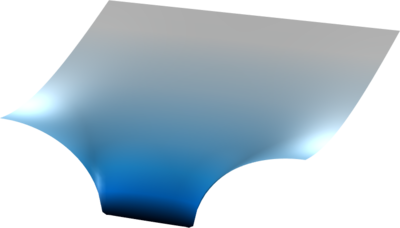
This example compares moisture transport within two types of anisotropic porous medium. The first component defines a layered structure. The structure alternates between layers with high and low moisture diffusivity. So the moisture spreads more easily along the layers than transversely. ... Read More


