
The Application Gallery features COMSOL Multiphysics® tutorial and demo app files pertinent to the electrical, structural, acoustics, fluid, heat, and chemical disciplines. You can use these examples as a starting point for your own simulation work by downloading the tutorial model or demo app file and its accompanying instructions.
Search for tutorials and apps relevant to your area of expertise via the Quick Search feature. Note that many of the examples featured here can also be accessed via the Application Libraries that are built into the COMSOL Multiphysics® software and available from the File menu.
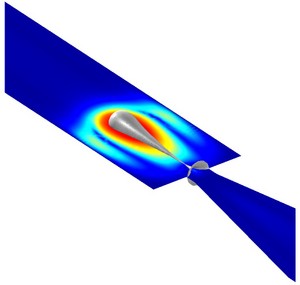
Although initially invented to be used in printers, inkjets have been adopted for other application areas, such as within the life sciences and microelectronics. Simulations can be useful to improve the understanding of the fluid flow and to predict the optimal design of an inkjet for a ... Read More
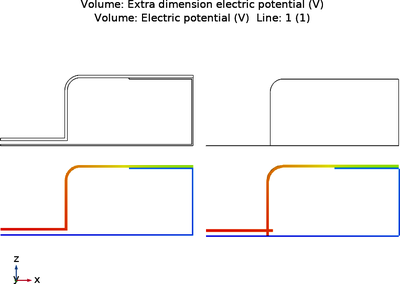
This example demonstrates a benchmark test showing that Electric Currents in Layered Shells physics interface can be used to obtain the same results as when the model is solved with the Electric Currents interface based on a solid 3D structure. Read More
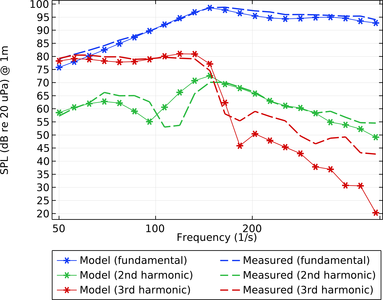
An automotive midwoofer is modeled using the lumped parameter approach. The electrical and mechanical components are modeled using a lumped electric circuit, which is coupled to a finite element model for the acoustics using the Lumped Speaker Boundary feature. The large signal ... Read More
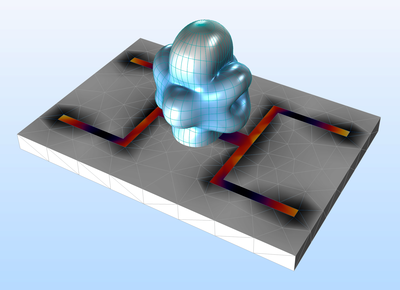
A wideband antenna study, such as an S-parameter or far-field pattern analysis, can be obtained by performing a transient response analysis and a time-to-frequency fast Fourier transform (FFT). This model runs a time dependent study first and then transforms the dependent variable, the ... Read More
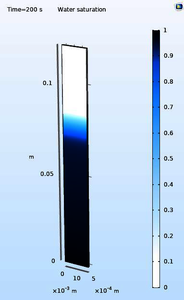
This example models wicking in a porous medium. Wicking is the phenomenon that occurs when a dry porous material is put into contact with a fluid: it will absorb the fluid due to capillary forces. The absorption will continue until an equilibrium is reached where the gravitational forces ... Read More
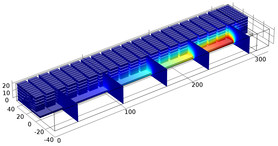
The elastic cantilever beam is one of the elementary structures used in MEMS designs. This model shows the bending of a cantilever beam under an applied electrostatic load. The model solves the deformation of the beam under an applied voltage. Read More
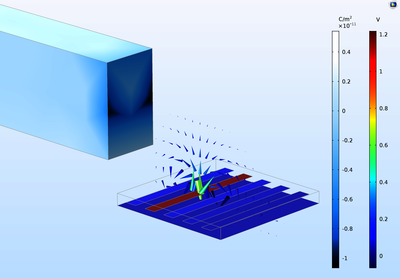
This tutorial model explains how to extract lumped matrices by means of the Stationary Source Sweep study. The capacitance matrix of a five-terminal system is used to infer the position of a metallic object rather like real-world capacitive position sensors. The example illustrates the ... Read More
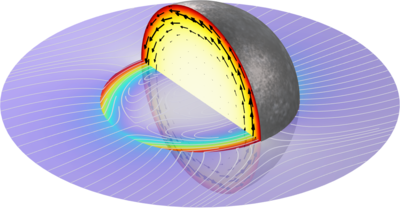
An iron sphere in a magnetic field is an excellent textbook example to demonstrate the effects of a magnetic field interacting with a permeable material. This tutorial series is designed as an introduction to numerically modeling electromagnetic effects with COMSOL. This series ... Read More
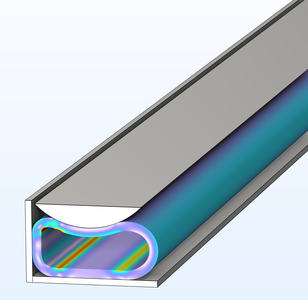
In this model you study the force-deflection relation of a car door seal made from a soft rubber material. The model uses a hyperelastic material model together with formulations that can account for the large deformations and contact conditions. Read More
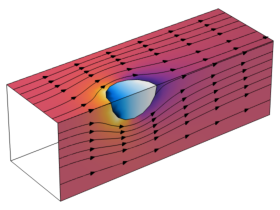
This model demonstrates the use of the Heat and Moisture Flow features for the simulation of superheated steam drying of a wood particle. A nonequilibrium formulation is used to compute the transport of the liquid water and vapor phases in the wood particle. Reference: Le, K. H., ... Read More


