
The Application Gallery features COMSOL Multiphysics® tutorial and demo app files pertinent to the electrical, structural, acoustics, fluid, heat, and chemical disciplines. You can use these examples as a starting point for your own simulation work by downloading the tutorial model or demo app file and its accompanying instructions.
Search for tutorials and apps relevant to your area of expertise via the Quick Search feature. Note that many of the examples featured here can also be accessed via the Application Libraries that are built into the COMSOL Multiphysics® software and available from the File menu.
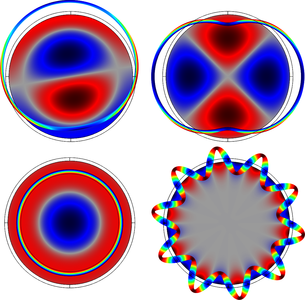
The dispersion curves for a fluid-filled pipe with elastic walls are computed and compared with the analytical results for a pure elastic and an acoustic waveguide, respectively. Results show good agreement and also provide insight into the dynamics of the fluid-filled pipe at low and ... Read More
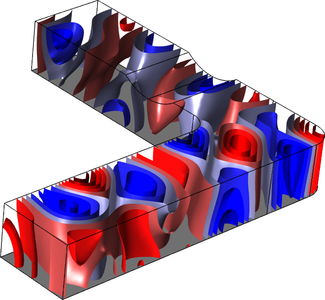
In this tutorial the acoustic behavior of a duct or waveguide with a right angled bend is analyzed. The model uses port boundary conditions at the inlet and outlet. The ports can capture and treat non-plane propagating modes in waveguides, extending the analysis above the first cutoff ... Read More
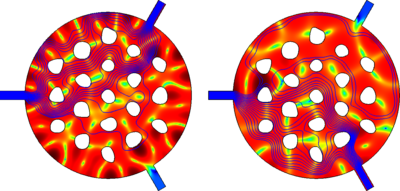
This model shows how shape optimization can be used to design an acoustic demultiplexer. A demultiplexer is a data distributing device, in this case it will distribute acoustic energy. The geometry consists of a circular domain with one input port and two output ports. The domain has the ... Read More
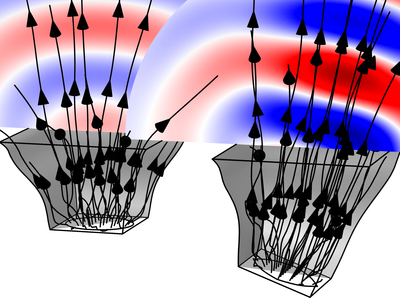
This model demonstrates how to use the Control Function feature to perform shape optimization on a rectangular horn for an improved on axis response. The results of the initial design are exported to a new component via a Filter dataset. Further, the off-axis spatial response is improved ... Read More
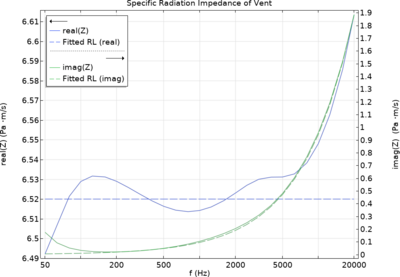
This model computes the specific acoustic radiation impedance of a very small circular vent in a flanged configuration. The model includes thermoviscous losses. The radiation impedance is fitted using a simple RL circuit which gives a simple lumped representation. The results are used ... Read More
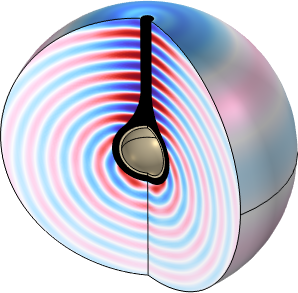
A spherical hydrophone consisting of a PZT ceramic, a coating material, and a cable is modeled in 2D axisymmetry. The Receiving Voltage Sensitivity (RVS) is computed for an incident plane wave and compared to an analytical solution from the reference for an ideal spherical hydrophone. ... Read More
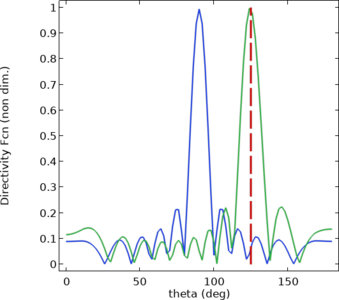
A line array of eleven spherical hydrophones embedded in a neoprene coating is modeled in 3D. The sensitivity of the array is analyzed with regard to varying angles of incidence of the background pressure field. The array directivity function is computed and compared to the analytical ... Read More

Headphones are closely coupled to the ear, and so it is not possible to measure their sensitivity in a classical acoustic free-field setup used for loudspeakers. The measurement requires the use of artificial heads and ears to accurately represent the usage conditions. This model shows ... Read More
This tutorial investigates the acoustic properties of a porous layer made of glass wool. The porous material has transverse isotropic properties and is modeled with the full anisotropic poroelastic material model. Read More
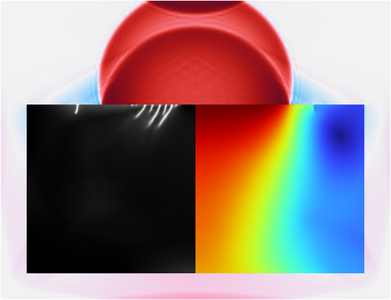
An acoustic point source emits a pressure wave in water that travels toward a piece of glass. Cracks are formed and propagate due to high tensile stresses developed in the glass. A fully coupled acoustic-structure interaction problem including phase field damage in solids is solved in ... Read More


