
The Application Gallery features COMSOL Multiphysics® tutorial and demo app files pertinent to the electrical, structural, acoustics, fluid, heat, and chemical disciplines. You can use these examples as a starting point for your own simulation work by downloading the tutorial model or demo app file and its accompanying instructions.
Search for tutorials and apps relevant to your area of expertise via the Quick Search feature. Note that many of the examples featured here can also be accessed via the Application Libraries that are built into the COMSOL Multiphysics® software and available from the File menu.
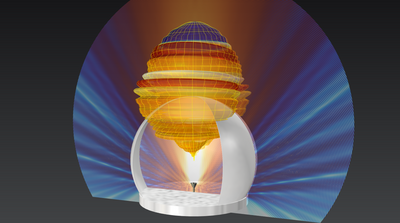
This model demonstrates an efficient approach to simulating a thin, spherical, large radome using a 2D axisymmetric formulation with cubic discretization. The axisymmetric method captures full 3D behavior for azimuthally symmetric geometries at only a fraction of the computational cost. ... Read More
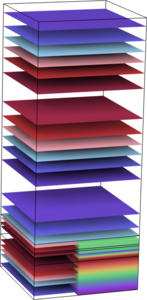
In applications where pressure waves and elastic waves propagate in porous materials filled with air both thermal and viscous losses are important. This is typically the case in insulation materials for room acoustics or lining materials in car cabins. Another example is porous materials ... Read More
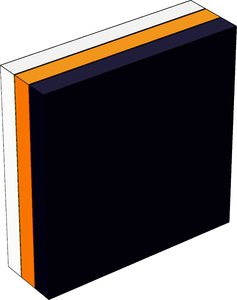
When radiation occurs across a very narrow gap this is often well-approximated as radiation between infinite parallel plates. This model considers three aluminum plates separated by narrow air gaps. The model compares the classical approach, based on the Surface-to-Surface Radiation ... Read More

This is a simple 1D model demonstrating ultrafast heat transfer simulations for femtosecond pulsed laser heating. Specifically, the following three models are implemented and compared with conventional Fourier heat conduction (known as parabolic one-step, POS): Hyperbolic one-step ... Read More

Electromagnetic scattering simulation for an object with continuous rotational symmetry can be performed in 2D axisymmetry instead of 3D to drastically reduce computational time and resources. This model shows how to simulate arbitrary plane wave incidence in 2D axisymmetric models by ... Read More

A plane electromagnetic wave is incident on a metallic sphere partially embedded on a substrate. In this electromagnetic scattering problem, the far-field variables are computed for a few elevation angles of incidence. Read More

Tesla microvalves exploit the non-linear nature of inertial flow to create anisotropic flow resistance. They can be used as robust valves owing to their passive working mechanism, but for many applications the diodicity is too low. Two-dimensional simulations and optimization over ... Read More

This slide deck introduces and demonstrates the modeling capabilities for crystallization and precipitation processes in COMSOL using the Size-Based Population Balance interface and Precipitation in Fluid Flow coupling feature released in 6.3. Read More

In this model a plane wave with circular polarization is reflected off an interface between air and glass. The model demonstrates three different ways of defining this problem. The first part shows how to define user-defined port mode fields. The second part uses the predefined circular ... Read More
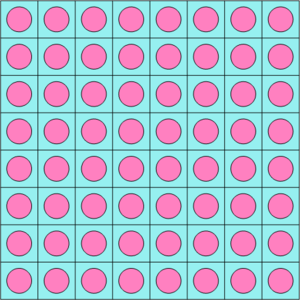
Various boundary conditions are employed in the computation of homogenized properties for heterogeneous materials. The choice between periodic or homogeneous boundary conditions depends on whether the infinitesimal volume is modeled as a repeating unit cell (RUC) or a representative ... Read More


