
The Application Gallery features COMSOL Multiphysics® tutorial and demo app files pertinent to the electrical, structural, acoustics, fluid, heat, and chemical disciplines. You can use these examples as a starting point for your own simulation work by downloading the tutorial model or demo app file and its accompanying instructions.
Search for tutorials and apps relevant to your area of expertise via the Quick Search feature. Note that many of the examples featured here can also be accessed via the Application Libraries that are built into the COMSOL Multiphysics® software and available from the File menu.

Rayleigh-Bénard's convection cells is a classic in fluid dynamics. We present here two different approaches for computing the critical Rayleigh number above which the cells form. Read More
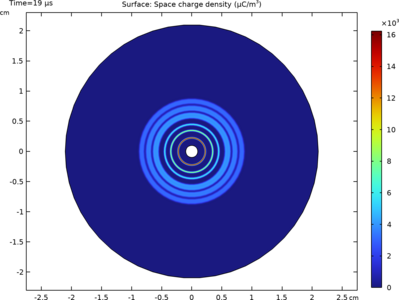
Usually limited to a specific region, corona discharges appear as a consistent luminosity. The attributes of steady glow corona discharges change depending on their polarity. Positive glow corona, also referred to as Hermstein's glow or ultra corona, presents a direct current (DC) aspect ... Read More
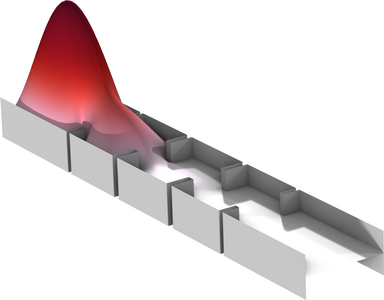
A waveguide filter is designed using shape optimization by moving and scaling rectangles in the geometry. The irises of the initial geometry are optimized to ensure good bandpass response and out-of-band rejection, while maintaining the double mirror symmetry. The EGO optimization solver ... Read More
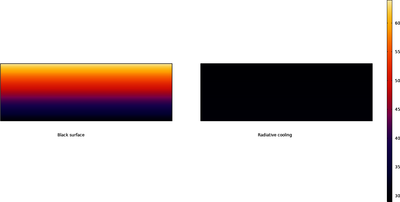
Because the atmosphere is nearly transparent to wavelengths in the range 8 to 13 µm (atmospheric window) for a clear sky, it is possible to cool down a surface even during a sunny day. This model compares the temperature distribution on a concrete block exposed to ambient and solar ... Read More

This model demonstrates the effect of the hopper design on the resulting flow patterns of the grains exiting the hopper. The flow changes from mass flow to funnel flow when the conical angle of the hopper is increased. Read More
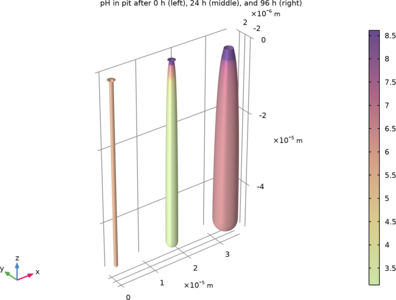
Pitting corrosion is localized corrosion by which local cavities, pits, are formed on a seemingly initially smooth metal surface. A pit may be initiated due to small surface defects, such as inhomogeneities in composition or shape, or from mechanical abuse. How and if the pit grows ... Read More

This example exemplifies how to model the Beer-Lambert law using the core functionality of COMSOL Multiphysics. A more detailed description of the phenomenon and the modeling process can be seen in the blog post "Modeling Laser-Material Interactions with the Beer-Lambert Law". Read More

Bicycle wheels are laced tangentially if they are intended to be used with disc brakes, because a radial pattern gives rise to larger forces in the rim. Otherwise, these rim forces are largely independent of the braking force. Read More
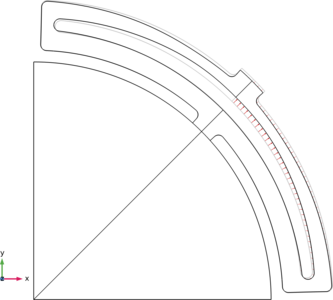
This model demonstrates how to tune the lowest natural frequency of the diaphragm of a MEMS microphone using Shape Optimization. The Stationary then Eigenfrequency study modifies the shape of the suspension springs that support the diaphragm. Although the model is in 3D, shape change is ... Read More

This tutorial shows how to simulate coupled heat and moisture transport in a wall made of a load bearing and an insulation layer. Moisture and temperature conditions vary with time on both sides of the wall and rain loading is included. The 1D model is a benchmark test defined in ... Read More


