
The Application Gallery features COMSOL Multiphysics® tutorial and demo app files pertinent to the electrical, structural, acoustics, fluid, heat, and chemical disciplines. You can use these examples as a starting point for your own simulation work by downloading the tutorial model or demo app file and its accompanying instructions.
Search for tutorials and apps relevant to your area of expertise via the Quick Search feature. Note that many of the examples featured here can also be accessed via the Application Libraries that are built into the COMSOL Multiphysics® software and available from the File menu.
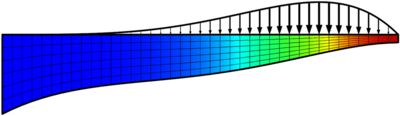
This example exemplifies the basics in how to optimize shapes using COMSOL Multiphysics®. A more detailed description of the phenomenon and the modeling process can be seen in the blog post "Designing New Structures with Shape Optimization". Read More
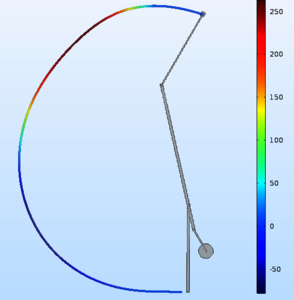
In this multibody dynamics model of a simple counterweight trebuchet, a parametric sweep is used to study throwing distance as function of the sling length. For more details on performing a multibody analysis of a counterweight trebuchet, see this blog post: What Is the Physics Behind a ... Read More

In direct bonding, particulate contamination at the interface can significantly reduce bonding quality. Even micron-scale particles may prevent local contact and lead to large interfacial voids. This model demonstrates a 3D simulation workflow for die-to-wafer (D2W) direct bonding. The ... Read More
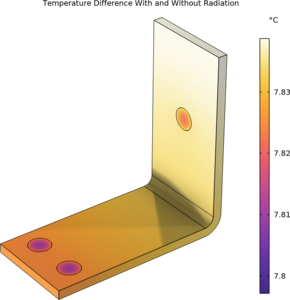
This model computes an electromagnetic-heated busbar with surface-to-surface radiation and compares the results with the busbar model without radiation. The surface emissivity of copper is varied between 0.1 (blank material), 0.3 (partially oxidized), and 0.7 (heavily oxidized). A more ... Read More

This model demonstrates the transient heating of a sample of material with a time- and space-varying heat load. Issues of solution accuracy with respect to mesh and solver tolerance can be quickly studied on this model. Learn more about this model in the accompanying blog post: "Intro to ... Read More

In this verification example, the built-in functionality for calculating dynamic coefficients in hydrodynamic bearings is validated. The results are compared with those obtained using the finite perturbation method to ensure consistency and accuracy. The model showcases how numerical ... Read More
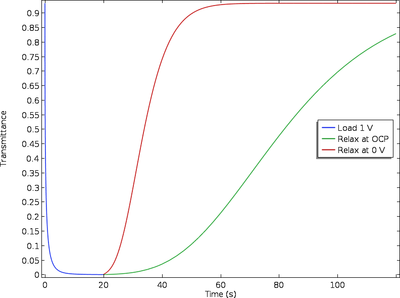
Electrochromic devices (ECDs) may be employed in ”smart” windows, for instance in buildings or motor cycle visors, where the transparency of the device can be controlled by applying a voltage. ECDs make use of the fact that the absorbance of visual light for a chemical species in a ... Read More
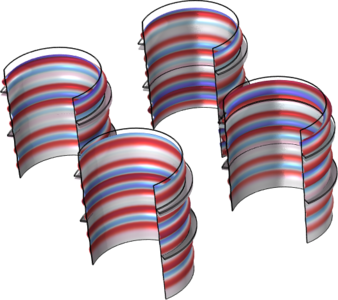
These models illustrate some important topics when modeling buckling imperfection. The Euler 2 Buckling Imperfection model shows a simple case with a cantilever beam buckling under compression. Three different buckling modes are combined as initial imperfections. The other model, ... Read More

This model demonstrates how to use the chatbot functionality in COMSOL Multiphysics® to add annotations to a model of a pacemaker electrode. To learn more about this model, see our accompanying blog post “Using the Chatbot Window in COMSOL Multiphysics®”. Read More
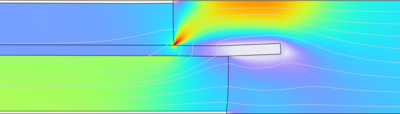
The electrodes of a lithium-ion battery are porous, consisting of an active solid material, a binder, and pores filled with liquid electrolyte. If a force is applied on the porous layers of a battery, this will affect the volume fraction of the electrolyte-filled pores in the electrodes, ... Read More


