
The Application Gallery features COMSOL Multiphysics® tutorial and demo app files pertinent to the electrical, structural, acoustics, fluid, heat, and chemical disciplines. You can use these examples as a starting point for your own simulation work by downloading the tutorial model or demo app file and its accompanying instructions.
Search for tutorials and apps relevant to your area of expertise via the Quick Search feature. Note that many of the examples featured here can also be accessed via the Application Libraries that are built into the COMSOL Multiphysics® software and available from the File menu.
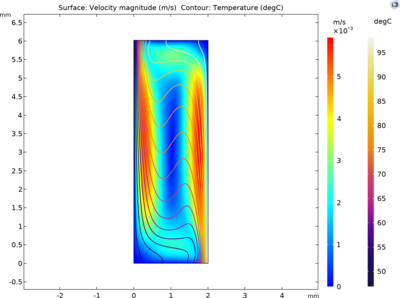
Polymerase chain reaction (PCR) is one of the most effective methods in molecular biology, medical diagnostics, and biochemical engineering in amplifying a specific sequence of DNA. There has been a great interest in developing portable PCR-based lab-on-a-chip systems for point-of-care ... Read More
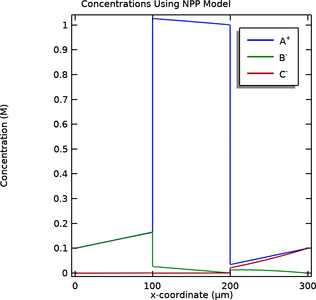
This model file was used for creating the plots featured in the blog post "How to Model Ion-Exchange Membranes and Donnan Potentials". Read More

This study presents a two-stage discrete element method (DEM) simulation of thermal conduction in compressed granular materials. In the first stage, a granular bed composed of spherical grains is mechanically compacted by applying a constant pressure of 20 kPa through a downward moving ... Read More
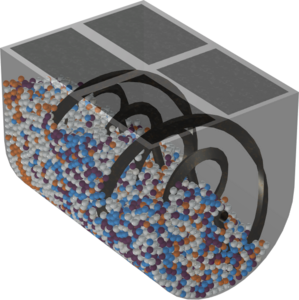
A ribbon mixer (sometimes referred to as a ribbon blender) is a mechanical device that is commonly used to mix different types of granular material. Ribbon mixers are widely used across various industries including food processing, pharmaceuticals, chemical industries, agriculture, ... Read More

This model is used on "Heat Transfer with Radiation in Participating Media and the Discrete Ordinates Method" to compare quadrature sets used in the method of discrete ordinates. To assess the performance of quadrature sets in complex geometries, results of incident irradiation and ... Read More

This example demonstrates the usage of the Scattered Field formulation to compute the scattering of light off of a single scatterer on top of a dielectric half-space. It uses the analytic Fresnel equations to design the background field. For a detailed introduction to this model, see ... Read More

This model uses the Granular Flow and Membrane interfaces to simulate the packing of spherical grains in a flexible container, a procedure often found in the processing industry. In this example, grains are packed into a cubic container constructed of a thin polymer fabric. Two packing ... Read More
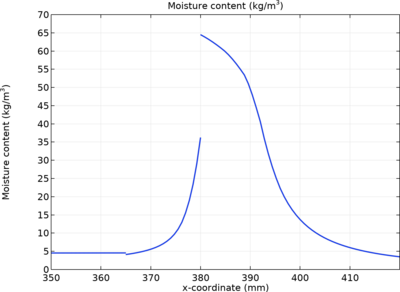
This model shows how to simulate moisture redistribution inside a wall with capillary active interior insulation. The wall consists of three layers: brick, mortar and insulating material. At the beginning of simulation, there is a sudden change in vapor pressure and temperature at ... Read More
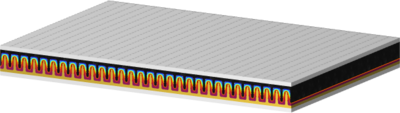
The miniaturization of electronics devices requires batteries with higher energy density and power. To increase the contact area between the electrodes and the solid electrolyte, 3D configurations such as the trench geometry are used. This example demonstrates how to model a solid-state ... Read More

These example models demonstrate using the Image to Curve add-in, which is included in COMSOL Multiphysics®. One example shows a simple structural analysis. An image of an H-beam is imported to a work plane and then extruded. A distributed load is applied to the beam's top ... Read More


