
The Application Gallery features COMSOL Multiphysics® tutorial and demo app files pertinent to the electrical, structural, acoustics, fluid, heat, and chemical disciplines. You can use these examples as a starting point for your own simulation work by downloading the tutorial model or demo app file and its accompanying instructions.
Search for tutorials and apps relevant to your area of expertise via the Quick Search feature. Note that many of the examples featured here can also be accessed via the Application Libraries that are built into the COMSOL Multiphysics® software and available from the File menu.
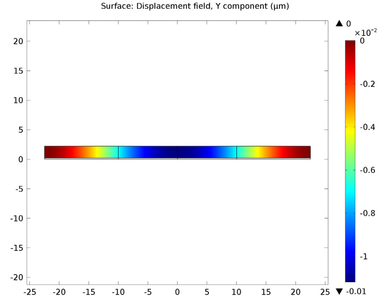
Silicon micromechanical resonators have long been used for designing sensors and are now becoming increasingly important as oscillators in the consumer electronics market. In this series of models, a surface micromachined MEMS resonator, designed as part of a micromechanical filter, is ... Read More

This tutorial model demonstrates how to use the Combined Inductively/DC Discharge interface to simulate the plasma generated in a pulsed arc. This modeling technique is useful for a large range of industrial applications including cutting, welding, spraying, waste destruction, and ... Read More

When electrons are emitted from a heated cathode in a plane parallel vacuum diode, they contribute to the space charge density in the diode, which in turn affects the electric potential distribution. If the potential difference between the cathode and the anode is not sufficiently large, ... Read More
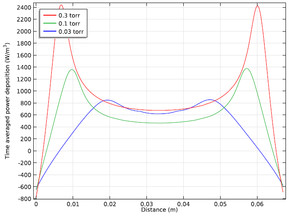
The underlying physics of a capacitively coupled plasma is rather complicated, even for rather simple geometric configurations and plasma chemistries. This model benchmarks the Capacitively Coupled Plasma physics interface against many different codes. Read More
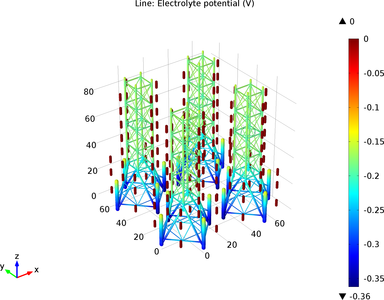
This example extends the corrosion protection system analysis of the single oil platform example by modeling the influence of multiple oil platforms placed in an array. The use of the Current Distribution on Edges, BEM interface significantly reduces the problem size and computational ... Read More
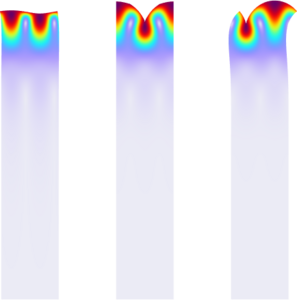
FEM simulation can be used to obtain a SAW velocity and some related parameters (squared electromechanical coupling coefficient, reflectivity, etc.) for different typical configurations. Such parameters are input data for various analytical and semi-analytical methods of SAW device ... Read More
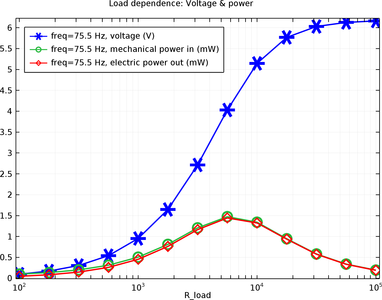
This model shows how to analyze a simple, cantilever based, piezoelectric energy harvester. A sinusoidal acceleration is applied to the energy harvester and the output power is evaluated as a function of frequency, load impedance and acceleration magnitude. Read More
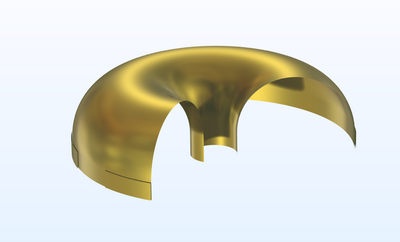
This tutorial demonstrates how to model a gyroscope based on the birdbath resonator gyroscope (BRG) design. The BRG is a type of Coriolis vibratory gyroscope (CVG) invented at the University of Michigan as a navigation-grade gyroscope in the mm-scale. This tutorial shows how the ... Read More
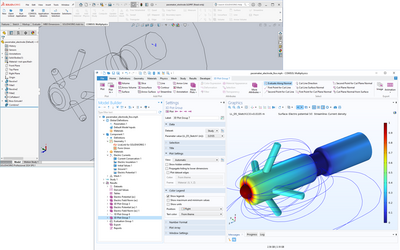
This model, dealing with the current and potential distribution around one pair of electrodes, demonstrates how to synchronize and modify geometry in SOLIDWORKS® by using the LiveLink™ interface with a parametric sweep. Read More
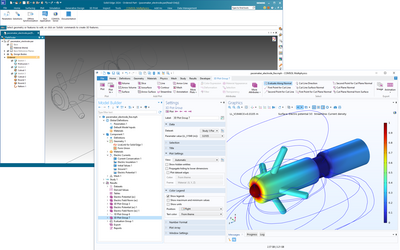
This model, dealing with the current and potential distribution around one pair of electrodes, demonstrates how to synchronize and modify geometry in Solid Edge® by using the LiveLink™ interface with a parametric sweep. Read More


