
The Application Gallery features COMSOL Multiphysics® tutorial and demo app files pertinent to the electrical, structural, acoustics, fluid, heat, and chemical disciplines. You can use these examples as a starting point for your own simulation work by downloading the tutorial model or demo app file and its accompanying instructions.
Search for tutorials and apps relevant to your area of expertise via the Quick Search feature. Note that many of the examples featured here can also be accessed via the Application Libraries that are built into the COMSOL Multiphysics® software and available from the File menu.
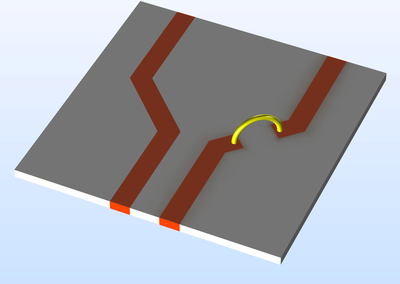
Mixed-mode S-parameters describe the responses of a circuit with balanced ports excited and terminated by two types of modes: common and differential modes. They are calculated using a full S-parameter matrix of a four-port network that is composed of four single ended lines. This ... Read More
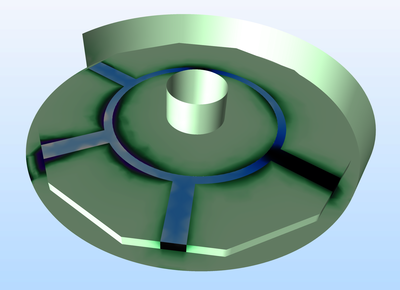
A 180° Ring Hybrid (Rat-Race Coupler) is a four-port network with 180° phase difference between two ports. It is cheaper to manufacture this type of microstrip line component compared to a wave guide 180° hybrid junction, so called magic-T. The objective of this model is to compute the S ... Read More
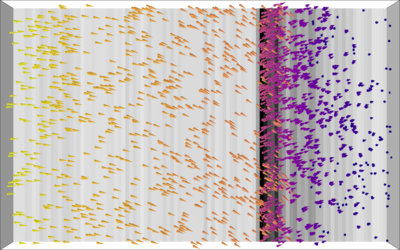
Multipaction can occur when electrons are accelerated by a high frequency RF field into surfaces. At certain frequencies, the number of electrons in a cavity can grow exponentially. This exponential growth cannot continue indefinitely because space charge effects in the cavity can ... Read More
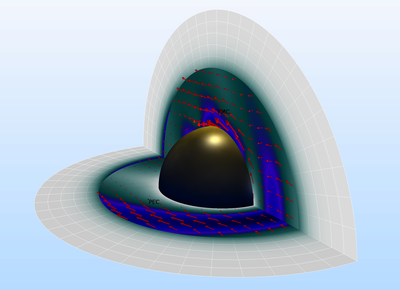
A classic benchmark problem in computational electromagnetics is to solve for the radar cross section (RCS) of a sphere in free space illuminated by a plane wave. This model solves for the RCS of a metallic sphere that has a very high conductivity, which can be treated as a material with ... Read More
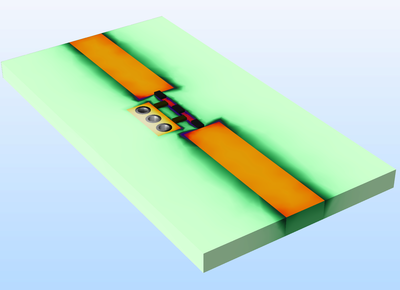
Passive devices can be designed using lumped element features if both the operating frequency of the device and the insertion loss of lumped elements are low. This example simulates two types of lumped element filters that are similar to lumped ports, except that they are strictly ... Read More
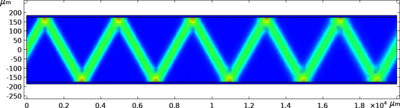
The bidirectional formulation of the Beam Envelopes interface can be used not only for counter-propagating wave simulations but also for waves propagating to up to two directions. In this model, an almost collimated Gaussian beam is excited at the left boundary and exhibits total ... Read More
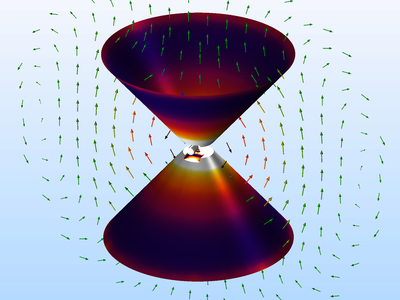
A Biconical antenna is a type of wideband antenna with omni-directional radiation pattern in the H-plane similar to a dipole antenna. A coaxial feed is connected to the radiators using two 90 degree bent arms. The model shows that the biconical antenna works well in applications ... Read More

It is possible to shape the radiation pattern and steer the beam from an antenna array by controlling the relative phases and magnitudes of the input signal. This example shows how to design an active electronically scanned array (AESA) using arithmetic phase progression on each antenna ... Read More
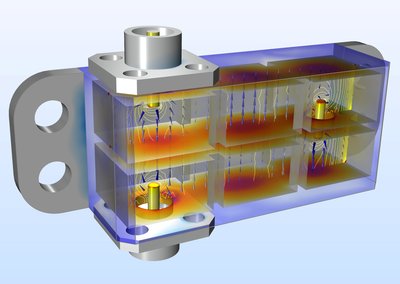
This example investigates the electrical performance of a cascaded cavity filter operating in the millimeter-wave 5G band with temperature changes. The thermal variations result in structural deformations of the structure. Thus, the resonant frequencies of the filter elements (cavities) ... Read More
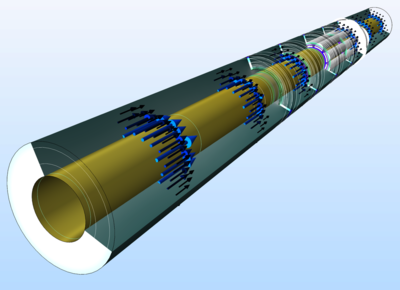
A very wide band coaxial low-pass filter is designed using a 2D axisymmetric model. To address the wide band frequency response with a fine frequency resolution, the model is built with a transient physics interface first. Then, S-parameters are calculated using a time-to-frequency ... Read More


