
The Application Gallery features COMSOL Multiphysics® tutorial and demo app files pertinent to the electrical, structural, acoustics, fluid, heat, and chemical disciplines. You can use these examples as a starting point for your own simulation work by downloading the tutorial model or demo app file and its accompanying instructions.
Search for tutorials and apps relevant to your area of expertise via the Quick Search feature. Note that many of the examples featured here can also be accessed via the Application Libraries that are built into the COMSOL Multiphysics® software and available from the File menu.
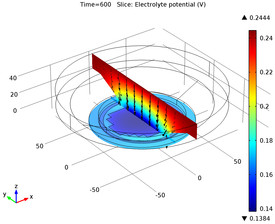
This example models time-dependent copper deposition on a resistive wafer in a cupplater reactor. As the deposited layer builds up, the resistive losses of the deposited layer decreases. The benefit of using a current thief for a more uniform deposit is demonstrated. Read More
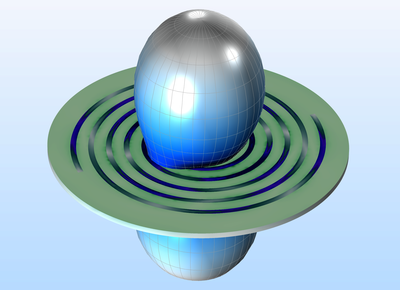
A spiral slot antenna provides a conformal design and can be used for communication, sensing, tracking, positioning, and many applications in different microwave frequency bands due to its wide-band frequency response. This model shows how to build a spiral geometry using parametric ... Read More
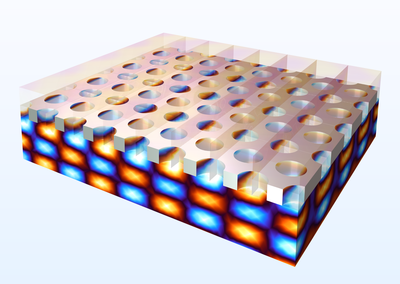
This model demonstrates how to perform simulations of an absorbing bandstop color filter, based on a hexagonal array of holes in a thin aluminum layer. The structure is hexagonally periodic but this example also shows how to set the model up as rectangularly periodic. Read More
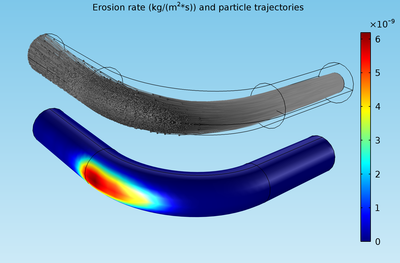
The Particle Tracing for Fluid Flow interface is used to compute the erosion of a pipe bend. The amount of material lost is computed using different erosion models. Read More

This example uses the Granular Flow interface to model the formation of the grain heap and then its subsequent spreading using a cylindrical roller. The roller has a combined rotational and translational motion. The resulting powder bed is then analyzed to determine its quality based on ... Read More
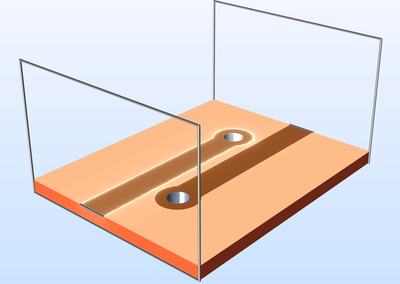
There are multiple ways to excite and terminate transmission lines using different types of port and lumped port features. In this example, transverse electromagnetic (TEM) type ports and a via type lumped port are used to simulate two adjacent microstrip lines. One via end is terminated ... Read More
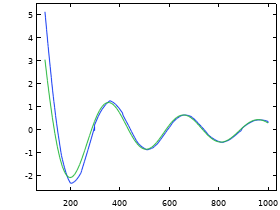
In this tutorial model, the far-field radiation pattern of a dipole antenna is computed in a 3D model component. Then, in a separate 3D model component, a ray is released using the far-field radiation pattern to initialize the ray's intensity, polarization, and phase. Read More
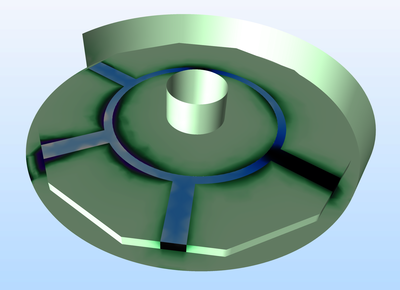
A 180° Ring Hybrid (Rat-Race Coupler) is a four-port network with 180° phase difference between two ports. It is cheaper to manufacture this type of microstrip line component compared to a wave guide 180° hybrid junction, so called magic-T. The objective of this model is to compute the S ... Read More
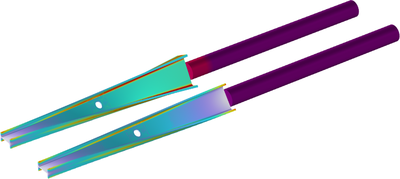
This example demonstrates the use of the Solid-Beam Connection multiphysics coupling to create transitions between the Solid Mechanics and Beam interfaces. Two different connection types are discussed, and a comparison of the stress distributions at the transition is made. Read More
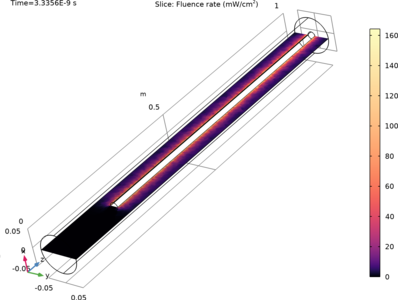
This model demonstrates how to compute the volumetric fluence rate in an ultraviolet (UV) reactor. The geometry is the annular fluid region surrounding a cylindrical lamp. The effect of reflection at the reactor walls on the radial fluence rate distribution is considered. Read More


