
The Application Gallery features COMSOL Multiphysics® tutorial and demo app files pertinent to the electrical, structural, acoustics, fluid, heat, and chemical disciplines. You can use these examples as a starting point for your own simulation work by downloading the tutorial model or demo app file and its accompanying instructions.
Search for tutorials and apps relevant to your area of expertise via the Quick Search feature. Note that many of the examples featured here can also be accessed via the Application Libraries that are built into the COMSOL Multiphysics® software and available from the File menu.
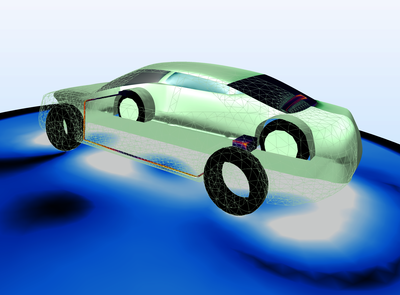
Modern cars have rear-windshield FM antennas to play FM radio. The radiation emitted from an antenna induces an electric current on the outer surface of any cable harnesses in the car, which can have negative effects. This model uses the RF Module to compute the far-field radiation ... Read More
This app demonstrates the following: Creating apps for small screens such as smartphones User-interface navigation with a top menu typically used on websites Dynamically hiding forms using card stacks to minimize the space required by the app Changing appearance by using different ... Read More
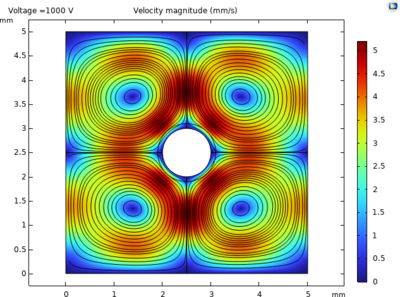
This model simulates the electrohydrodynamic (EHD) flow of a dielectric liquid around a wire electrode positioned between two parallel flat-plate electrodes. The ion transport is described using the Poisson–Nernst–Planck equations, while fluid motion is governed by the Navier–Stokes ... Read More

A large reflector can be modeled easily with the 2D axisymmetric formulation. In this model, the radius of the reflector is greater than 20 wavelengths and the reflector is illuminated by an axial feed circular horn antenna. The simulated far-field shows a high-gain sharp beam pattern Read More
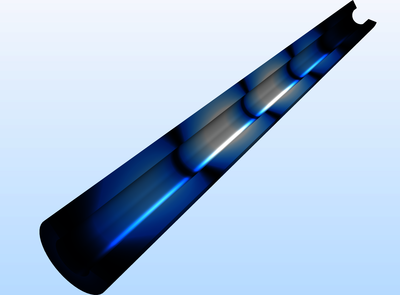
Simulation of Maxwell’s equations in the time domain is useful if the objective of the analysis is to observe a transient phenomenon, to find the time it takes a signal to propagate, or if the materials being modeled are non-linear with respect to the electric or magnetic field strength. ... Read More
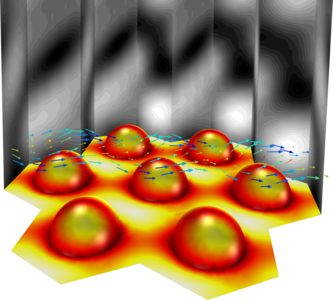
A plane wave is incident on a reflecting hexagonal grating. The grating cell consists of a protruding semisphere. The scattering coefficients for the different diffraction orders are calculated for a few different wavelengths. Read More
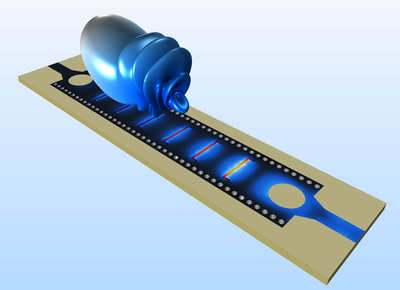
Substrate Integrated Waveguides (SIW) can be used in antenna applications. Leaky waves from a slot array on the top surface of the SIW in this model generate a beam in a certain direction that can be steered by choosing a different operating frequency. Read More
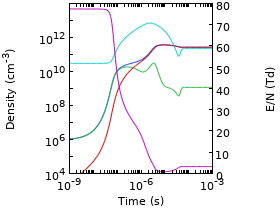
The electron energy distribution function (EEDF) plays an important role in the overall behavior of discharges. In this example, the formation period of an Argon plasma is studied with special attention paid to the EEDF. The plasma is created within a 4 cm gap by a DC source voltage of 1 ... Read More
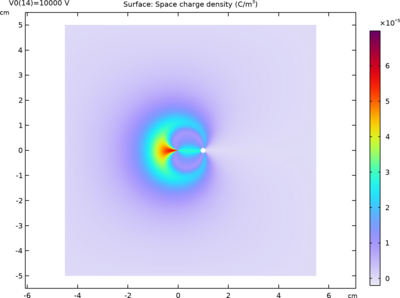
This model utilizes a continuation solver to efficiently compute the current–voltage characteristics of a corona discharge generated by a wire-to-wire configuration. It provides a flexible framework that can be easily adapted to study other discharge configurations and types. Read More
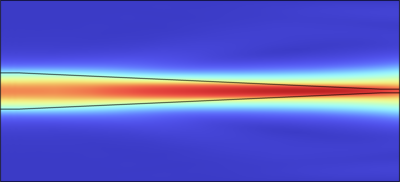
A tapered optical waveguide structure is used for matching two waveguides having different geometric cross sections and/or different material parameters. The tapered waveguide has one geometric cross section at the input plane and another cross section at the output plane. In between ... Read More


