
The Application Gallery features COMSOL Multiphysics® tutorial and demo app files pertinent to the electrical, structural, acoustics, fluid, heat, and chemical disciplines. You can use these examples as a starting point for your own simulation work by downloading the tutorial model or demo app file and its accompanying instructions.
Search for tutorials and apps relevant to your area of expertise via the Quick Search feature. Note that many of the examples featured here can also be accessed via the Application Libraries that are built into the COMSOL Multiphysics® software and available from the File menu.

DC glow discharges in the low-pressure regime have long been used for gas lasers and fluorescent lamps. DC discharges are attractive to study because the solution is time independent. The 1D and 2D models show how to use the DC Discharge interface to set up an analysis of a positive ... Read More
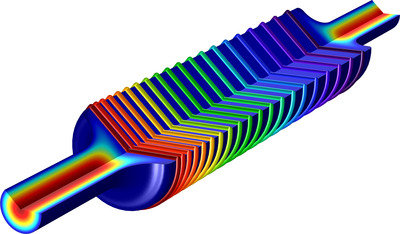
Carbon deposition on the surface of solid catalysts is commonly observed in hydrocarbon processing. A known problem is that carbon deposits can impede the activity of catalysts as well as block the flow of gas through a catalyst bed. This example investigates the thermal decomposition ... Read More
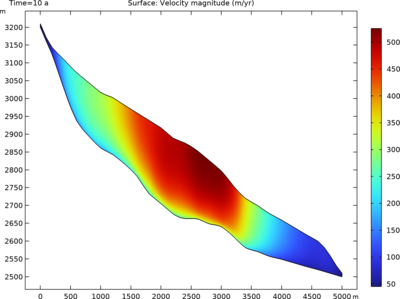
This example shows how to set up a glacier flow model in principle, containing several important aspects of glacier modeling: The creation of the 2D geometry, the modeling of non-Newtonian flow, and the implementation of basal sliding. In this example, two different glacier types, a cold ... Read More
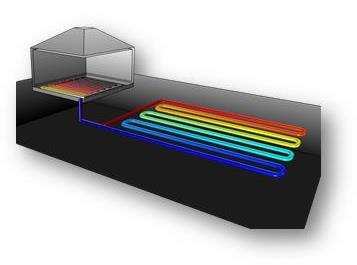
Geothermal heating is an environmentally friendly and energy-efficient method to supply modern and well insulated houses with heat. Heat exchangers placed at a sufficient depth in the ground below the house utilize subsurface heat, where temperatures are almost constant throughout the ... Read More
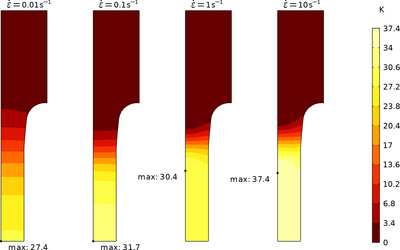
In this example, a tensile test is simulated at four different strain rates. The Johnson–Cook hardening law is used to model the strain rate dependency of the plastic hardening. The temperature distribution and thermal expansion caused by the heating generated by the plastic ... Read More
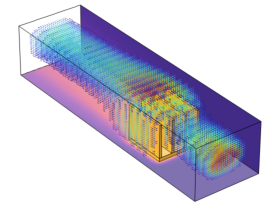
This tutorial model uses a heat sink geometry from the Part Library. The tutorial shows different approaches to heat transfer modeling when studying the cooling of an electronic chip. In the first part, only the solid parts are modeled, while the convective airflow is modeled using ... Read More
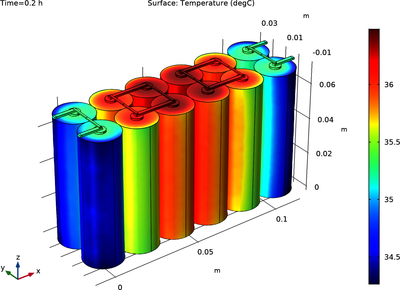
This example demonstrates how to model the temperature distribution in a battery pack during a 4C discharge. The pack is constructed by first coupling two cylindrical batteries in parallel. Six parallel-connected pairs are then connected in series to create the full pack. (This is also ... Read More
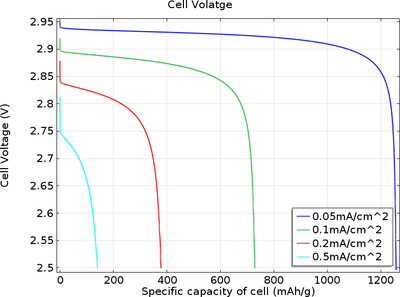
Rechargeable lithium-air batteries have recently attracted great interest mainly due to their high energy density. The theoretical value is about 11400 Wh/kg which is around 10 times greater than the lithium-ion batteries. In this tutorial, discharge of a lithium-air battery is ... Read More
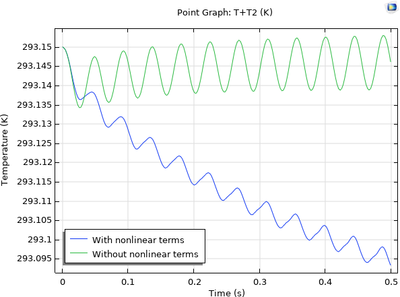
A thermoacoustic engine is a device with no moving parts that can generate acoustic energy from temperature gradients within the engine. It uses the relationship between the movement of oscillating air and the temperature changes in the air compressed and expanded by the acoustic waves. ... Read More
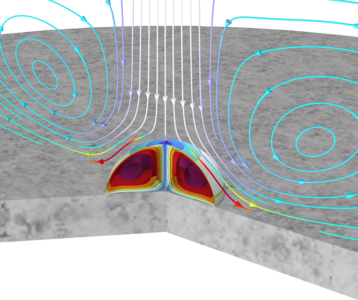
This model describes the evaporation of a droplet that consists of concentrated solution of acetone and water. It accounts for the coupled phenomena of chemical species transport and heat transfer over phase boundaries (liquid-gas boundary) as well as for multiphase flow. The droplet ... Read More


