
The Application Gallery features COMSOL Multiphysics® tutorial and demo app files pertinent to the electrical, structural, acoustics, fluid, heat, and chemical disciplines. You can use these examples as a starting point for your own simulation work by downloading the tutorial model or demo app file and its accompanying instructions.
Search for tutorials and apps relevant to your area of expertise via the Quick Search feature. Note that many of the examples featured here can also be accessed via the Application Libraries that are built into the COMSOL Multiphysics® software and available from the File menu.
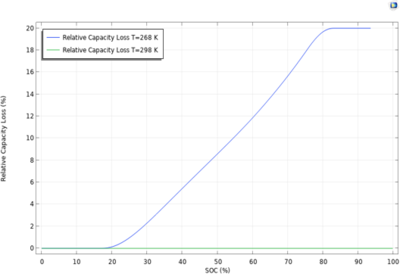
Deposition of metallic lithium on the negative electrode in preference to lithium intercalation is known to be a capacity loss and safety concern for lithium-ion batteries. Harsh charge conditions such as high currents (fast charging) and/or low temperatures can lead to lithium plating. ... Read More
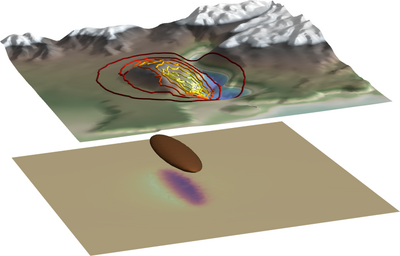
Magnetic prospecting is a geological exploration method that is applicable to certain types of iron ore deposits, in particular those made up of magnetite and hematite. The method consists of measuring the magnetic anomalies (changes in the earth's magnetic field) due to the presence of ... Read More

A simple equivalent circuit model approach is presented for Nickel metal hydride batteries. The 0D model consists of resistor, capacitor, current source and state-of-charge based voltage source (SOC). An Arrhenius type dependence is used to account for self-discharge. All model ... Read More

This model simulates a simple three-dimensional axisymmetric Helmholtz resonator, a classic acoustics model of a resonating circuit with a known theoretical solution. The idealized version considered here consists of a tube and a closed volume in series which are exposed to a pulsatile ... Read More
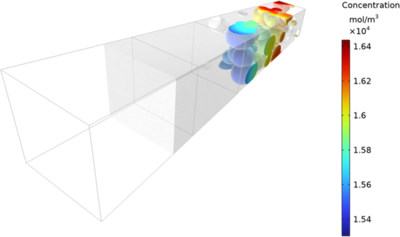
Solid-state batteries (SSB) are a promising technology that could suffer from internal mechanical stresses due to the growth and shrinkage of the electrodes within all-solid components. With this model, the charge-discharge cycling of an SSB is simulated with a focus on the interaction ... Read More
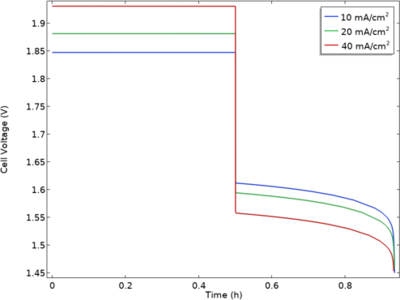
The zinc bromine redox flow battery is an electrochemical energy storage technology suitable for stationary applications. Compared to other flow battery chemistries, the Zn-Br cell potentially features lower cost, higher energy densities and better energy efficiencies. In the cell ... Read More

This is a model of a MEMS microphone solved in the frequency domain including the DC prestress effects. The model is set up using the Electromechanics multiphysics interface, Thermoviscous Acoustics, and Pressure Acoustics. The microphone consists of a perforated plate and a prestressed ... Read More
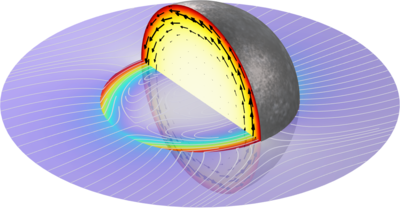
An iron sphere in a magnetic field is an excellent textbook example to demonstrate the effects of a magnetic field interacting with a permeable material. This tutorial series is designed as an introduction to numerically modeling electromagnetic effects with COMSOL. This series ... Read More

In a redox flow battery electrochemical energy is stored as redox couples in the electrolyte, which is stored in tanks outside the electrochemical cell. During operation, electrolyte is pumped through the cell and, due to the electrochemical reactions, the individual concentrations of ... Read More
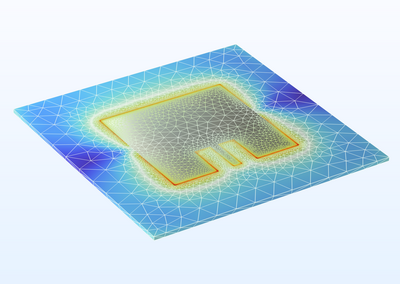
The model utilizes a dedicated mesh refinement study, Frequency Domain RF Adaptive Mesh, which dynamically refines the mesh in the region of interest. For the Application Library model Microstrip Patch Antenna, it increases the mesh resolution around areas with high field variations. The ... Read More


