
The Application Gallery features COMSOL Multiphysics® tutorial and demo app files pertinent to the electrical, structural, acoustics, fluid, heat, and chemical disciplines. You can use these examples as a starting point for your own simulation work by downloading the tutorial model or demo app file and its accompanying instructions.
Search for tutorials and apps relevant to your area of expertise via the Quick Search feature. Note that many of the examples featured here can also be accessed via the Application Libraries that are built into the COMSOL Multiphysics® software and available from the File menu.

Some conventional three-port power dividers are resistive power dividers and T-junction power dividers. Such dividers are either lossy or not matched to the system reference impedance at all ports. In addition, isolation between two coupled ports is not guaranteed. The Wilkinson power ... Read More
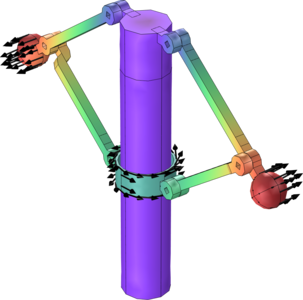
A centrifugal governor is used to control the speed of rotating machinery. One of the most common applications is in controlling the RPM of an engine by regulating the fuel supply. This model illustrates the functioning of a spring loaded centrifugal governor. The dynamics of the ... Read More

This model shows how to build and solve a radiative heat transfer problem using the Heat Transfer interface. In particular, this 2D model illustrates the use of the surface-to-surface radiation feature. In this model, three surfaces form a cavity. Heat flux is set at two outer ... Read More
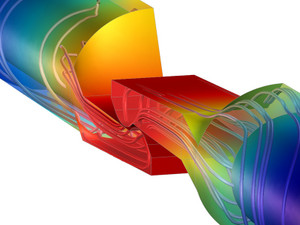
This model illustrates how to implement a multiphysics contact. It models the thermal and electrical behavior of two contacting parts of a switch. The electrical current and the heat flow from one part to the other only through the contact surface. The contact switch device has a ... Read More
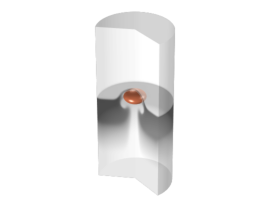
This example simulates an oil droplet rising through a suspension. The suspension is initially stratified, with a dense layer between two clear layers. The droplet is initially located in the bottom clear layer. The particles in the suspension start to sediment toward the bottom of the ... Read More
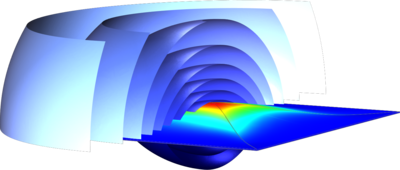
This model analyzes a piezoelectric microelectromechanical system (MEMS) speaker. The speaker, composed of four triangular membranes, uses a layer of lead zirconate titanate (PZT) material with two electrodes on top of a silicon layer as actuators. The triangular membranes are separated ... Read More
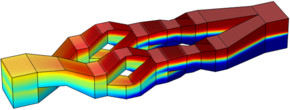
The development of mixers does often not only have to account for effectiveness, but also other factors must be involved, such as cost and complexity for manufacturing. The three models study a laminar static micro mixer with two parallel sets of split-reshape-recombine mixing elements. ... Read More
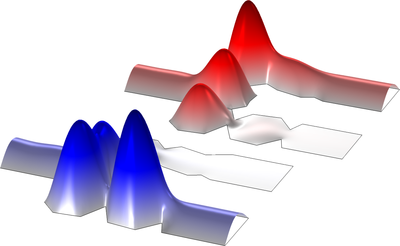
A diplexer is a device that combines or splits signals into two different frequency bands, widely used in mobile communication systems. This example simulates splitting properties using a simplified 2D geometry. The geometry is optimized using shape optimization in order to get the ... Read More
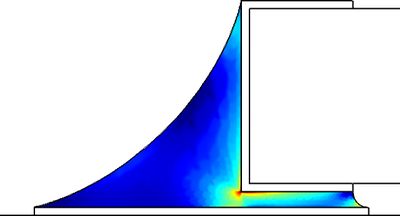
A surface mount resistor is subjected to thermal cycling. The difference in the thermal expansion of different materials will introduce stresses in the structure. The solder which connects the resistor with the printed circuit board is seen as the weakest link in the assembly. It ... Read More
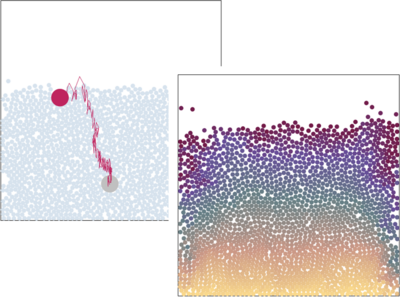
Formally known as size separation in vibrated granular materials, the Brazil nut effect (BNE) (and sometimes the Muesli effect) is a phenomenon that causes large grains to separate from small ones and rise to the top of a granular bed under vibrations. This phenomenon can be studied ... Read More


