
The Application Gallery features COMSOL Multiphysics® tutorial and demo app files pertinent to the electrical, structural, acoustics, fluid, heat, and chemical disciplines. You can use these examples as a starting point for your own simulation work by downloading the tutorial model or demo app file and its accompanying instructions.
Search for tutorials and apps relevant to your area of expertise via the Quick Search feature. Note that many of the examples featured here can also be accessed via the Application Libraries that are built into the COMSOL Multiphysics® software and available from the File menu.
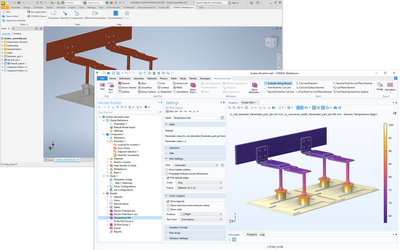
This tutorial model of the Joule heating effect in a busbar demonstrates how to synchronize an assembly between the Inventor® software and the COMSOL Multiphysics® software, how to modify the geometry from COMSOL Multiphysics®, and how to run a geometric parametric ... Read More
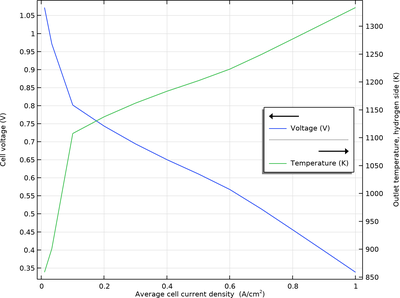
In this model of an ammonia-fed solid oxide fuel cell, the required hydrogen is supplied through endothermic thermal decomposition of ammonia. The model includes the full coupling between the mass balances and gas flow in the H2 and O2 gas diffusion electrodes, the momentum balances in ... Read More
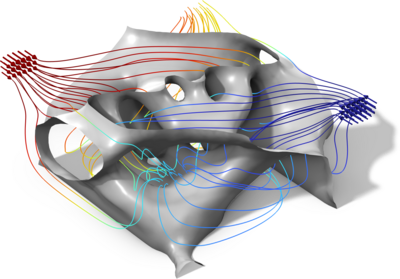
The heat transfer rate and hydraulic resistance of a three dimensional heat exchanger is optimized in the laminar flow regime. Read More
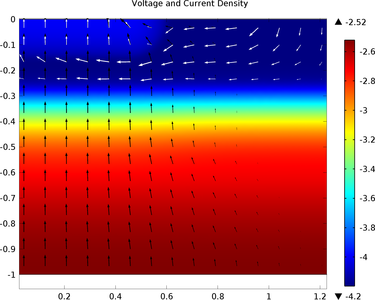
This model shows how to set up a simple Bipolar Transistor model. The output current-voltage characteristics in the common-emitter configuration are computed and the common-emitter current gain is determined. Read More
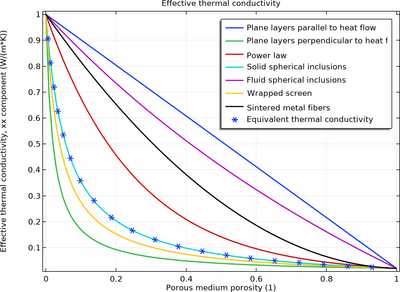
This tutorial presents the averaging models available within the Heat Transfer in Porous Media interface, used to compute the effective thermal conductivity, when the local thermal equilibrium assumption is made. The models are compared for porosities ranging from 0 to 1, and for a ... Read More
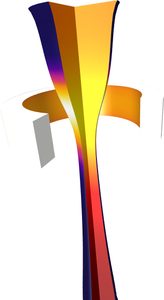
This example is about the modeling of the fiber drawing process. Thermal fiber drawing is a process in which a comparatively thicker structure is heated and drawn into extended lengths of microstructured fiber. This process is done by passing them through the furnace and pulling them ... Read More
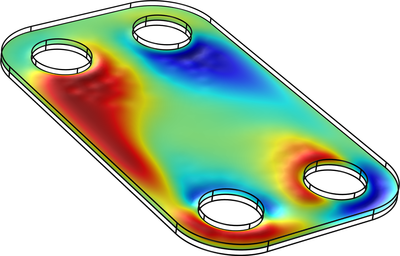
This model demonstrates how to use the built-in shape optimization functionality to improve the performance of a plate heat exchanger. The optimization reduces the path immediately in front of the inlets and outlets to increase the length of typical streamlines. This leads to a improved ... Read More
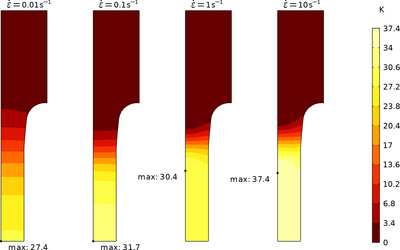
In this example, a tensile test is simulated at four different strain rates. The Johnson–Cook hardening law is used to model the strain rate dependency of the plastic hardening. The temperature distribution and thermal expansion caused by the heating generated by the plastic ... Read More
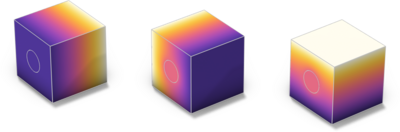
In this example, a heat transfer model of a fiber composite's unit cell is analyzed with the Cell Periodicity feature. The homogenized thermal conductivity, density and heat capacity of a composite material are computed based on the individual properties of fiber and matrix. A comparison ... Read More
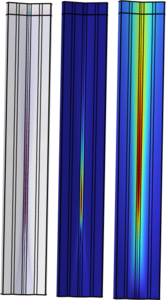
Acoustic streaming, a steady flow induced by sound waves, has been used in biomedical and engineering industrial., Examples include enhancement of convective heat transfer, ultrasonic cleaning, localized micro-mixing, hemolysis of blood cells, and micropumps etc. The phenomenon is ... Read More


