
The Application Gallery features COMSOL Multiphysics® tutorial and demo app files pertinent to the electrical, structural, acoustics, fluid, heat, and chemical disciplines. You can use these examples as a starting point for your own simulation work by downloading the tutorial model or demo app file and its accompanying instructions.
Search for tutorials and apps relevant to your area of expertise via the Quick Search feature. Note that many of the examples featured here can also be accessed via the Application Libraries that are built into the COMSOL Multiphysics® software and available from the File menu.
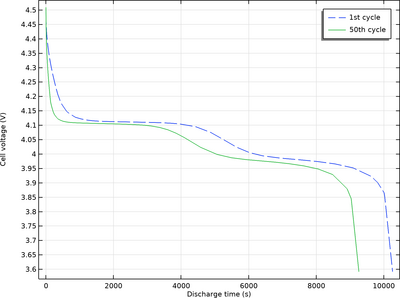
Some positive electrode materials are known to deteriorate in overcharged lithium-ion battery cells. Predominantly, manganese containing electrode materials such as LMO and NMC can loose capacity due to manganese dissolving from the materials at overcharge. This decomposition is a ... Read More
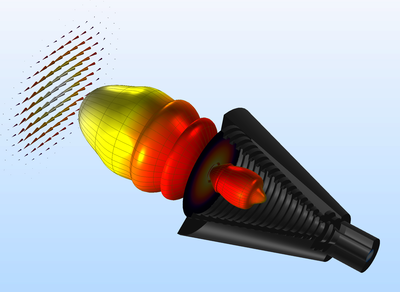
Corrugated circular aperture (conical) horn antennas are popularly used as feed horns for dish reflector antennas due to their low sidelobes and cross-polarization level. The excited TE mode from a circular waveguide passes along the corrugated inner surface of a circular horn antenna, ... Read More
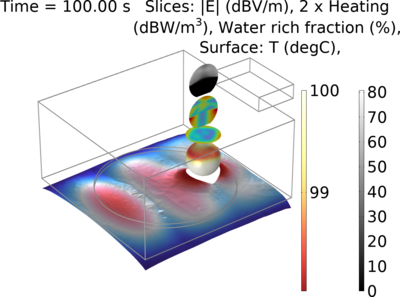
A spherical water-rich load (potato) is placed on the rotating glass tray of a microwave oven some distance from the center of rotation. 1 kW of 2.45 GHz microwave power is applied via a waveguide feed. The plate rotates at 9 degrees per second. The heat transfer model involves the ... Read More
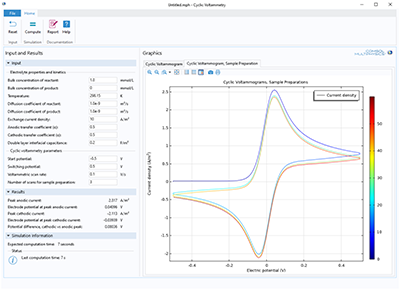
The purpose of the app is to demonstrate and simulate the use of cyclic voltammetry. You can vary the bulk concentration of both species, transport properties, kinetic parameters, as well as the cycling voltage window and scan rate. Cyclic voltammetry is a common analytical technique ... Read More
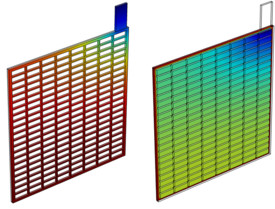
This 3D model example demonstrates the use of the Primary Current Distribution interface for modeling current distributions in electrochemical cells. In primary current distribution, the potential losses due to electrode kinetics and mass transport are assumed to be negligible, and ... Read More

In this model a plane wave with circular polarization is reflected off an interface between air and glass. The model demonstrates three different ways of defining this problem. The first part shows how to define user-defined port mode fields. The second part uses the predefined circular ... Read More
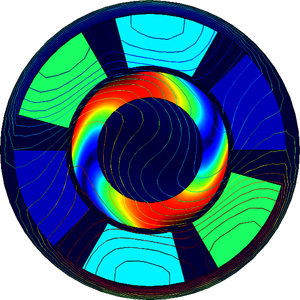
This three-phase induction motor model is used to compare with Testing Electromagnetic Analysis Method (TEAM) workshop problem 30. The Magnetic Fields physics interface is used to model the motor in the frequency domain at 60 Hz. The Velocity (Lorentz Term) feature is used to model the ... Read More
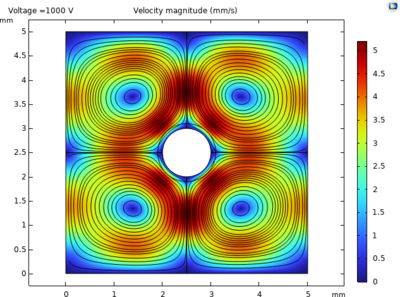
This model simulates the electrohydrodynamic (EHD) flow of a dielectric liquid around a wire electrode positioned between two parallel flat-plate electrodes. The ion transport is described using the Poisson–Nernst–Planck equations, while fluid motion is governed by the Navier–Stokes ... Read More

This model demonstrates dielectric barrier discharge (DBD) in air subjected to an AC applied voltage. As the voltage amplitude increases, the discharge intensity correspondingly strengthens. Furthermore, the dominant component of the discharge current transitions from displacement ... Read More
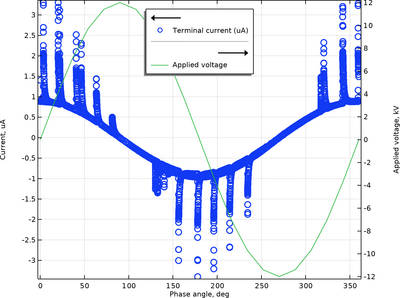
The electrical insulation strength of gases is generally much lower than that of solids. Under normal operating conditions, electrical discharges—known as partial discharges—can occur in voids or cracks within a solid dielectric. This model simulates partial discharges in a spherical ... Read More


