
The Application Gallery features COMSOL Multiphysics® tutorial and demo app files pertinent to the electrical, structural, acoustics, fluid, heat, and chemical disciplines. You can use these examples as a starting point for your own simulation work by downloading the tutorial model or demo app file and its accompanying instructions.
Search for tutorials and apps relevant to your area of expertise via the Quick Search feature. Note that many of the examples featured here can also be accessed via the Application Libraries that are built into the COMSOL Multiphysics® software and available from the File menu.

When electrons are emitted from a heated cathode in a plane parallel vacuum diode, they contribute to the space charge density in the diode, which in turn affects the electric potential distribution. If the potential difference between the cathode and the anode is not sufficiently large, ... Read More
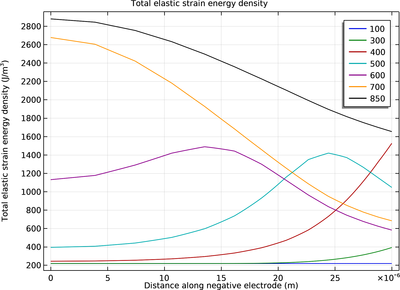
Diffusion-induced stress in lithium-ion battery electrode materials can occur as a result of compositional inhomogeneities during lithium intercalation in the host material particles. These stresses are important since the electrode host material can undergo significant volume changes ... Read More
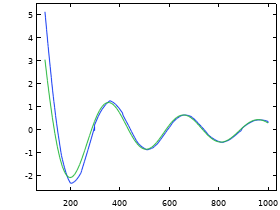
In this tutorial model, the far-field radiation pattern of a dipole antenna is computed in a 3D model component. Then, in a separate 3D model component, a ray is released using the far-field radiation pattern to initialize the ray's intensity, polarization, and phase. Read More

This model demonstrates how a nonlinear equation system can be setup to solve for the eigenfrequencies of a symmetric laser cavity. The model uses the bidirectional formulation of the Electromagnetic Waves, Beam Envelopes physics interface. The computed eigenfrequencies are verified with ... Read More
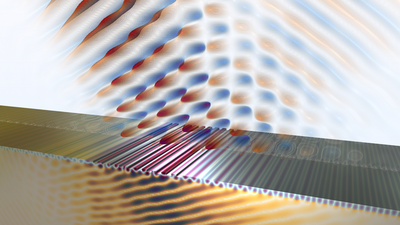
This model simulates the coupling of free-space laser radiation into waveguide modes using an optical grating coupler. The coupling efficiency and the radiation loss are calculated for different angles of incidence of the laser beam. Read More
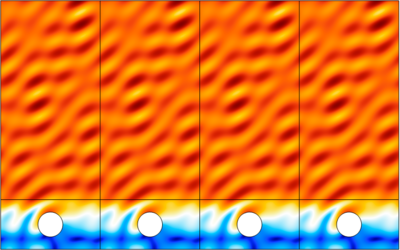
This is a model of acoustic absorption by a porous acoustic open cell foam. In porous materials the sound propagates in a network of small interconnected pores. Because the dimensions of the pores are small, losses occur due to thermal conduction and viscous friction. Acoustic foams are ... Read More

This application presents an example of pressure driven flow and electrophoresis in a 3D micro channel system. Researchers often use a device similar to the one in this model as an electrokinetic sample injector in biochips to obtain well-defined sample volumes of dissociated acids and ... Read More
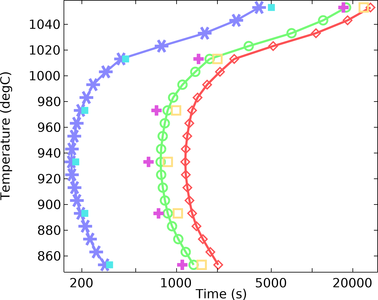
This model shows how to use the Metal Processing Module and the Optimization Module to calibrate parameters of a phase transformation model against TTT (Time Temperature Transformation) data. Read More
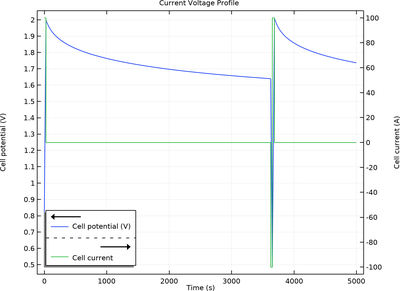
This model illustrates the effect of oxygen and hydrogen formation and recombination on the performance and self-discharge of an electrochemical capacitor with a water-based electrolyte. A load cycle consisting of mixed constant current pulses and rest periods at an open circuit is ... Read More
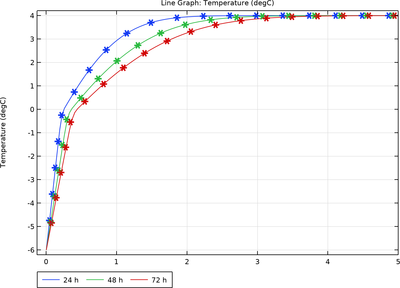
In this example, a heat-conduction problem with phase change in a porous material is solved, and the results are compared with the analytical solution, also known as the Lunardini solution. This is the first benchmark case from the InterFrost project, which was initiated to compare ... Read More


