
The Application Gallery features COMSOL Multiphysics® tutorial and demo app files pertinent to the electrical, structural, acoustics, fluid, heat, and chemical disciplines. You can use these examples as a starting point for your own simulation work by downloading the tutorial model or demo app file and its accompanying instructions.
Search for tutorials and apps relevant to your area of expertise via the Quick Search feature. Note that many of the examples featured here can also be accessed via the Application Libraries that are built into the COMSOL Multiphysics® software and available from the File menu.
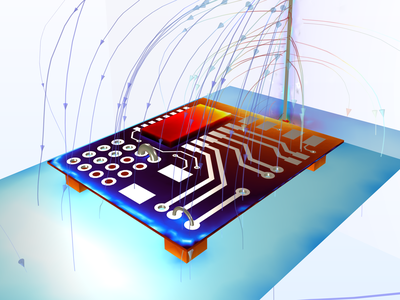
This example demonstrates how an ESD event causes logic error of a microchip on a PCB board. The ESD current is based on the extended HBM (Human Body Model) and it is predefined in the Lumped Port feature. Read More
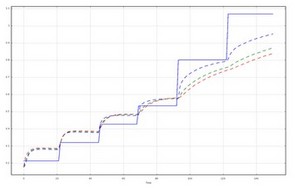
The first model describes the simultaneous flow of two immiscible fluids in porous media - here air displaces water in a multi-step inlet pressure experiment. We solve for the pressure and the degree saturation for the air and water within a representative volume and so track saturation ... Read More
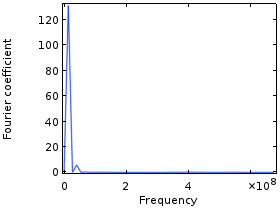
This tutorial model demonstrates how to compute the impedance of a capacitively coupled plasma. The Time Periodic study computes the time periodic solution of the plasma. Subsequently, the solution is transformed to the time domain, after which the fast Fourier transform (FFT) solver is ... Read More
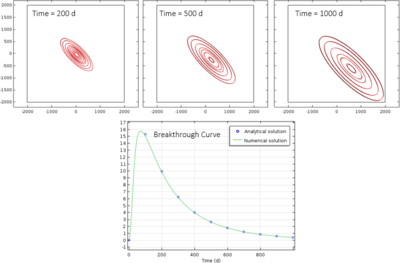
Predicting the transport of solutes that move with subsurface fluids is of general interest in environmental engineering and geosciences. Solutes may not only be pollutants but also artifical tracers added to the groundwater for investigation purposes. This model tracks a solute over ... Read More
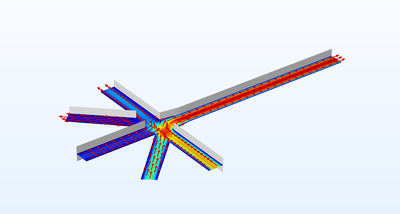
This model presents a time-dependent study of a microchannel that is used to infuse and flush another piece of equipment with a fluid. The pressure at the five inlets varies sinusoidally as functions of time, and the velocity vector at the outlet is studied. The model uses an ... Read More

In this example, wear of the friction material in a disc brake is studied. Quasistatic friction forces are prescribed from simple kinematic considerations. The geometry of the brake pad is continuously updated to account for the material removal due to wear following the well-known ... Read More
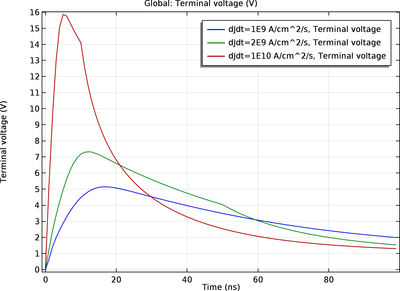
This tutorial simulates the turn-on transient (forward recovery) of a simple PIN diode, based on the book "Fundamentals of Power Semiconductor Devices" by B. J. Baliga (p. 242, 2008 edition). The diode is current driven with a constant ramp rate of 1e9, 2e9 and 1e10 A/cm^2/sec and a ... Read More
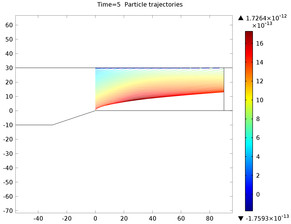
When a temperature gradient in a gas exists, suspended particles will tend to move from regions of high temperature to low. The force which produces this effect is called the thermophoretic force. Gas molecules colliding with a particle from the hot side have a higher velocity than the ... Read More
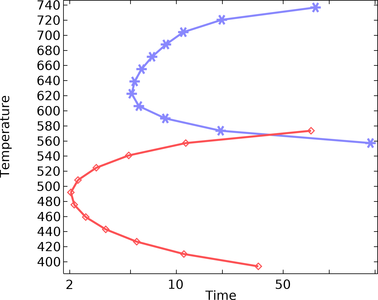
During quenching of steel, austenite decomposes into phases such as ferrite, pearlite, bainite, and martensite. A common way to illustrate the phase transformation characteristics of a particular steel alloy is to use transformation diagrams. Two of the most commonly used diagram types ... Read More
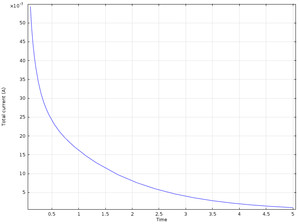
The common electroanalytical method of exhaustive amperometric detection in a microscopic thin layer is modelled as a 1D-symmetric diffusion problem. The simulated result agrees with the analytical Cottrell equation at short times, and deviates as expected at long times when the ... Read More


