
The Application Gallery features COMSOL Multiphysics® tutorial and demo app files pertinent to the electrical, structural, acoustics, fluid, heat, and chemical disciplines. You can use these examples as a starting point for your own simulation work by downloading the tutorial model or demo app file and its accompanying instructions.
Search for tutorials and apps relevant to your area of expertise via the Quick Search feature. Note that many of the examples featured here can also be accessed via the Application Libraries that are built into the COMSOL Multiphysics® software and available from the File menu.
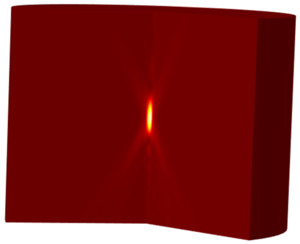
This tutorial shows how to model tissue heating induced by focused ultrasound. First, the stationary acoustic field in the water and the tissue are modeled to obtain the acoustic intensity distribution in the tissue. The absorbed acoustic energy is then calculated and used as the heat ... Read More
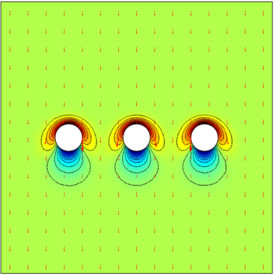
This example utilizes the Richards’ Equation interface to assess how well geophysical irrigation sensors see the true level of fluid saturation in variably saturated soils. The challenge to characterizing fluid movement in variably saturated porous media lies primarily in the need to ... Read More
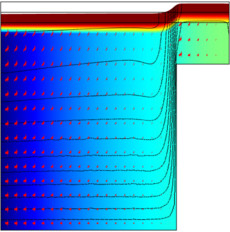
The Poroelasticity interface couples Darcy's law and solid mechanics to assess deformation of porous media that results from fluid withdrawals. The model builds on top of the Terzaghi Compaction example. Results from Terzaghi compaction and Biot poroelasticity analyses are compared to ... Read More
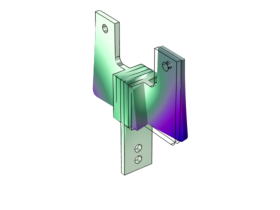
In this example, the eigenmodes of a structural damper are computed. In the damper, most of the deformation is controlled by the viscoelastic domains, which have strongly frequency-dependent stiffness and damping properties. This leads to a nonlinear eigenfrequency problem, which can be ... Read More
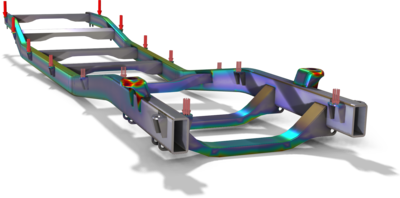
This example illustrates how to perform eigenfrequency and static analyses of a ladder frame structure for a light truck. Important modeling strategies are described. For example, how to convert a solid geometry to a shell model, how to make different types of connections, and how to ... Read More
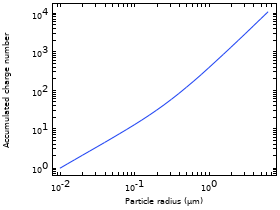
This model computes the fluid flow, charge transport and electric potential in an electrostatic precipitator. Based on the resulting fields, particles of different diameter are fed into the device and the transmission probability is computed. As expected, the separation efficiency shows ... Read More
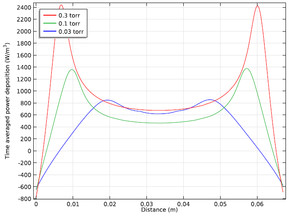
The underlying physics of a capacitively coupled plasma is rather complicated, even for rather simple geometric configurations and plasma chemistries. This model benchmarks the Capacitively Coupled Plasma physics interface against many different codes. Read More
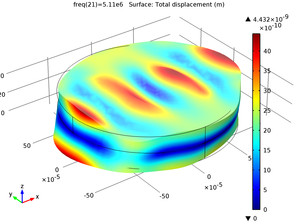
AT cut quartz crystals are widely employed in a range of applications, from oscillators to microbalances. One of the important properties of the AT cut is that the resonant frequency of the crystal is temperature independent to first order. This is desirable in both mass sensing and ... Read More
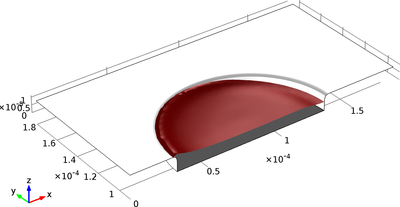
This model simulates the shape evolution of a microconnector bump over time as copper deposits on an electrode surface. Transport of cupric ions in the electrolyte occurs by convection and diffusion. The electrode kinetics are described by a concentration dependent Butler-Volmer ... Read More
Steel pipelines are often subjected to complex stress/strain conditions in the oil and gas industry. Additionally, pipes are subjected to significant longitudinal strain due to soil movement. For the elastoplastic stress simulation, the Solid Mechanics interface is used with the small ... Read More


