
The Application Gallery features COMSOL Multiphysics® tutorial and demo app files pertinent to the electrical, structural, acoustics, fluid, heat, and chemical disciplines. You can use these examples as a starting point for your own simulation work by downloading the tutorial model or demo app file and its accompanying instructions.
Search for tutorials and apps relevant to your area of expertise via the Quick Search feature. Note that many of the examples featured here can also be accessed via the Application Libraries that are built into the COMSOL Multiphysics® software and available from the File menu.
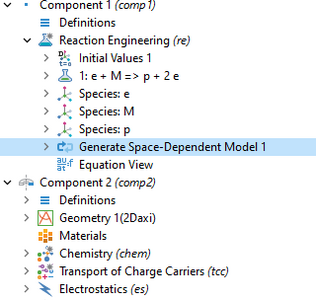
The example shows how to generate a discharge model from the Reaction Engineering interface with a self-defined discharge chemistry. It reproduces the library model 127181 (Double-Headed Streamer in Parallel-Plate Electrodes). Read More
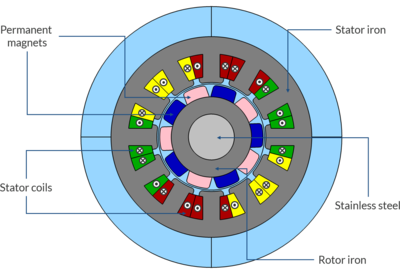
This is a primer model of a permanent magnet machine. It is a generic model that can be modified to simulate a motor or generator. It demonstrates different capabilities of COMSOL Multiphysics® to examine aspects of machine design, such as air gap magnetomotive force (MMF), ... Read More
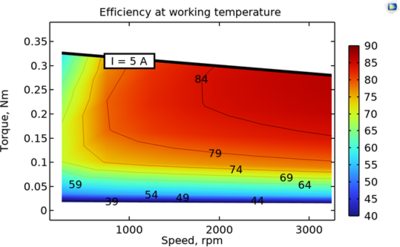
This a continuation of the permanent magnet motor model available here . In this model, an heat transfer analysis has been performed to compute the temperature rise for various stator current and rotor speed. A detailed analysis on torque, and losses in iron and copper have then been ... Read More

Electric impedance measurements are used for imaging and detection. Applications range from nondestructive testing and geophysical imaging to medical imaging. Several alternative techniques are shown to model such a system. One of them shows how to use conditional expressions to define ... Read More
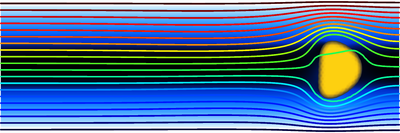
Applying an electric field across a suspension of immiscible liquids may stimulate droplets of the same phase to coalesce. The method known as electrocoalescence has important applications, for instance, in the separation of oil from water. To model electrocoalescence, you need to solve ... Read More
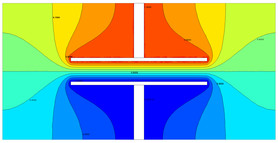
A capacitor, in its simplest form, is a two terminal electrical device that stores electric energy when a voltage difference is applied across the terminals. The stored electric energy is proportional to the applied voltage squared and is quantified by the capacitance of the device. This ... Read More
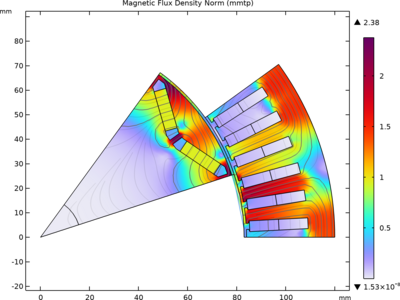
Obtaining the steady-state performance is an essential task for the electric motor designer. As with many electromagnetic devices, the steady-state condition of an electric motor is when electric and magnetic field variations have stabilized to periodic variations. That is when ... Read More
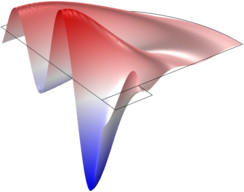
A piezoelectric transducer can be used either to transform an electric current to an acoustic pressure field or, the opposite, to produce an electric current from an acoustic field. These devices are generally useful for applications that require the generation of sound in air and ... Read More
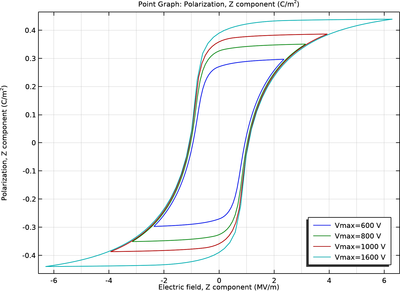
Ferroelectric materials exhibit nonlinear polarization behavior such as hysteresis and saturation at large applied electric fields. Many piezoelectric materials are ferroelectric. This model analyzes a simple actuator made of PZT piezoelectric ceramic material, which is subjected to ... Read More
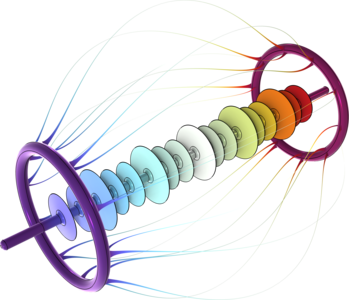
This example demonstrates how to use the Electrostatic interface to calculate the surface electric field of a typical high-voltage insulator. It is shown that the inhomogeneity and the maximum of the surface electric field are greatly reduced with the installation of the grading rings. ... Read More


