
The Application Gallery features COMSOL Multiphysics® tutorial and demo app files pertinent to the electrical, structural, acoustics, fluid, heat, and chemical disciplines. You can use these examples as a starting point for your own simulation work by downloading the tutorial model or demo app file and its accompanying instructions.
Search for tutorials and apps relevant to your area of expertise via the Quick Search feature. Note that many of the examples featured here can also be accessed via the Application Libraries that are built into the COMSOL Multiphysics® software and available from the File menu.
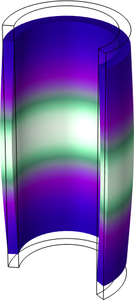
This model calculates the eigenfrequencies and mode shapes of an unconstrained cylinder in axisymmetry. The model is taken from NAFEMS Free Vibration Benchmarks. The eigenfrequencies are compared with the values given in the benchmark report. Three different physics interfaces are ... Read More
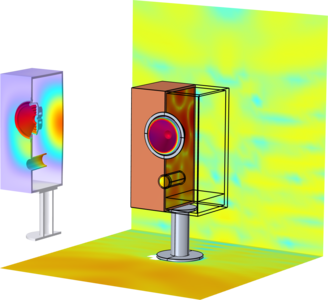
This model shows a full vibroacoustic analysis of a loudspeaker including driver, cabinet, and stand. It lets you apply a nominal driving voltage and extract the resulting sound pressure level in the cabinet and in the outside room, as well as the deformation of the cabinet and driver, ... Read More
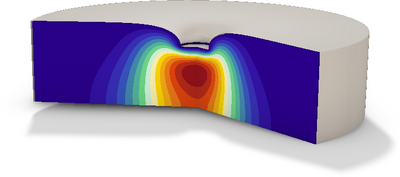
This example demonstrates how to use the Poroelasticity multiphysics coupling between the Solid Mechanics and Darcy's Law interfaces to model linear biphasic poroviscoelastic behavior of soft biological tissues. The implementation is verified using two numerical benchmarks from the ... Read More

The propagation of elastic waves in the ground after a seismic event is simulated using a 2D model. The effect of the ground surface topology on the wave propagation is illustrated when an ideal half-space is modified with the presence of a small mountain. The model is a variation of ... Read More
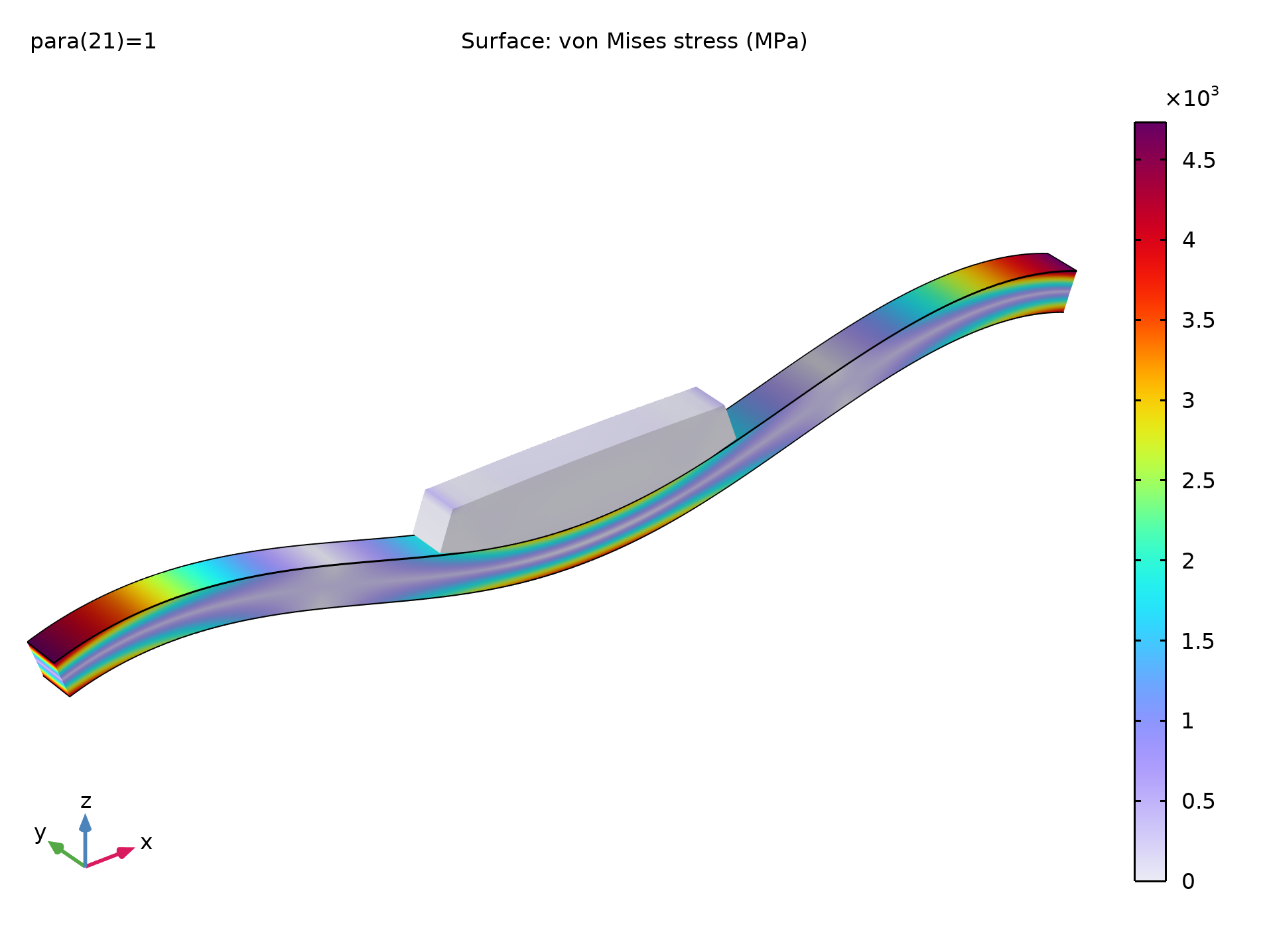
This conceptual example shows how to calculate critical points in models with contact. The model consists of a block modeled with the Solid Mechanics interface pressing on an arch modeled with the Shell interface. The contact problem is solved using the augmented Lagrangian method. The ... Read More

Cryer's problem is a three-dimensional consolidation benchmark. A porous sphere is subjected to a uniform boundary pressure. The pore pressure at the center of the sphere rises due to the Mandel-Cryer effect that is captured by a two-way coupling between Darcy's law and solid mechanics. Read More
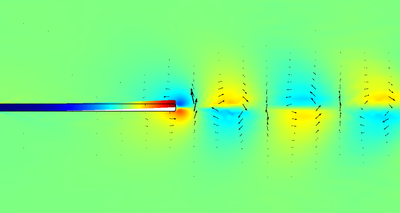
This is a small 2D demonstration model that couples the Linearized Navier-Stokes, Frequency Domain, Solid Mechanics, and Turbulent Flow (k-epsilon) physics interfaces to model the vibrations of a plate located in a 2D viscous parallel plate flow. This type of model is used to model fluid ... Read More

A demonstration of topology optimization using the Structural Mechanics Module and the Optimization Module. The classical MBB beam is solved in 2D using a Helmholtz filter and Solid Isotropic Material Penalization (SIMP) technique to recast the original combinatorial optimization problem ... Read More
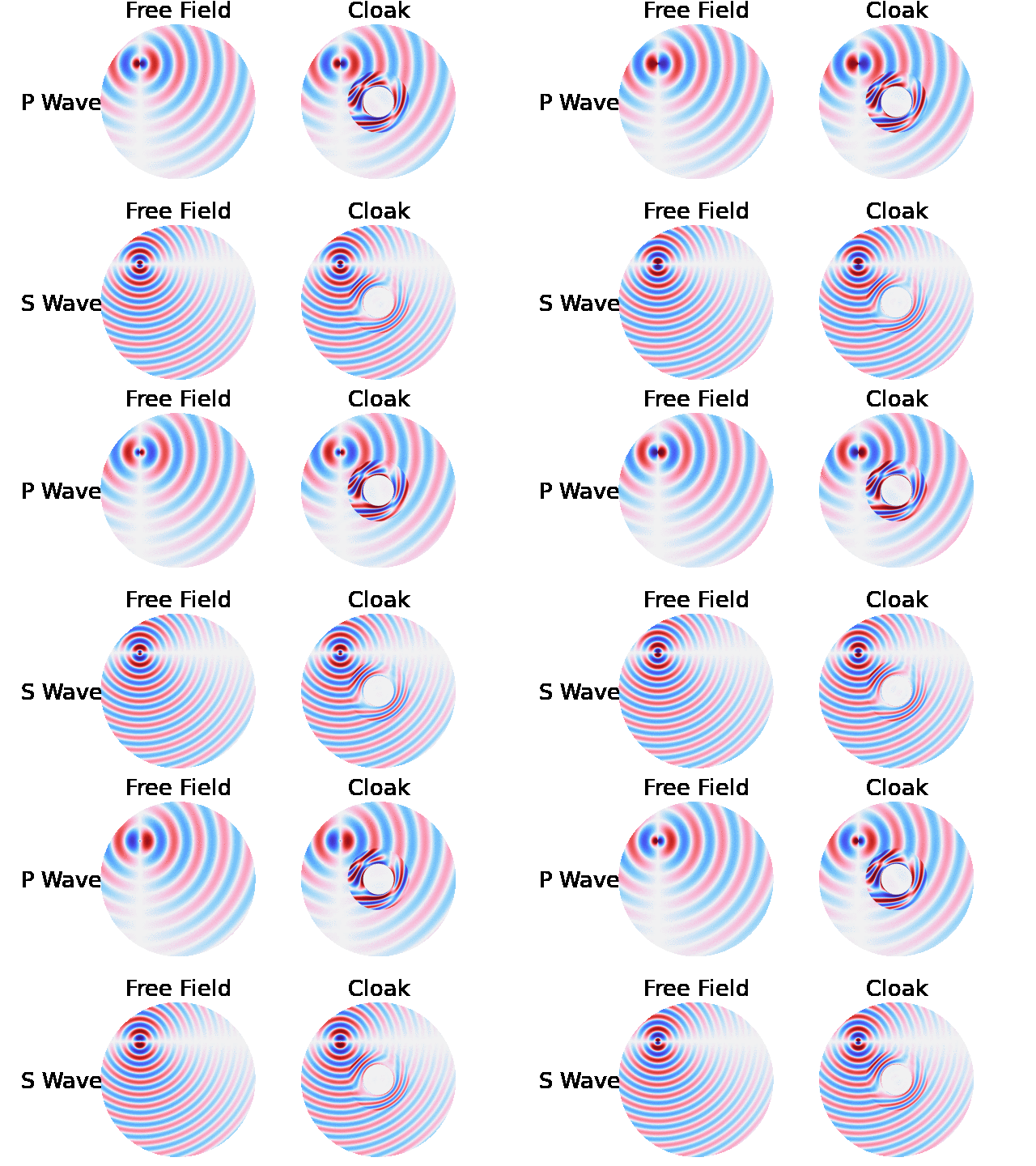
In this example, the External Stress feature in the Solid Mechanics interface is used to provide the material model with the nonsymmetric stress required in the design of an elastic invisibility cloak. The cloak is a domain with special material properties aimed at shielding a region of ... Read More
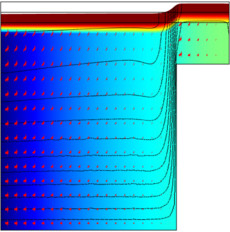
The Poroelasticity interface couples Darcy's law and solid mechanics to assess deformation of porous media that results from fluid withdrawals. The model builds on top of the Terzaghi Compaction example. Results from Terzaghi compaction and Biot poroelasticity analyses are compared to ... Read More


