
The Application Gallery features COMSOL Multiphysics® tutorial and demo app files pertinent to the electrical, structural, acoustics, fluid, heat, and chemical disciplines. You can use these examples as a starting point for your own simulation work by downloading the tutorial model or demo app file and its accompanying instructions.
Search for tutorials and apps relevant to your area of expertise via the Quick Search feature. Note that many of the examples featured here can also be accessed via the Application Libraries that are built into the COMSOL Multiphysics® software and available from the File menu.
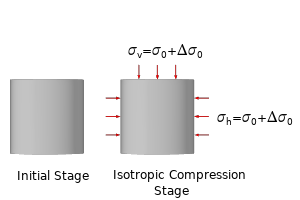
This model simulates the isotropic compression of naturally structured and artificially structured clays using the Modified Structured Cam-Clay (MSCC) material model. The aim of the example is to reproduce the compression behavior given in a benchmark for four structured clays. Read More

Electronic equipment often has to be certified to function after having been subjected to a specified shock load. In this example, the effect of an 50g 11ms half sine shock on a circuit board is investigated using response spectrum analysis. The results are compared with a time domain ... Read More
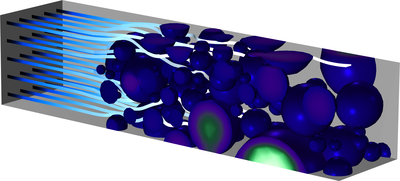
In this example, a heterogeneous NMC (Nickel-Manganese-Cobalt) electrode structure is generated from tomography data using a Model Method. Time-dependent discharge and electrochemical impedance spectroscopy (EIS) simulations are then made on the full 3D geometry. A solid mechanics ... Read More
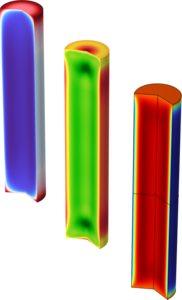
A steel billet is quenched in oil from its austenitic state. A 2D axisymmetric model is used to simulate the coupled problem of austenite decomposition, heat transfer, and solid mechanics. During the quenching process, the austenite decomposes into a combination of ferrite, pearlite, ... Read More

For models with acoustic-structure couplings it is necessary to calculate the left eigenvectors to use the Frequency Domain, Modal solver. The model shows the necessary changes to the default settings of the eigenfrequency solver. Read More
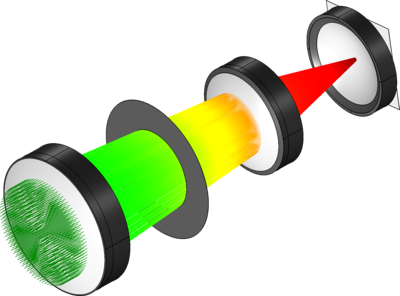
This tutorial shows how to set up a multi-element objective lens. The chosen lens is a Petzval lens with field flattener described in 'Fundamental Optical Design', by M. Kidger, 2001, pg 192. The tutorial demonstrates how to include a geometric sequence using the 'Spherical General Lens ... Read More
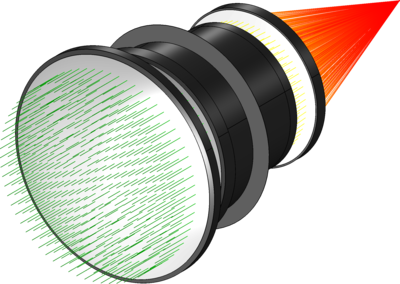
This tutorial shows how to set up a multi-element objective lens. The chosen lens is the Double Gauss described in 'Modern Lens Design (2nd edition)', by W. Smith, 2005, pg 323. The tutorial demonstrates how to create a geometry sequence using the 'Spherical Lens 3D' part found in the ... Read More
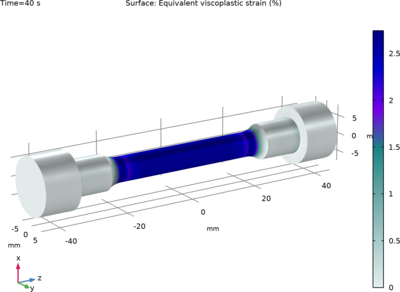
Most metals and alloys undergo viscoplastic deformation at high temperatures. In case of cyclic loading, a constitutive law with both isotropic and kinematic hardening is necessary to describe effects such as ratcheting, cyclic softening/hardening, and stress relaxation. The Lemaitre ... Read More
A gate-all-around MOSFET consists of a nanowire with a gate electrode wrapped around the circumference. Since the entire nanowire forms the channel, this configuration provides the best possible electrostatic control of the channel and offers a good candidate for the miniaturization of ... Read More
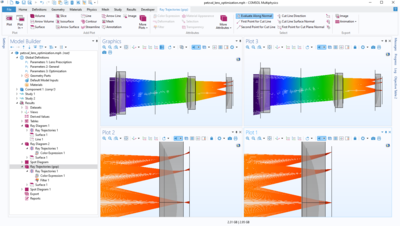
This example shows how to perform parameter optimization on a lens system. The optimization is motivated by the replacement of one of the glasses in a prior optical prescription with a new glass having slightly different optical dispersion coefficients. The control parameters are the ... Read More


