
The Application Gallery features COMSOL Multiphysics® tutorial and demo app files pertinent to the electrical, structural, acoustics, fluid, heat, and chemical disciplines. You can use these examples as a starting point for your own simulation work by downloading the tutorial model or demo app file and its accompanying instructions.
Search for tutorials and apps relevant to your area of expertise via the Quick Search feature. Note that many of the examples featured here can also be accessed via the Application Libraries that are built into the COMSOL Multiphysics® software and available from the File menu.

In this tutorial, a PM motor with 10 rotor poles and 12 stator slots is modeled in 2D, to capture the torque ripple over an electrical period and map the volumetric loss density in the rotor and stator iron. Read More
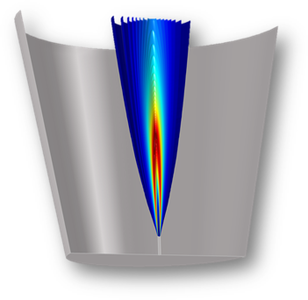
The model simulates non-premixed turbulent combustion of syngas (synthesis gas) in a simple round-jet burner. Syngas is a gas mixture, primarily composed of hydrogen, carbon monoxide and carbon dioxide. The name syngas relates to its use in creating synthetic natural gas. In the model, ... Read More
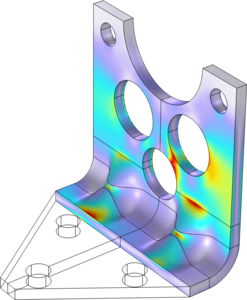
In this parameter optimization example, the mass of a bracket is minimized by changing the size and position of a number of geometrical objects. The requirements give limits both on the lowest natural frequency, and on the maximum stress in a static load case. This means that results ... Read More
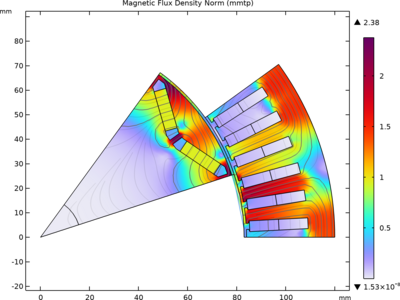
Obtaining the steady-state performance is an essential task for the electric motor designer. As with many electromagnetic devices, the steady-state condition of an electric motor is when electric and magnetic field variations have stabilized to periodic variations. That is when ... Read More
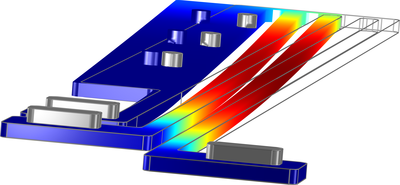
This example model consists of a two-hot-arm thermal actuator made of polysilicon. The actuator is activated through thermal expansion. The temperature increase required to deform the two hot arms, and thus displace the actuator, is obtained through Joule heating (resistive heating). The ... Read More
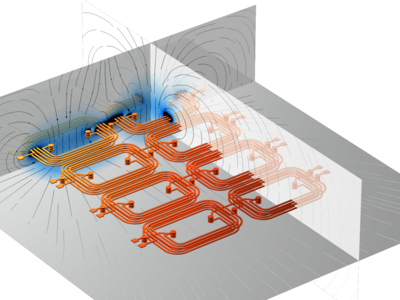
This model demonstrates how to use the Magnetic Fields, Currents Only interface together with the Stationary Source Sweep with Initialization study to compute the inductance matrix of PCB coils with a number of 12. Read More

This model shows how to use the scattered-field formulation to compute the transmission coefficient for impinging P and S plane elastic waves onto a finite-size phononic crystal. The transmission tends to zero in the frequency ranges corresponding to P- and S-wave band gaps, as ... Read More
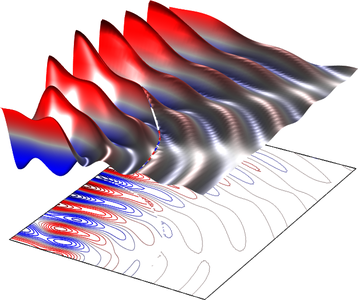
An axisymmetric model of a rigid piston in an infinite baffle is used to exemplify the Exterior Field Calculation feature of the Acoustics Module. The radiation results provided by the COMSOL Multiphysics® software are compared to analytical results for the on-axis radiation ... Read More
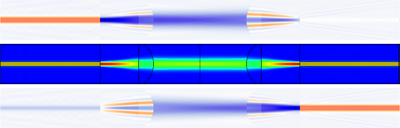
Focusing a laser beam onto the tip of a single mode fiber is a common way to couple light. To achieve good coupling efficiency, the spatial mode of the light field has to match the spatial mode of the fiber. In this model, we use the beam envelopes method to compute a small free-space ... Read More
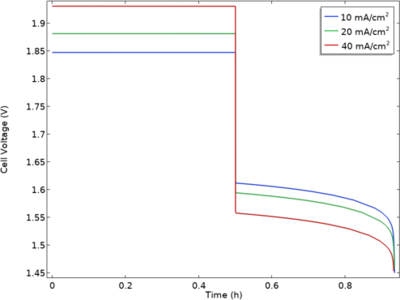
The zinc bromine redox flow battery is an electrochemical energy storage technology suitable for stationary applications. Compared to other flow battery chemistries, the Zn-Br cell potentially features lower cost, higher energy densities and better energy efficiencies. In the cell ... Read More


