
The Application Gallery features COMSOL Multiphysics® tutorial and demo app files pertinent to the electrical, structural, acoustics, fluid, heat, and chemical disciplines. You can use these examples as a starting point for your own simulation work by downloading the tutorial model or demo app file and its accompanying instructions.
Search for tutorials and apps relevant to your area of expertise via the Quick Search feature. Note that many of the examples featured here can also be accessed via the Application Libraries that are built into the COMSOL Multiphysics® software and available from the File menu.
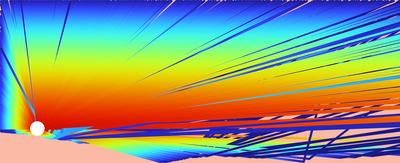
This example model simulates the long-path echo of trumpet sounds reflected from a building 500 m away. The echo can only be heard at night because of the acoustic ray refraction in the atmosphere with different temperature profiles. The model is solved using the ray tracing in the ... Read More
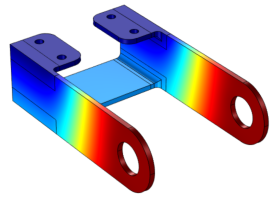
This tutorial example shows how to perform a random vibration analysis of a structure using power spectral density (PSD). The computations are based on the modal reduced order model (ROM). Read More

This model demonstrates 3D topology and shape optimization for an extruded geometry. This can be achieved using equation-based modeling and extrusion operators. The model considers stiffness maximization of a beam subject to a constraint on the mass, but the method can be used with any ... Read More
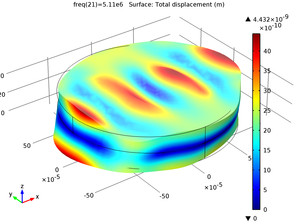
AT cut quartz crystals are widely employed in a range of applications, from oscillators to microbalances. One of the important properties of the AT cut is that the resonant frequency of the crystal is temperature independent to first order. This is desirable in both mass sensing and ... Read More
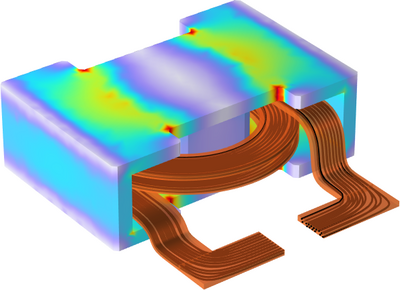
Inductors are used in many applications for low pass filtering or for impedance matching of predominantly capacitive loads. They are used in a wide frequency range from near static up to several MHz. An inductor usually has a magnetic core to increase the inductance, while keeping its ... Read More
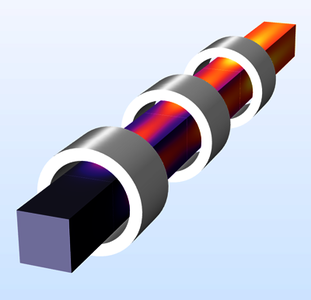
This app demonstrates the following: Geometry parts and parameterized geometries Using tables for user input parameters Visualization on a 2D cross-section of a 3D geometry Improved visualization and user experience when a geometry object (the air object) is hidden. Induction heating ... Read More
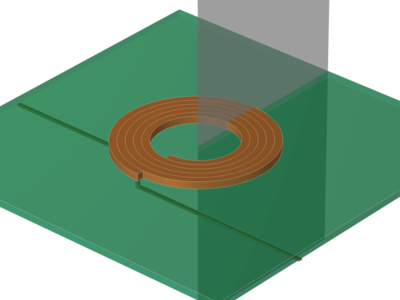
At the resonance frequency, the capacitive coupling between the turns causes the impedance of a coil to transition from inductive to capacitive. This application analyzes the resonance of a 5 turn spiral coil of copper equipped with a thin epoxy varnish insulation layer. The capacitive ... Read More
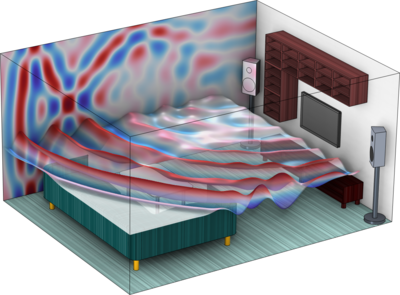
The use of wave-based techniques for room acoustic simulations has spread in the last years due to the increase in computational performance as well as the development of new numerical methods. The challenge of including realistic impedance conditions at walls is traditionally solved in ... Read More
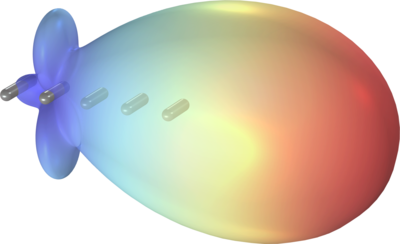
This model demonstrates the use of boundary element method in the Electromagnetic Waves, Boundary Element interface to model an optical Yagi-Uda antenna. The antenna is driven by an electrical point dipole, which is implemented through the background field. The field distribution around ... Read More
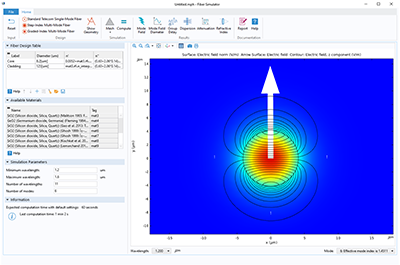
The transmission speed of optical waveguides is superior to microwave waveguides because optical devices have a much higher operating frequency than microwaves, enabling a far higher bandwidth. Single-mode step-index fibers are used for long-haul (even transoceanic) communication, ... Read More


