
The Application Gallery features COMSOL Multiphysics® tutorial and demo app files pertinent to the electrical, structural, acoustics, fluid, heat, and chemical disciplines. You can use these examples as a starting point for your own simulation work by downloading the tutorial model or demo app file and its accompanying instructions.
Search for tutorials and apps relevant to your area of expertise via the Quick Search feature. Note that many of the examples featured here can also be accessed via the Application Libraries that are built into the COMSOL Multiphysics® software and available from the File menu.
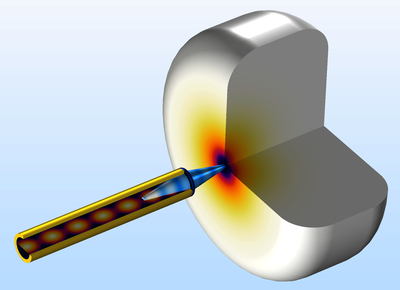
The response of a millimeter wave with frequencies of 35 GHz and 95 GHz is known to be very sensitive to water content. This model utilizes a low-power 35 GHz Ka-band millimeter wave and its reflectivity to moisture for noninvasive cancer diagnosis. Since skin tumors contain more ... Read More
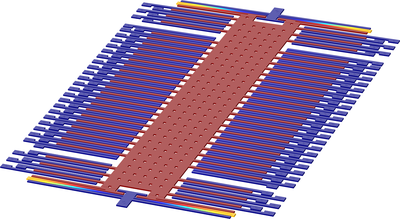
This model shows how to simulate a capacitively actuated surface micromachined accelerometer, using the Electromechanics Interface. It is based on a case study from the book Microsystem Design by Stephen D. Senturia (Kluwer Academic Publishers, 5th Edition, 2003, pages 513-525). Read More
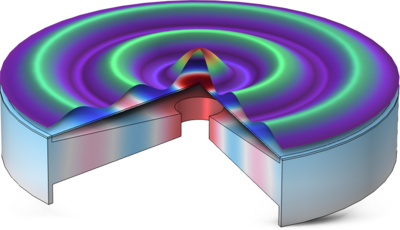
This example of a simple axisymmetric condenser microphone includes all the relevant physics and determines the microphone sensitivity as well as microphone capacitance for the specific simplified microphone geometry and material parameters. It solves a fully coupled multiphysics model ... Read More
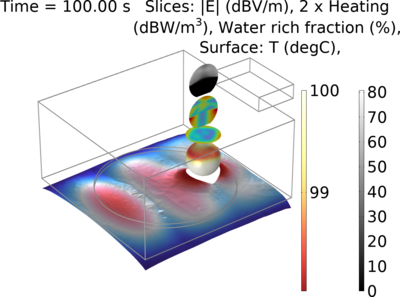
A spherical water-rich load (potato) is placed on the rotating glass tray of a microwave oven some distance from the center of rotation. 1 kW of 2.45 GHz microwave power is applied via a waveguide feed. The plate rotates at 9 degrees per second. The heat transfer model involves the ... Read More
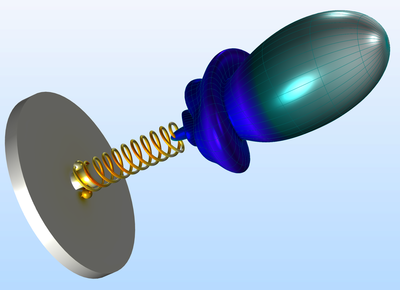
A helical antenna has two major modes. One is normal mode and the other is axial mode. When the helical antenna is operating at the normal mode, its far-field radiation pattern is similar to the torus shaped pattern of a classic dipole antenna. At the axial mode, the helical antenna is ... Read More
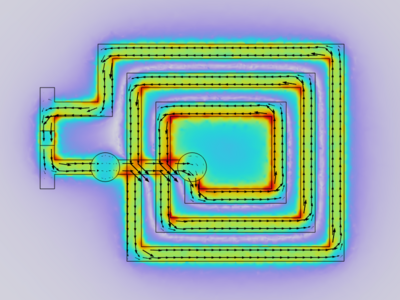
This tutorial example shows how to use the Electric Currents in Shells interface together with Magnetic Field interface to compute the resistance and inductance of a planar PCB coil in the stationary regime. Read More
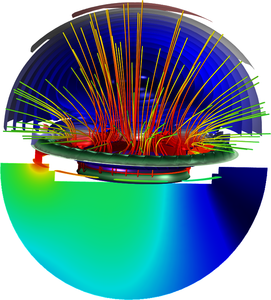
This model analyzes the electromagnetic, mechanical, and acoustical characteristics of the OWS-1943T-8CP (discontinued) speaker. Beside certain details, the geometry, material properties, and measurements are copyright by Ole Wolff. Starting from the geometry of the speaker, an ... Read More
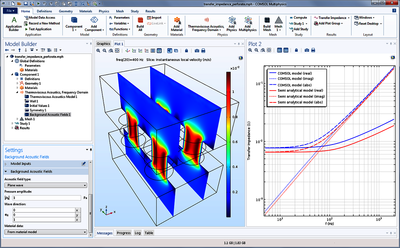
Perforates are plates with a distribution of small perforations or holes. They are used in muffler systems, sound absorbing panels, and in many other places as liners, where it is important to control attenuation precisely. As the perforations become smaller and smaller, viscous and ... Read More
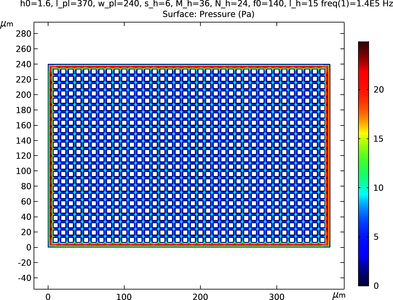
This benchmark model compares the damping coefficients of perforated plates from computation results versus experimental data. The simulation includes 18 different geometric configurations. It uses the Bao's perforation model, which is built-in in the Thin Film Flow physics interface. ... Read More
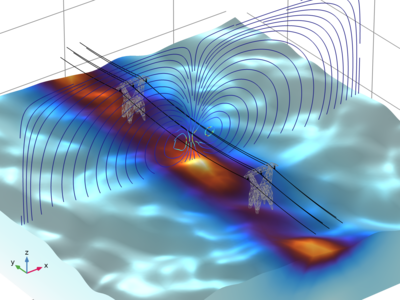
Power lines are commonly used as a means of transmitting electrical power across large distances. In this tutorial, towers transmitting high voltage three-phase AC power are modeled, and the resulting magnetic field is computed. The towers have two shielding lines. Read More


