
The Application Gallery features COMSOL Multiphysics® tutorial and demo app files pertinent to the electrical, structural, acoustics, fluid, heat, and chemical disciplines. You can use these examples as a starting point for your own simulation work by downloading the tutorial model or demo app file and its accompanying instructions.
Search for tutorials and apps relevant to your area of expertise via the Quick Search feature. Note that many of the examples featured here can also be accessed via the Application Libraries that are built into the COMSOL Multiphysics® software and available from the File menu.
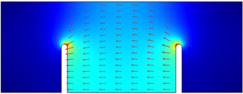
This example treats the modeling of electroosmotic flow in porous media. The system consists of a compartment of sintered porous material and two electrodes that generate an electric field. The cell combines pressure and electroosmotic driven flow. The equations that are solved are the ... Read More
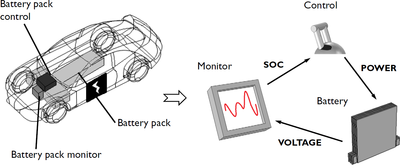
This is a template base model containing the physics, geometry and mesh of a lithium-ion battery, defined in 1D. The model makes use of four lithiation parameters which are used to define the relative balancing of the negative and positive electrodes, as well as global cell state of ... Read More
Due to the large differences in length scales in a lithium-ion battery, with the thickness of the different layers typically being several orders of magnitude smaller than the extension in the sheet direction, a lithium-ion battery is often well represented by a one-dimensional model. ... Read More
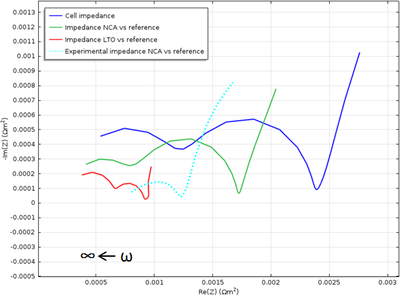
The goal with this app is to explain experimental electrochemical impedance spectroscopy (EIS) measurements and to show how you can use a simulation app, along with measurements, to estimate the properties of lithium-ion batteries. The app takes measurements from an EIS experiment and ... Read More
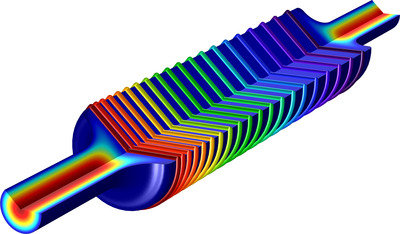
Carbon deposition on the surface of solid catalysts is commonly observed in hydrocarbon processing. A known problem is that carbon deposits can impede the activity of catalysts as well as block the flow of gas through a catalyst bed. This example investigates the thermal decomposition ... Read More
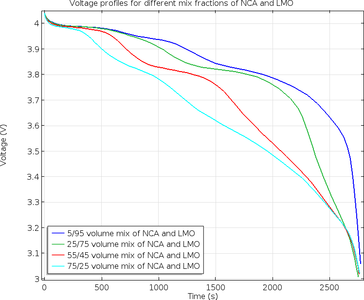
Lithium-ion batteries can have multiple active materials in both the positive and negative electrodes. For example, the positive electrode can have a mix of active materials. These materials can have different design properties (volume fraction, particle size), thermodynamic properties ... Read More
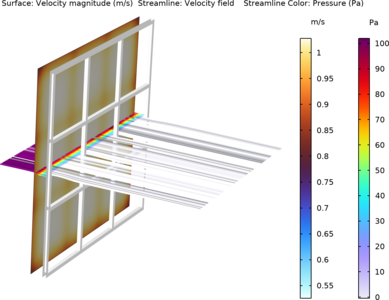
This example demonstrates simulation of a turbulent flow in a geometry with an air filter. Porous material of the filter induces an abrupt pressure drop and drastic increase of turbulence level inside the filter. Read More
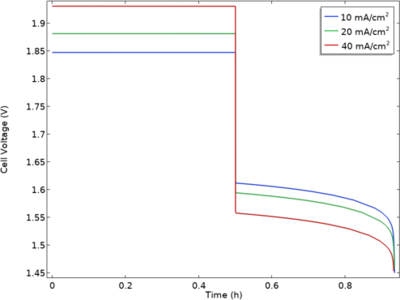
The zinc bromine redox flow battery is an electrochemical energy storage technology suitable for stationary applications. Compared to other flow battery chemistries, the Zn-Br cell potentially features lower cost, higher energy densities and better energy efficiencies. In the cell ... Read More
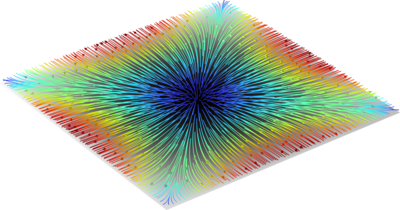
This example describes how to simulate the flow of a thin film of fluid in the gap between two rectangular plates, one of them with a porous facing, when the fluid is squeezed as a consequence of the relative motion between the plates. The model accounts for the ingress and egress of ... Read More
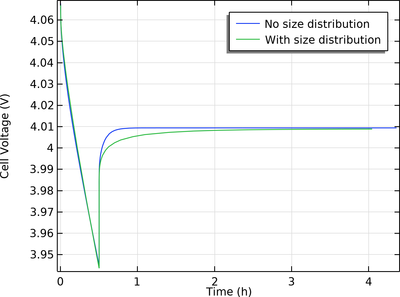
Battery electrodes featuring large heterogeneities in terms of particle sizes may sometimes not be adequately described by homogenized models using one single particle size only. As an alternative to adding multiple instances of the Additional Porous Electrode material node, this ... Read More


