
The Application Gallery features COMSOL Multiphysics® tutorial and demo app files pertinent to the electrical, structural, acoustics, fluid, heat, and chemical disciplines. You can use these examples as a starting point for your own simulation work by downloading the tutorial model or demo app file and its accompanying instructions.
Search for tutorials and apps relevant to your area of expertise via the Quick Search feature. Note that many of the examples featured here can also be accessed via the Application Libraries that are built into the COMSOL Multiphysics® software and available from the File menu.
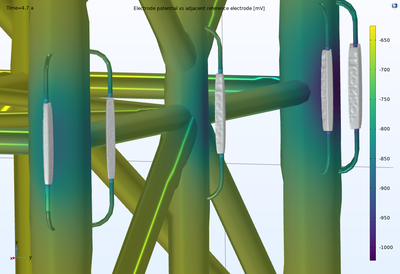
This tutorial models the cathodic protection of an oil rig structure during a time period of 15 years. As a result of the consumption of the sacrificial anodes, the protective capabilities system are reduced over time. The anode shape change in the model is defined by using the Level ... Read More
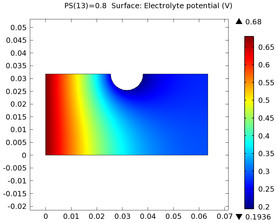
This example models cathodic protection of a steel reinforcing bar in concrete. Three different electrochemical reactions are considered on the steel surface. Charge and oxygen transport are modeled in the concrete domain, where the electrolyte conductivity and oxygen diffusivity depend ... Read More
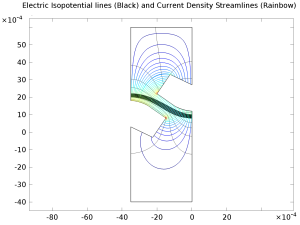
The chlor-alkali membrane process is one of the largest in industrial electrolysis with the production of roughly 40 million metric tons of both chlorine and caustic soda per year. Chlorine is used predominantly for the production of vinyl chloride monomer, which in turn is used for the ... Read More
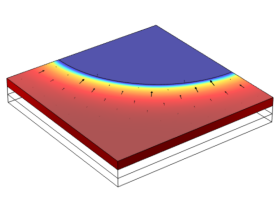
This example extends the Fuel Cell Cathode tutorial to also include liquid water transport in the oxygen electrode. Liquid water is produced using a user-defined expression for vapor condensation, depending on the relative humidity level in the gas phase. An experimental capillary ... Read More
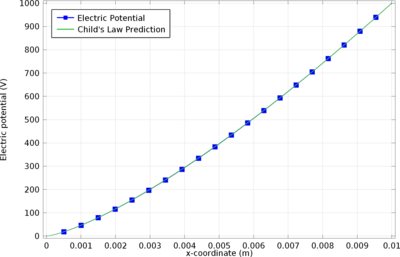
Space charge limited emission is a phenomenon that restricts the current of charged particles that can be released from a surface. As the electron current released by a cathode increases, so does the magnitude of the charge density in the immediate vicinity of the cathode. This ... Read More
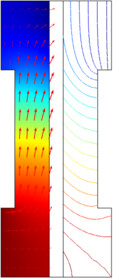
This example focuses on the species transport within the gas diffusion layers (GDLs) of a proton exchange membrane (PEM) fuel cell. The geometry models a cell with two adjacent flow channels of different pressures, a situation that may occur in a cell with serpentine flow channels, or in ... Read More

In small PEM fuel cell systems (in the sub-100 W range) no active devices for cooling or air transport are normally used. This is due to the desire to minimize parasitic power losses from pumps and fans, and to reduce the system complexity, size, and cost. The reactants at the cathode ... Read More
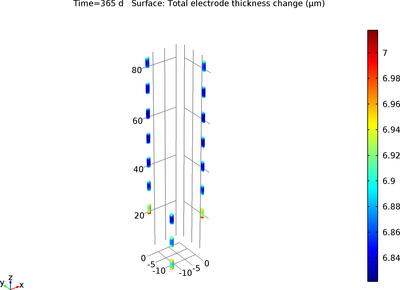
This model exemplifies how the rate of steel corrosion in an oil platform increases over time due to build-up of a resistive film on the sacrificial anodes, formed by reaction products. The model also includes secondary current distribution electrode kinetics on the protected steel ... Read More
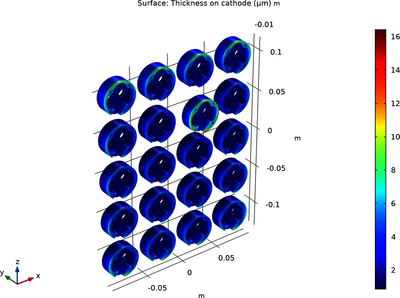
When several components are to be electroplated they are typically mounted on a rack in the electroplating bath. An important aspect is then achieving a uniform thickness of the plated layer for all components mounted on the rack. This example model allows for investigating the effect ... Read More
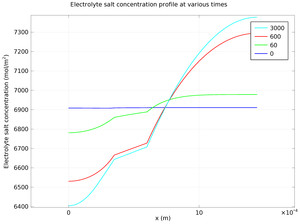
This model simulates the discharge of a Nickel-Metal Hydride (NiMH) battery using the Battery with Binary Electrolyte interface. The geometry is in one dimension and the model is isothermal. The model serves as an introduction to NiMH modeling, and can be further extended to include ... Read More


