
The Application Gallery features COMSOL Multiphysics® tutorial and demo app files pertinent to the electrical, structural, acoustics, fluid, heat, and chemical disciplines. You can use these examples as a starting point for your own simulation work by downloading the tutorial model or demo app file and its accompanying instructions.
Search for tutorials and apps relevant to your area of expertise via the Quick Search feature. Note that many of the examples featured here can also be accessed via the Application Libraries that are built into the COMSOL Multiphysics® software and available from the File menu.
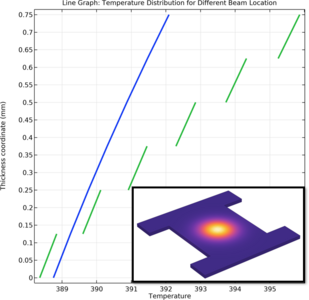
This example uses the thermal expansion of a laminated composite shell model to demonstrate the use of the feature Thermal Contact, Interface, applied on interfaces between layers in a laminated composite shell. The first study is computed neglecting this additional thermal resistance in ... Read More

In this model, an axial field magnetic gear with a gear ratio of 5:2 is modeled. Both the high-speed and low-speed rotors consist of permanent magnets and back iron. The low-speed rotor consists of five pole pairs, while the high-speed rotor consists of two pole pairs and the stationary ... Read More
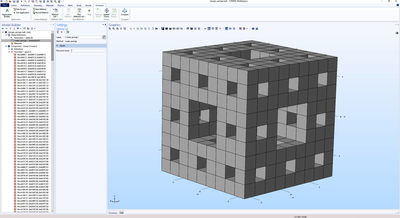
You can use the Method Editor in the Application Builder for creating methods that perform almost any type of modeling tasks, including geometry modeling. It is easy to miss the fact that methods can support recursion by having a method calling itself in a recursive loop. Here, we will ... Read More

This small tutorial model studies energy conservation in a small conceptual test setup. The model has an inlet and outlet (modeled using ports) and a Helmholtz resonator with a very narrow neck. The acoustics in the narrow neck are modeled with Thermoviscous Acoustic for a detailed ... Read More
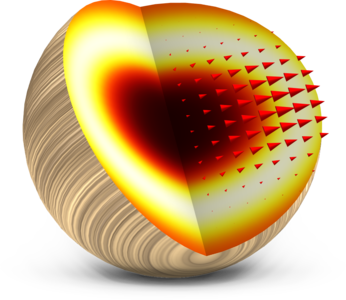
The pyrolysis of a centimeter-sized wood particle presents a fully coupled multiphysics problem with mass transfer, fluid flow, and heat transfer. This example model consists of two parts. The first part demonstrates how to set up a model describing the pyrolysis of a porous, ... Read More
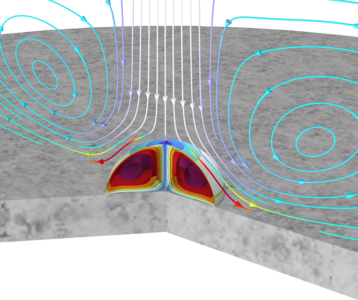
This model describes the evaporation of a droplet that consists of concentrated solution of acetone and water. It accounts for the coupled phenomena of chemical species transport and heat transfer over phase boundaries (liquid-gas boundary) as well as for multiphase flow. The droplet ... Read More

Two approaches are demonstrated to introduce a goal-seeking Global Equation into a COMSOL Multiphysics® model. This Global Equation acts to adjust a single input of the model such that any single scalar output of the model takes on a desired target value, or goal. Learn more in ... Read More
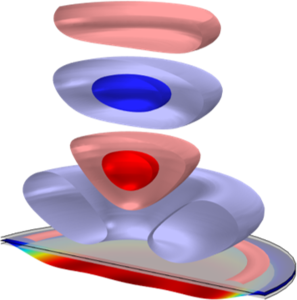
This tutorial demonstrates a full electro-vibroacoustic analysis of a conceptual electrostatic speaker driver, composed of thin conducting plastic diaphragm residing between two perforated metal sheets called grids or stators. When an audio signal is applied to the grids (out of phase), ... Read More

Tutorial model investigating a set of two competing reactions. The model demonstrates the natural modeling strategy for reaction engineering in COMSOL Multiphysics®. That is, how to go from chemical equations to space-dependent models of reacting flow with a minimum of work. Read More
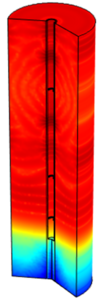
This model demonstrates how to simulate a piezoelectric transducer as both a sound transmitter and a receiver in a well logging setup. Other applications of this setup are, for example, in the field of nondestructive testing. A transmitting transducer is connected to an electrical ... Read More


