
The Application Gallery features COMSOL Multiphysics® tutorial and demo app files pertinent to the electrical, structural, acoustics, fluid, heat, and chemical disciplines. You can use these examples as a starting point for your own simulation work by downloading the tutorial model or demo app file and its accompanying instructions.
Search for tutorials and apps relevant to your area of expertise via the Quick Search feature. Note that many of the examples featured here can also be accessed via the Application Libraries that are built into the COMSOL Multiphysics® software and available from the File menu.
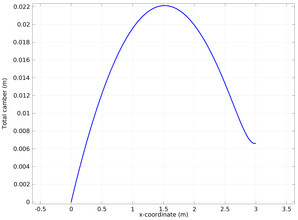
In this example you will build and solve a 3D beam model using the 3D Beam interface. This model shows how a thermally induced deformation of a beam is modeled. Temperature differences are applied across the top and bottom surfaces as well as the left and right surfaces of the beam. ... Read More
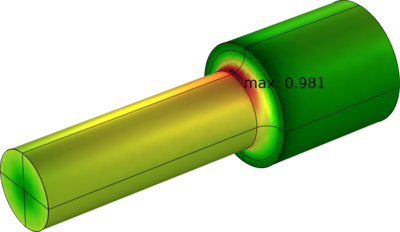
This example shows how to perform a High Cycle Fatigue (HCF) analysis with a non-proportional load history caused by a transversal force and a torque which are applied in different combinations. Three different fatigue models (Findley, Matake, and Dang Van) are compared. Read More
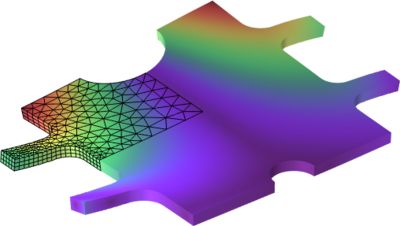
In this tutorial, the vibrational behavior of a small aluminum plate with four waveguide structures is analyzed. This is an example of a structural component located in a device where elastic waves are propagating, like a smart speaker, an electric motor, or a MEMS device. The plate can ... Read More
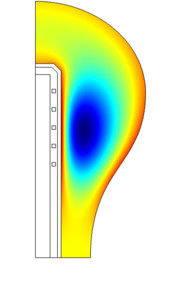
This model simulates an electrodeless lamp with argon/mercury chemistry. The low excitation threshold for mercury atoms means that even though the mercury is present in small concentrations, its behavior dominates. There is strong UV emission from the plasma at 185 nm and 253 nm. The UV ... Read More
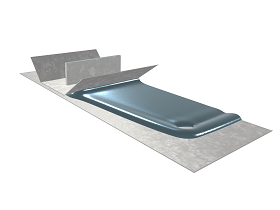
This is a tutorial of a slot die coating process in 3D where the channel is obstructed. The example uses a two-phase flow phase-field method with a non-Newtonian power-law fluid. The effects on the film thickness of the channel obstruction can clearly be seen. Read More
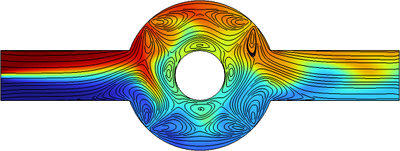
Microlaboratories for biochemical applications often require rapid mixing of different fluid streams. At the microscale, flow is usually highly ordered laminar flow, and the lack of turbulence makes diffusion the primary mechanism for mixing. While diffusional mixing of small ... Read More
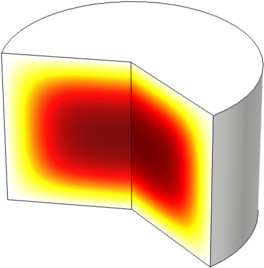
This is a benchmark model for an axisymmetric transient thermal analysis. The temperature on the boundaries changes from 0 degrees C to 1000 degrees C at the start of the simulation. The temperature at 190 s from the anlysis is compared with a NAFEMS benchmark solution. Read More
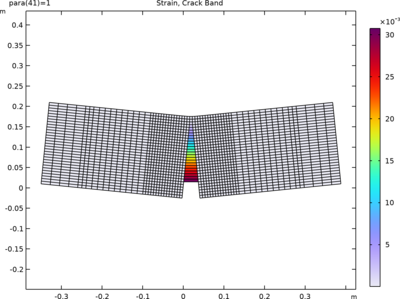
In this example, two model for brittle damage are used to evaluate the fracture of a notched concrete beam subjected to three point bending. The results are compared with experimental data. Read More

This model demonstrates how a nonlinear equation system can be setup to solve for the eigenfrequencies of a symmetric laser cavity. The model uses the bidirectional formulation of the Electromagnetic Waves, Beam Envelopes physics interface. The computed eigenfrequencies are verified with ... Read More
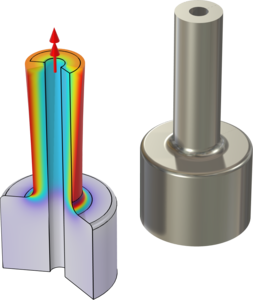
Including circumferential displacements in a 2D axisymmetric Solid Mechanics interface allows to compute twist and bending deformations. This model determines stress concentration factors for a hollow shaft for load cases of axial extension, torsion, as well as bending, using a ... Read More


