
The Application Gallery features COMSOL Multiphysics® tutorial and demo app files pertinent to the electrical, structural, acoustics, fluid, heat, and chemical disciplines. You can use these examples as a starting point for your own simulation work by downloading the tutorial model or demo app file and its accompanying instructions.
Search for tutorials and apps relevant to your area of expertise via the Quick Search feature. Note that many of the examples featured here can also be accessed via the Application Libraries that are built into the COMSOL Multiphysics® software and available from the File menu.
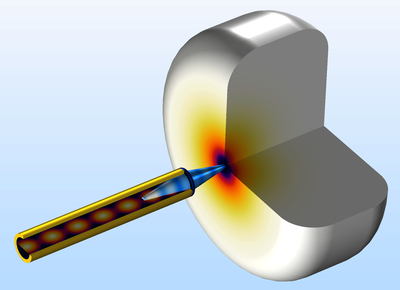
The response of a millimeter wave with frequencies of 35 GHz and 95 GHz is known to be very sensitive to water content. This model utilizes a low-power 35 GHz Ka-band millimeter wave and its reflectivity to moisture for noninvasive cancer diagnosis. Since skin tumors contain more ... Read More
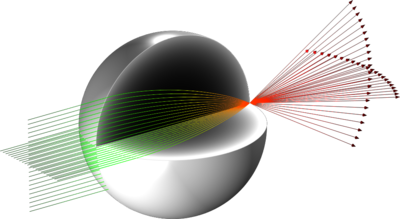
A Luneburg lens is a type of graded index, or GRIN lens, in which the gradient of the refractive index leads to special focusing properties. This example model uses the Geometrical Optics interface to compute the curved ray trajectories in the graded-index medium. Read More
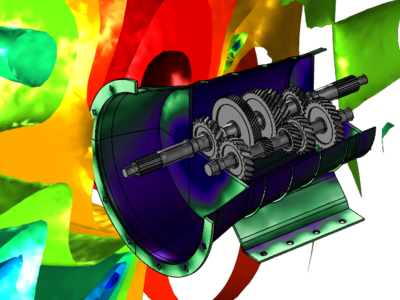
A gearbox is used to transfer power from an engine to its associated wheels or cogs, which can result in radiating noise to the surroundings. This is due to the transmission of undesired lateral and axial forces on the bearings and housing, while transmitting power from one shaft to the ... Read More
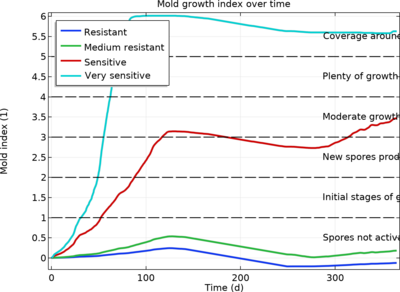
This tutorial demonstrates how to use the temperature and relative humidity computed from a heat and moisture transport simulation of an insulated roof as inputs for a mold prediction model. The VTT model for mold growth and decline prediction calculates a mold index M by solving an ... Read More
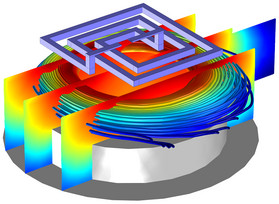
The COMSOL® software includes capabilities for 3D plasma modeling. In this example, a square coil is placed on top of a dielectric window and is electrically excited at 13.56 MHz. A plasma is formed in the chamber beneath the dielectric window, which contains argon gas at low ... Read More
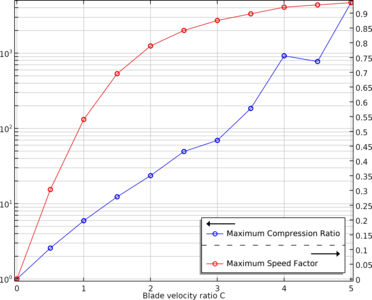
The Free Molecular Flow interface, available in the Molecular Flow Module, is an efficient tool for modeling extremely rarefied gases when the gas molecules move much faster than any geometric entities in the domain. For turbomolecular pumps, in which the blades move at speeds comparable ... Read More
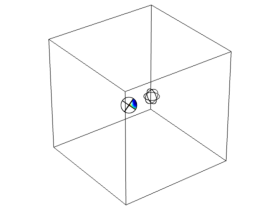
This model verifies that the onset of streamer formation between two spheres separated by atmospheric pressure dry air at a distance of 2cm occurs at 51.8kV. The electrical breakdown is detected by integrating Townsend coefficients along the electric field lines between the two spheres. ... Read More
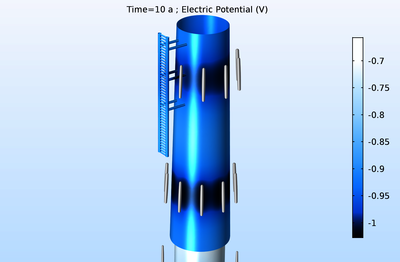
A monopile foundation is a large-diameter structural element that can be used to support structures like offshore wind turbines. This application exemplifies how the cathodic protection of a monopile decreases over time as the sacrificial anodes dissolve. The model can be used to ... Read More
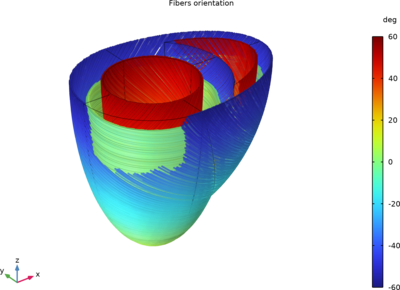
The standard biventricular cardiac model is used to show how to set up fiber directions in a complex geometry. The fibers are then used to model the large deformation of the myocardium with the Holzapfel-Gasser-Ogden anisotropic material model. The Aliev-Panfilov equations are included ... Read More
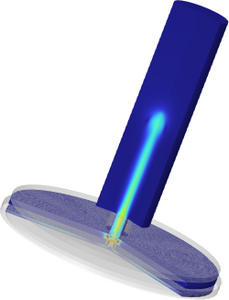
Piezoelectric microblowers are compact, lightweight air pumps with varying applications including electronics cooling and airflow related medical devices. The device consists of a PZT-brass diaphragm and a specially designed housing including a pumping chamber, air inlet and outlet ... Read More


