
The Application Gallery features COMSOL Multiphysics® tutorial and demo app files pertinent to the electrical, structural, acoustics, fluid, heat, and chemical disciplines. You can use these examples as a starting point for your own simulation work by downloading the tutorial model or demo app file and its accompanying instructions.
Search for tutorials and apps relevant to your area of expertise via the Quick Search feature. Note that many of the examples featured here can also be accessed via the Application Libraries that are built into the COMSOL Multiphysics® software and available from the File menu.
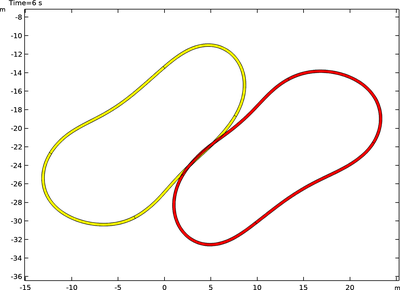
In this conceptual example, the soft impact between two elastic rings is modeled using the Solid Mechanics and Shell interfaces. One of the rings is given an initial velocity to initiate the impact event. Both rings are unconstrained and not subjected to any external forces. Contact is ... Read More
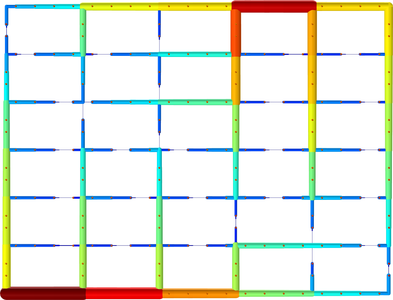
The layout of a district heating network is designed using topology optimization. Read More
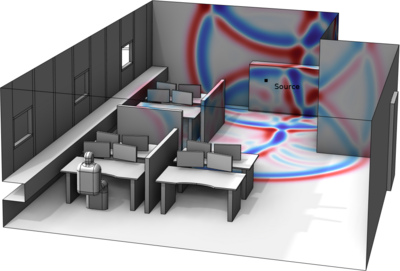
In this tutorial, the acoustics of an open-plan office space are analyzed using a wave-based approach in the time domain. An initial pulse is released and the room response is analyzed. Realistic frequency-dependent impedance conditions for the ceiling, carpet, and gypsum walls are ... Read More
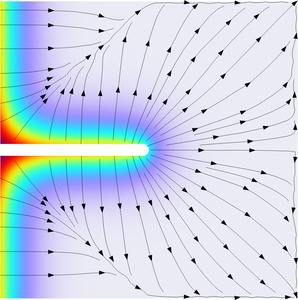
Hydrogen embrittlement refers to the degradation of metal ductility due to the absorption of hydrogen. The metal becomes more brittle and thus cracks might initiate at lower stress levels. It is important to estimate hydrogen concentration and the speed at which it diffuses into the ... Read More
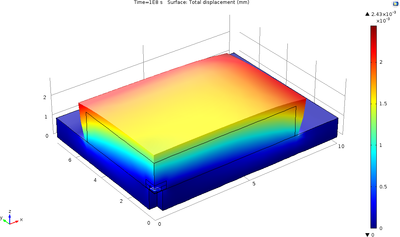
Modern integrated circuits are available as plastic encapsulated microcircuits (PEM). These devices are molded out of polymeric materials and epoxy resins in order to protect the internal semiconductors. Unfortunately, polymeric mold compounds absorb moisture when exposed to a humid ... Read More
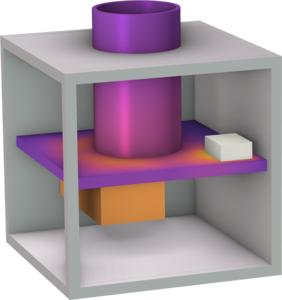
This model demonstrates how to compute satellite temperature over multiple orbit periods by coupling Orbital Thermal Loads to Heat Transfer in Solids. The direct solar, albedo, and Earth infrared thermal loads are computed over a single orbit, and are periodically repeated over multiple ... Read More
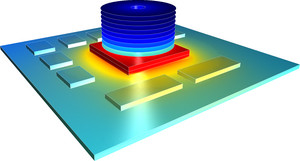
This problem follows a typical preliminary board-level thermal analysis. First perform a simulation of the board with some Integrated Circuits (ICs). Then, add a disk-stack heat sink to observe cooling effects. Finally, explore adding a copper layer to the bottom of the board in order to ... Read More
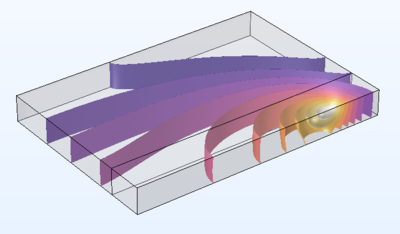
This model simulates arc welding of a titanium plate made from an alpha-beta titanium alloy. During a weld pass, the material experiences a thermal transient, including both heating and cooling. Phase transformations are modeled, and the evolution of the phase composition over time is ... Read More
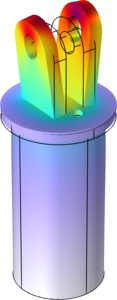
Communication masts usually have a framework with a bolted triangular lattice design. The diagonals of the framework are assembled from several parts and welded together. When operating under a given wind load at a specific location, the antenna’s total rotation angle should stay below ... Read More
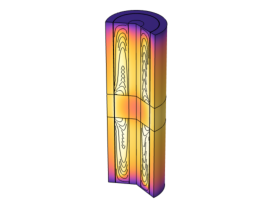
Fluid dampers are used in military devices for shock isolation and in civil structures for suppressing earthquake-induced shaking and wind-induced vibrations, among many other applications. Fluid dampers work by dissipating the mechanical energy into heat. This model shows the phenomenon ... Read More


