
The Application Gallery features COMSOL Multiphysics® tutorial and demo app files pertinent to the electrical, structural, acoustics, fluid, heat, and chemical disciplines. You can use these examples as a starting point for your own simulation work by downloading the tutorial model or demo app file and its accompanying instructions.
Search for tutorials and apps relevant to your area of expertise via the Quick Search feature. Note that many of the examples featured here can also be accessed via the Application Libraries that are built into the COMSOL Multiphysics® software and available from the File menu.
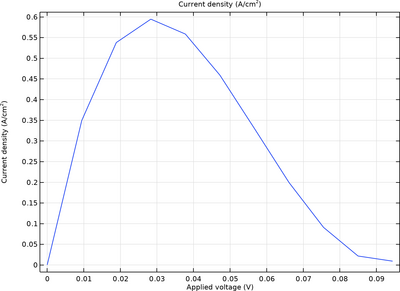
This tutorial demonstrates how to model the band-to-band tunneling across a p–n junction. The tunneling effect is imitated by defining the User-Defined Recombination domain feature which makes the electrons disappear from the conduction band on the n-side and holes disappear from the ... Read More
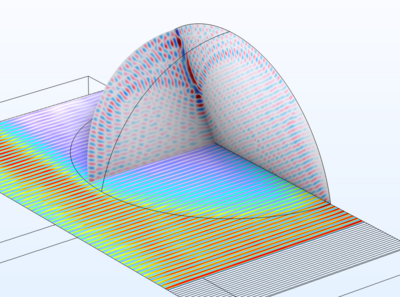
When a droplet is placed on a substrate on which surface acoustic waves (SAWs) are traveling, the energy of the SAWs is transferred into the droplet to form an acoustic field. The transferred energy is attenuated and generates a streaming flow. This type of streaming enables contactless ... Read More
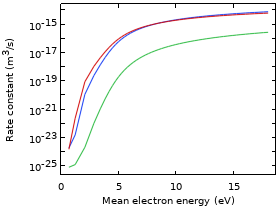
This model solves the Boltzmann equation in the two-term approximation for a background of molecular and atomic hydrogen. Electron mobility and source terms are computed by suitable integration of the electron energy distribution function over electron impact cross sections. Read More
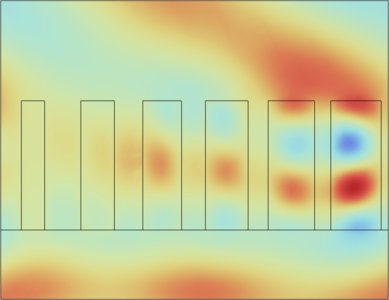
This model demonstrates how to simulate a metasurface beam deflector that uses anomalous refraction. The structure itself is a repeated array of six posts (so-called meta elements). The periodicity of the individual posts is 500 nm, so the full structure of six posts is 3 um wide. The ... Read More
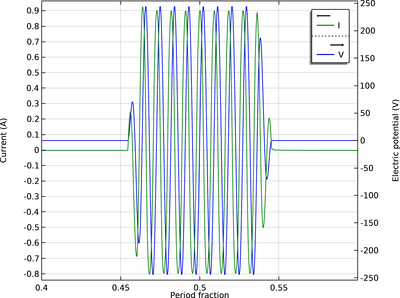
This tutorial model shows how to set up a model of a pulsed capacitive discharge. The on pulse consists of 10 periods of excitation at 13.56MHz, followed by no excitation for 100 periods. The I-V characteristics, the electron density, temperature and plasma potential are studied. Read More
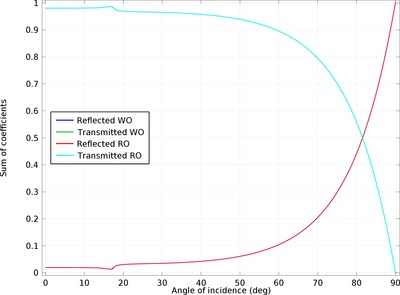
This model uses the Wave Optics Module and the Ray Optics module to model the propagation of rays through a diffraction grating at different angles of incidence. It uses the S-parameters computed by the Electromagnetic Waves, Frequency Domain interface on a unit cell of the grating to ... Read More
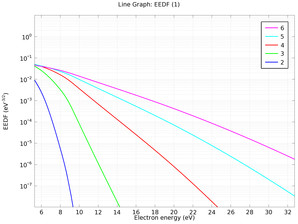
The Boltzmann equation can be solved to validate sets of electron impact collision cross sections. In fact, sets of collision cross sections are traditionally inferred by solving a two-term approximation to the Boltzmann equation and comparing the results to swarm experiments. This model ... Read More
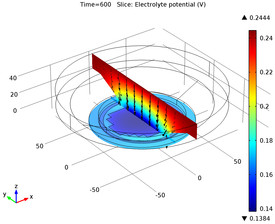
This example models time-dependent copper deposition on a resistive wafer in a cupplater reactor. As the deposited layer builds up, the resistive losses of the deposited layer decreases. The benefit of using a current thief for a more uniform deposit is demonstrated. Read More
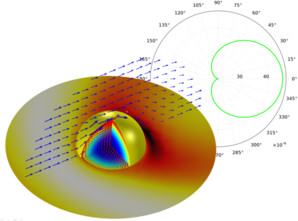
This model demonstrates the simulation of the scattering of a plane wave of light by a gold nanosphere. The scattering is computed for the optical frequency range over which gold can be modeled as a material with negative complex-valued permittivity. The far-field pattern and losses are ... Read More
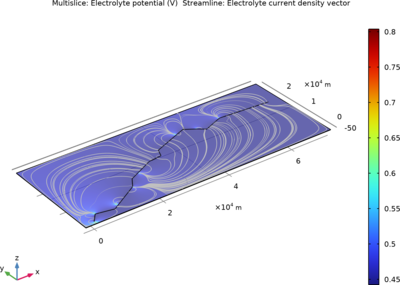
In this example, three parallel pipelines of length 68 km and a horizontal separation distance of 10 m between them are protected against corrosion by an impressed current cathodic protection (ICCP) system using a series of anodes. Each anode is connected to all three pipelines, ... Read More


