
The Application Gallery features COMSOL Multiphysics® tutorial and demo app files pertinent to the electrical, structural, acoustics, fluid, heat, and chemical disciplines. You can use these examples as a starting point for your own simulation work by downloading the tutorial model or demo app file and its accompanying instructions.
Search for tutorials and apps relevant to your area of expertise via the Quick Search feature. Note that many of the examples featured here can also be accessed via the Application Libraries that are built into the COMSOL Multiphysics® software and available from the File menu.
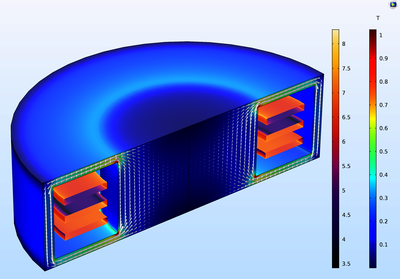
Inductive devices experience capacitative coupling between conductors at high frequencies. Modeling this phenomenon requires that you describe electric fields that have components both parallel with and perpendicular to the wire. This consideration might lead to the conclusion that a 3D ... Read More
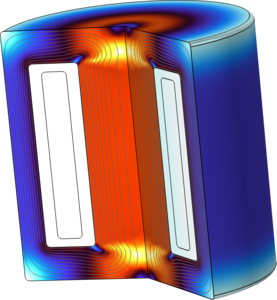
If an inductor's magnetic material is nonlinear, then the inductance depends on the current passing through it. This model consists of an inductor with a nonlinear magnetic core, where the small-signal inductance is simulated as a function of current. The model also investigates how ... Read More
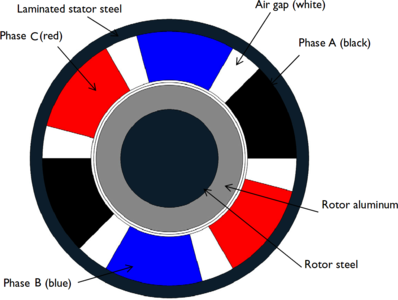
This is an example of a model of an induction motor in which the eddy currents are induced in the rotor by the time harmonic currents on the stator windings and the rotation of the rotor. In this example, we analyze the induction motor in 2D using the transient solver in the Rotating ... Read More
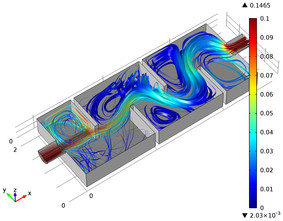
This app demonstrates the following: Parametric geometry containing a geometry sequence with if-statements to produce different types of designs Options to set the mesh size A graphical user interface that includes different windows that can be shown or hidden Light Theme Water ... Read More
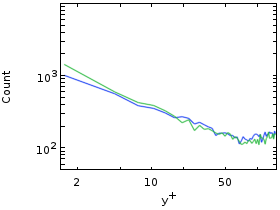
In this benchmark model, solid particles are released in a fully developed turbulent channel flow. The particles are subjected to a drag force that includes contributions from the fluid turbulence, implemented using a Continuous Random Walk (CRW) model. Because the turbulence in the ... Read More
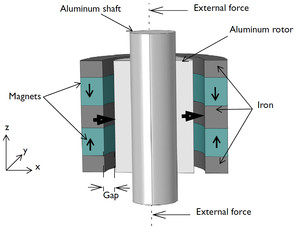
This model illustrates the working principle of a passive electrodynamic bearing. An electrically conducting rotor rotating in a magnetic field produced by a permanent magnets induces eddy currents on the conducting rotor. The eddy currents, in turn, produce a magnetic field that opposes ... Read More
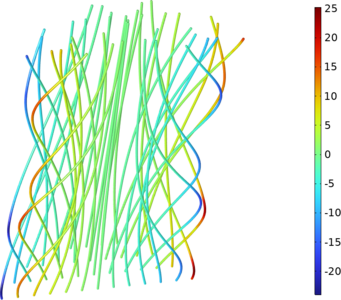
Turbulent flow, SSG-LRR interface is employed to investigate turbulent flow in a straight semicircular duct. The resulting flow pattern is characterized by slow secondary motions in the plane normal to the duct axis. The order of magnitude of velocity of those motions is 1% of the ... Read More

This model presents the flow noise generated by flow past the so-called tandem cylinder configuration. The test is part of the “First Workshop on Benchmark problems for Airframe Noise Computations”. The tutorial model shows the steps involved in a flow-induced noise simulation in COMSOL ... Read More
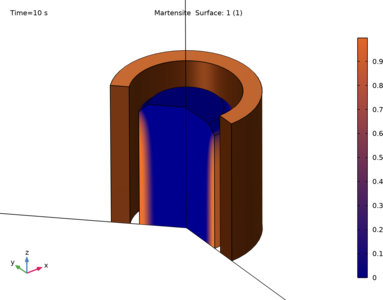
This example shows how to model induction hardening of a small steel pin. The ferritic-pearlitic pin is induction heated using a coil with a high frequency alternating current. The surface of the pin is thereby austenitized, and the pin is then water cooled to produce a hard, martensitic ... Read More
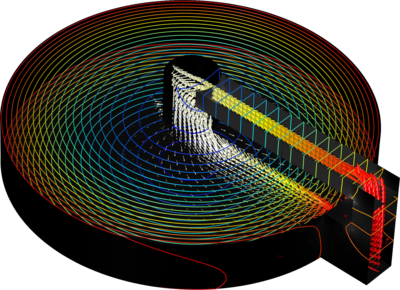
A homopolar generator is composed of an electrically conductive rotating disc placed in a uniform magnetic field that is perpendicular to the plane of rotation. The motion of the conductor through the static magnetic field induces Lorentz currents in the disc. By connecting the outside ... Read More


