
The Application Gallery features COMSOL Multiphysics® tutorial and demo app files pertinent to the electrical, structural, acoustics, fluid, heat, and chemical disciplines. You can use these examples as a starting point for your own simulation work by downloading the tutorial model or demo app file and its accompanying instructions.
Search for tutorials and apps relevant to your area of expertise via the Quick Search feature. Note that many of the examples featured here can also be accessed via the Application Libraries that are built into the COMSOL Multiphysics® software and available from the File menu.
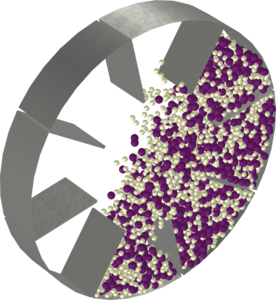
This model simulates the mixing of two types of grains in a rotating drum with baffles. The effect of the number of baffles on the mixing is demonstrated by varying the number of baffles in the drum. This model also demonstrates how to build and run a model method that evaluates the ... Read More
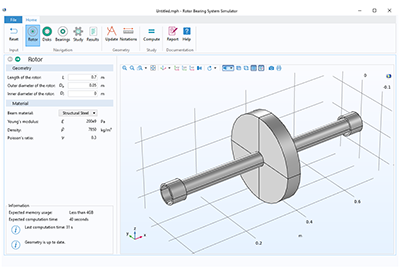
This app demonstrates the following: Navigation system using toggle buttons in the ribbon and Back/Forward buttons in the settings window Selecting predefined or user-defined materials Using a table for input of geometry objects The app simulates a rotor bearing system consisting of ... Read More

Modeling packed beds, monolithic reactors, and other catalytic heterogeneous reactors is substantially simplified with the Reacting Flow in Porous Media multiphysics interface. This defines the diffusion, convection, migration, and reaction of chemical species for porous media flow ... Read More
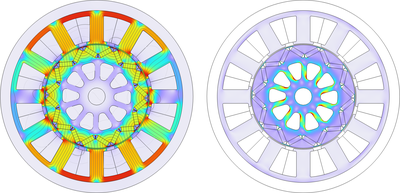
The magnets in an Interior Permanent Magnet (IPM) motor are embedded in the rotor core, where they form narrow regions known as bridges. The thickness of the magnetic bridge is an important parameter to consider in design, both from the electromagnetic and the mechanical perspectives. As ... Read More
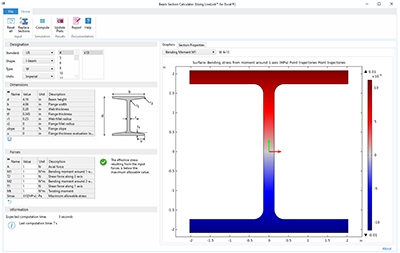
This app demonstrates the following: Reading and importing data from an Excel®-file Exporting data to an Excel®-file Light theme The app computes the beam section properties and true stress distribution in a designated steel beam section. A broad range of American and European beam ... Read More
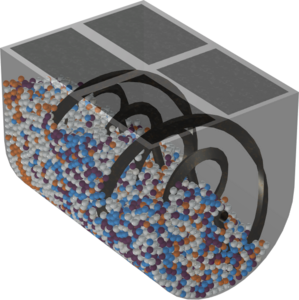
A ribbon mixer (sometimes referred to as a ribbon blender) is a mechanical device that is commonly used to mix different types of granular material. Ribbon mixers are widely used across various industries including food processing, pharmaceuticals, chemical industries, agriculture, ... Read More
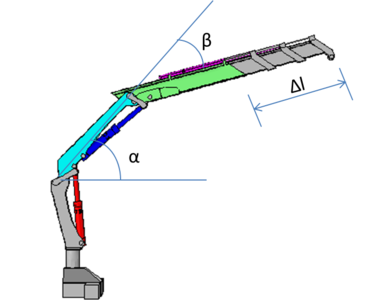
This app demonstrates the following: Using the knob form object Updating the geometry by rotating a knob Provides info if the results are above or below certain critical values Many trucks are equipped with cranes for handling loads and such cranes have a number of hydraulic ... Read More
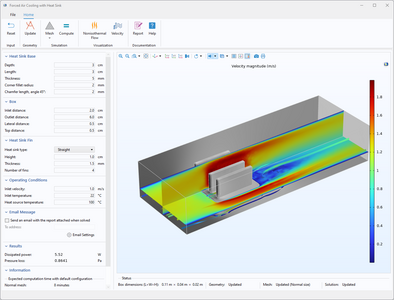
This app demonstrates the following: Geometry parts and parameterized geometries Sending an email with a report when the computation is finished User-defined email server settings which is useful when running compiled standalone applications Options for setting different mesh sizes ... Read More
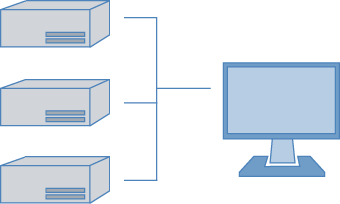
Use this app to validate that the default settings correctly submit jobs to a cluster. These default settings are taken from the preferences. The app allows you to override the default cluster settings, test modifications to the current setup, and test different settings for connecting ... Read More
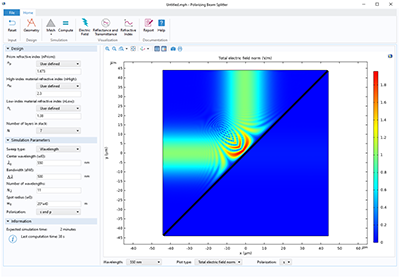
A Gaussian beam is incident on a 45-degree thin-film stack embedded in glass material prisms. The thin-film stack is designed from alternating high and low refractive index materials. The wave will be refracted at the Brewster angle at each internal interface. Thus, mainly p-polarized ... Read More


