
The Application Gallery features COMSOL Multiphysics® tutorial and demo app files pertinent to the electrical, structural, acoustics, fluid, heat, and chemical disciplines. You can use these examples as a starting point for your own simulation work by downloading the tutorial model or demo app file and its accompanying instructions.
Search for tutorials and apps relevant to your area of expertise via the Quick Search feature. Note that many of the examples featured here can also be accessed via the Application Libraries that are built into the COMSOL Multiphysics® software and available from the File menu.
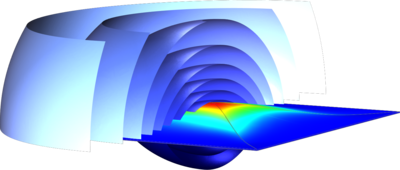
This model analyzes a piezoelectric microelectromechanical system (MEMS) speaker. The speaker, composed of four triangular membranes, uses a layer of lead zirconate titanate (PZT) material with two electrodes on top of a silicon layer as actuators. The triangular membranes are separated ... Read More
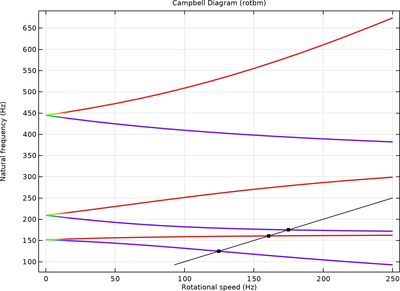
Different types of elements can be used for modeling a rotor, depending on the level of complexity and the type of the system being modeled. The modeling steps and representation of the results will vary with the type of idealization. In this tutorial model, an eigenfrequency analysis is ... Read More
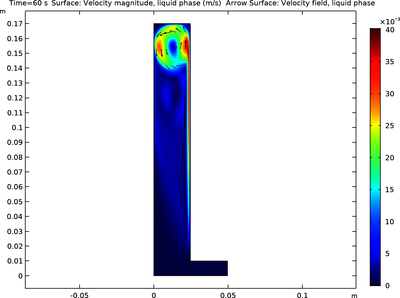
Copper electrowinning is the process of copper extraction from an electrolyte solution and its deposition at the cathode surface, by passing an external current through the electrolytic cell and using an insoluble anode. During the process, oxygen bubbles are generated at the anode ... Read More
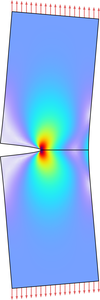
This model deals with the stability of a plate with an edge crack that is subjected to a tensile load. To analyze the stability of existing cracks, fracture mechanics theory can be utilized. A commonly used parameter in fracture mechanics, used to predict if a specific crack will cause ... Read More
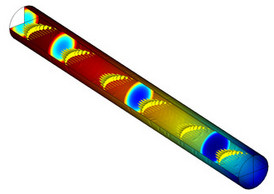
Tubular reactors are often used in continuous large-scale production, for example in the petroleum industry. One key design parameter is the conversion, or the amount of reactant that reacts to form the desired product. In order to achieve high conversion, process engineers optimize the ... Read More
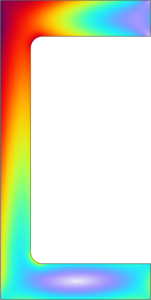
This benchmark demonstrates how to use the Beam interface in the Structural Mechanics Module. It calculates the deformation, section forces, and stresses in a cantilever beam as well as a number of eigenfrequencies. It also illustrates how to use the Beam Cross Section interface to ... Read More
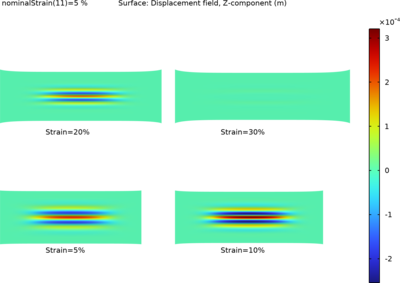
This example demonstrates the wrinkling of a thin rectangular sheet stretched uniaxially. First, a static analysis is performed to determine the region of negative principal stresses without wrinkling. Next, a prestressed buckling analysis is carried out to find out the linearized ... Read More

Optical lenses of millimeter size cannot easily be analyzed with the Electromagnetic Waves, Frequency Domain interface on standard workstations due to the large number of finite element mesh elements required. This model explains how the Electromagnetic Waves, Beam Envelopes interface ... Read More
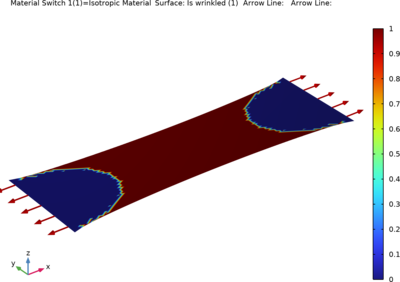
This example demonstrates the wrinkling phenomenon in a thin sheet stretched uniaxially. The modified membrane theory, which incorporates the wrinkling model, ensures noncompressive principal stresses in the wrinkled region. The analytical results are compared to the numerical results. Read More
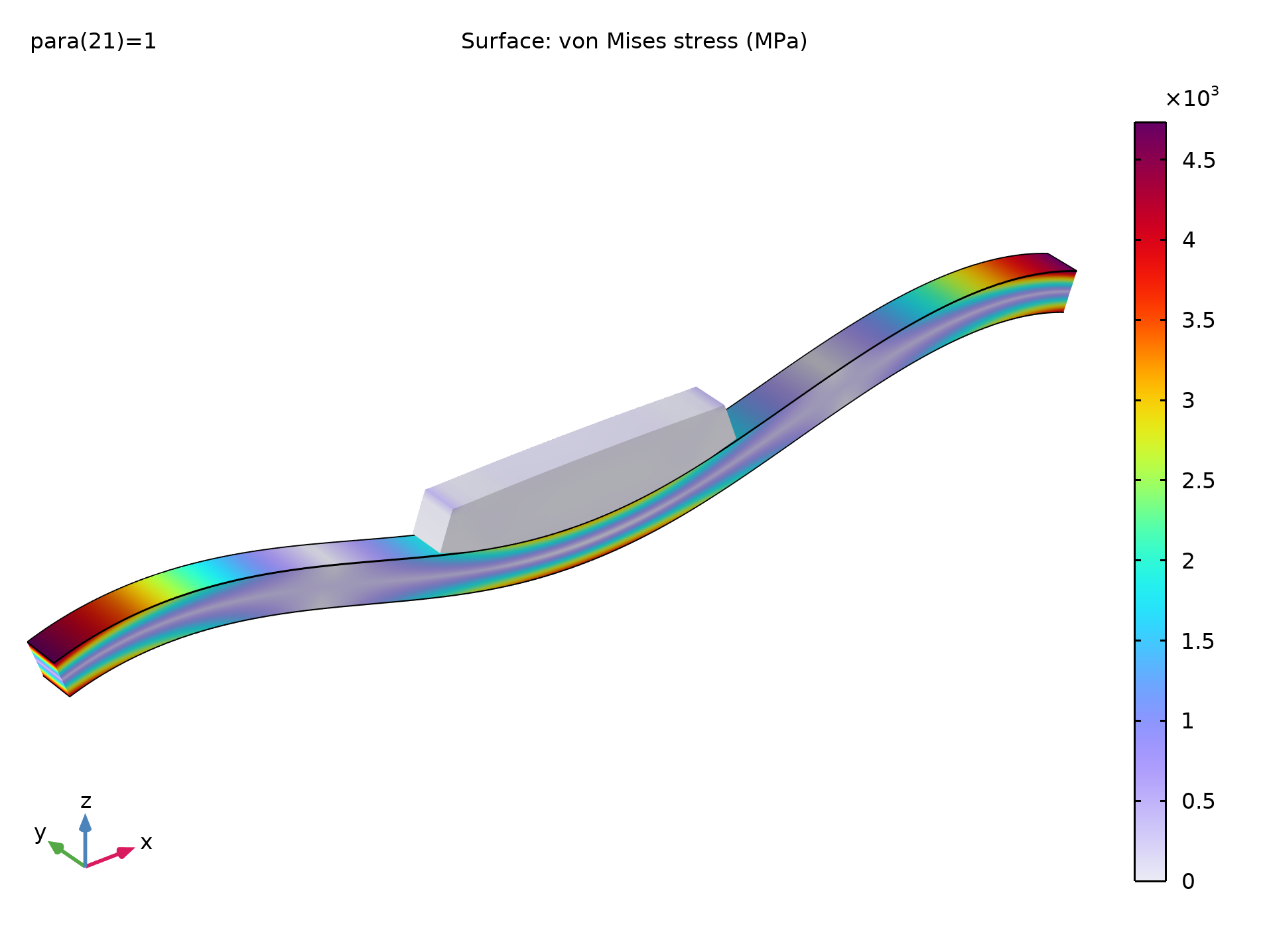
This conceptual example shows how to calculate critical points in models with contact. The model consists of a block modeled with the Solid Mechanics interface pressing on an arch modeled with the Shell interface. The contact problem is solved using the augmented Lagrangian method. The ... Read More


