
The Application Gallery features COMSOL Multiphysics® tutorial and demo app files pertinent to the electrical, structural, acoustics, fluid, heat, and chemical disciplines. You can use these examples as a starting point for your own simulation work by downloading the tutorial model or demo app file and its accompanying instructions.
Search for tutorials and apps relevant to your area of expertise via the Quick Search feature. Note that many of the examples featured here can also be accessed via the Application Libraries that are built into the COMSOL Multiphysics® software and available from the File menu.
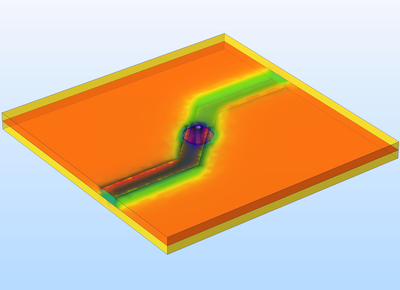
In signal integrity (SI) applications, time-domain reflectometry (TDR) is a useful technique for analyzing the discontinuity in a signal path by observing the reflected signal strength. The reflected signal distorts the input pulse mainly by impedance mismatch if there is no external ... Read More
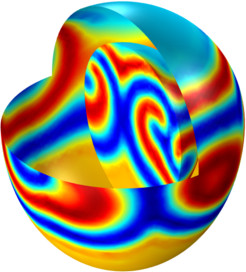
Modeling the electrical activity in cardiac tissue is an important step in understanding the patterns of contractions and dilations in the heart. The heart produces rhythmic electrical pulses, which trigger the mechanical contractions of the muscle. A number of heart conditions involve ... Read More
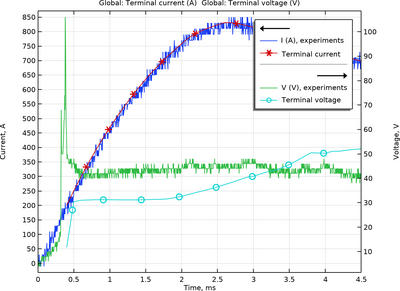
This model presents a 2D simulation of transient arc discharge movement along guided copper rails. While accurately modeling transient arcs typically requires a 3D simulation, the 2D approach offers greater efficiency and remains valuable for initial investigations and demonstration ... Read More
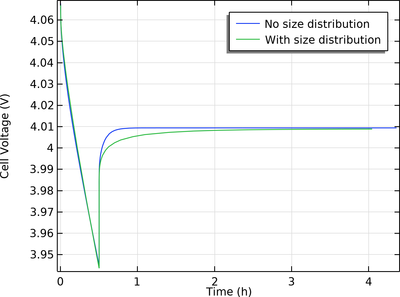
Battery electrodes featuring large heterogeneities in terms of particle sizes may sometimes not be adequately described by homogenized models using one single particle size only. As an alternative to adding multiple instances of the Additional Porous Electrode material node, this ... Read More
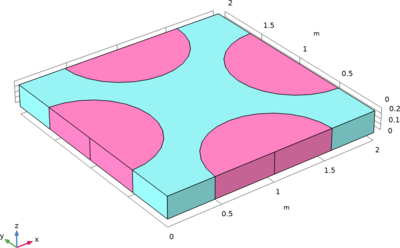
In this example, the micromechanical properties of a piezoelectric fiber composite are studied. The homogenized electromechanical properties of the composite are derived from the individual microscopic properties of matrix and fiber. Read More

This model example investigates the transport of reactants and water in a high temperature PEMFC. The model includes mass and momentum transport phenomena in the flow channels, gas diffusion layers (GDLs), and porous electrodes, as well as electrochemical currents in the GDLs, the porous ... Read More
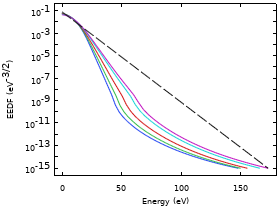
This tutorial models an ICP reactor by solving plasma fluid type equations fully coupled with the homogeneous and time-independent electron Boltzmann equation in the classical two-term approximation. The approximated Boltzmann equation is solved for each position of space and is coupled ... Read More
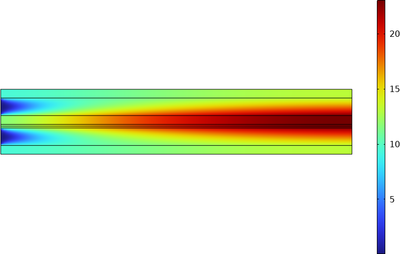
This example models co-electrolysis of H2O and CO2 using a solid oxide electrolyzer cell. The model includes the full coupling between the mass balances and gas flow in the H2 and O2 gas diffusion electrodes, the momentum balances in the H2 and O2 gas flow channels, the energy balance ... Read More
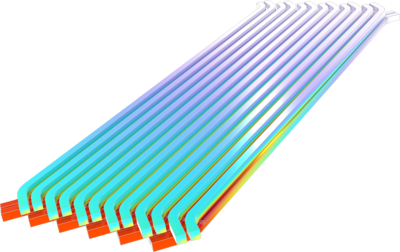
In a polymer electrolyte membrane fuel cell (PEMFC), water is produced at the cathode. The cell is also fed with water vapor via the inlet gas streams, in order to keep the polymer electrolyte membrane humidified. If the water partial pressure in the gas phase exceeds the vapor ... Read More
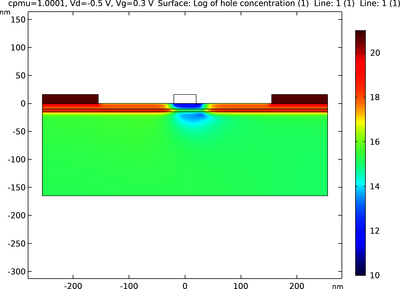
This tutorial analyzes the DC characteristics of an InSb p-Channel FET, using the density-gradient theory to add the effect of quantum confinement to the conventional drift-diffusion formulation, without a large increase of computational resources. The confinement effect is applied both ... Read More


