
The Application Gallery features COMSOL Multiphysics® tutorial and demo app files pertinent to the electrical, structural, acoustics, fluid, heat, and chemical disciplines. You can use these examples as a starting point for your own simulation work by downloading the tutorial model or demo app file and its accompanying instructions.
Search for tutorials and apps relevant to your area of expertise via the Quick Search feature. Note that many of the examples featured here can also be accessed via the Application Libraries that are built into the COMSOL Multiphysics® software and available from the File menu.
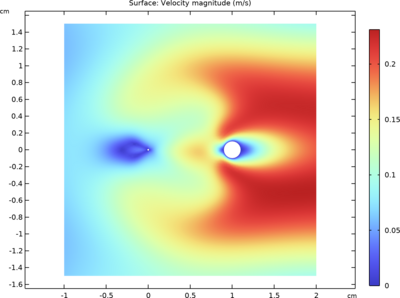
This model simulates the velocity of the ionic wind generated by a wire-to-wire corona discharge. Ionic wind, created by the movement of charged particles in an electric field, can be harnessed for various applications, including cooling electronic components and enhancing heat ... Read More
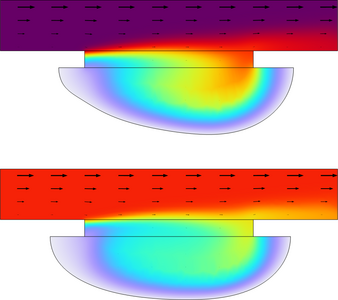
This model illustrates how to improve the symmetry of a wet chemical etching process by varying the convection and chemical concentration as a function time. Read More

Example for a geometry sequence to deduce a shell model from an imported solid CAD file. The model demonstrates how to generate parameters from dimensions of a geometry and how to convert a solid CAD geometry into a shell representation using midsurface and extract Read More
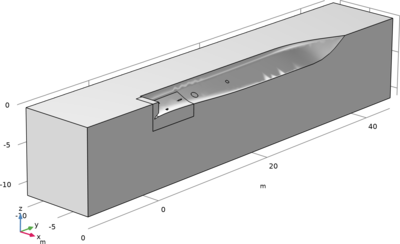
Example for a geometry sequence to create a ship hull using Loft. The different cross sections are defined using Dimensions and Constraints. Read More
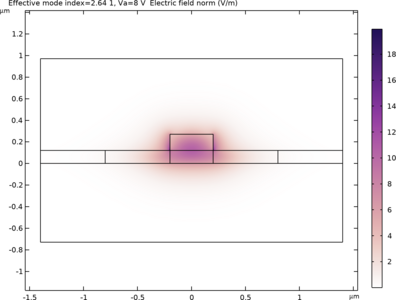
This tutorial demonstrates how to model a Silicon-on-Insulator (SoI) Modulator – a well-known optics device configuration that takes advantage of the free-carrier plasma dispersion effect and allows for the electrical control of the optical waveguide properties. The simulation couples ... Read More
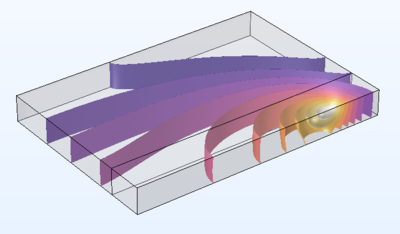
This model simulates arc welding of a titanium plate made from an alpha-beta titanium alloy. During a weld pass, the material experiences a thermal transient, including both heating and cooling. Phase transformations are modeled, and the evolution of the phase composition over time is ... Read More
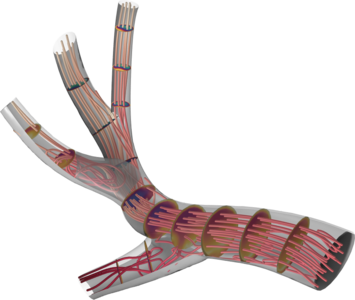
This example treats a pulmonary artery stenosis as a porous medium and demonstrates how to set up a model that combines free and porous media flow of a non-Newtonian fluid. The non-Newtonian behavior of blood is modeled using the Carreau model. Read More

This example builds surrogate models with deep neural network (DNN) training to quickly estimate the performance of a microstrip patch antenna based on four design parameters: patch length, tuning stub length, dielectric constant of a substrate, and frequency. The model also simulates a ... Read More

Modeling packed beds, monolithic reactors, and other catalytic heterogeneous reactors is substantially simplified with the Reacting Flow in Porous Media multiphysics interface. This defines the diffusion, convection, migration, and reaction of chemical species for porous media flow ... Read More
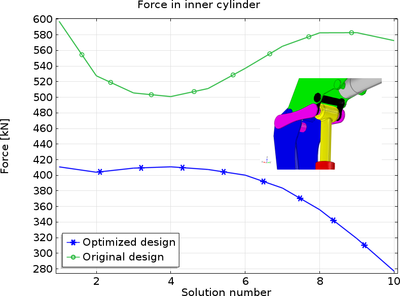
In complex mechanical systems, it can be challenging to find an optimal (or even good enough) solution only through engineering insight or trial-and-error procedures. Using mathematical optimization methods can then be an efficient path to a better design. In this example, a link ... Read More


