
The Application Gallery features COMSOL Multiphysics® tutorial and demo app files pertinent to the electrical, structural, acoustics, fluid, heat, and chemical disciplines. You can use these examples as a starting point for your own simulation work by downloading the tutorial model or demo app file and its accompanying instructions.
Search for tutorials and apps relevant to your area of expertise via the Quick Search feature. Note that many of the examples featured here can also be accessed via the Application Libraries that are built into the COMSOL Multiphysics® software and available from the File menu.

This tutorial model solves for a hydrogen plasma created in a microwave cavity. The model computes the fluid flow and gas heating self-consistently. Read More
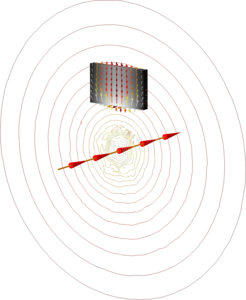
Induced eddy currents and associated thermal loads is of interest in many high power AC applications. This example is of general nature and illustrates some of the involved physics as well as suitable modeling techniques in the AC/DC Module. In this model a metallic plate is placed ... Read More
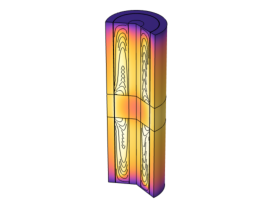
Fluid dampers are used in military devices for shock isolation and in civil structures for suppressing earthquake-induced shaking and wind-induced vibrations, among many other applications. Fluid dampers work by dissipating the mechanical energy into heat. This model shows the phenomenon ... Read More
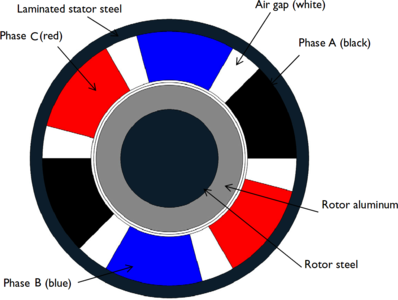
This is an example of a model of an induction motor in which the eddy currents are induced in the rotor by the time harmonic currents on the stator windings and the rotation of the rotor. In this example, we analyze the induction motor in 2D using the transient solver in the Rotating ... Read More
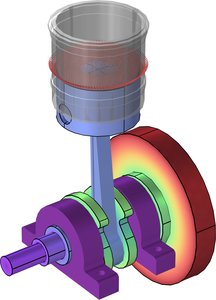
A single cylinder reciprocating engine supported on hydrodynamic bearings is studied. A starting torque is applied to bring the engine to required rpm. The loading torque is switched on once the engine picks up speed. After the start-up, the engine operates on its own driven by the ... Read More

This tutorial example serves as an introduction to the Corrosion Module and models the metal oxidation and oxygen reduction current densities on the surface of a galvanized nail, surrounded by a piece of wet wood, which acts as electrolyte. The protecting zinc layer on the nail is not ... Read More

This tutorial studies the etching of silicon using an inductively coupled plasma reactor with an RF bias in a mixture of CF4/O2. The etching rate is computed along the wafer as a function of the RF bias voltage. Read More
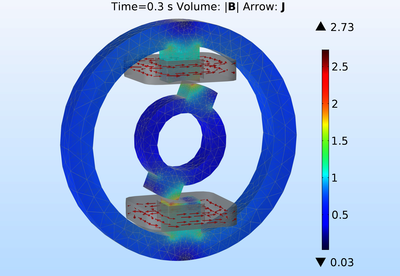
Switched reluctance motors work on the principle of reluctance torque. The stator and rotor will interact to minimize the reluctance for the flux path. This application simulates the behavior of the motor when the stator winding is excited with a step voltage and when the rotor is at a ... Read More

A cylindrical magnet falling through a copper tube induces eddy currents on the tube walls, which in turn, create a magnetic field that opposes the magnetic field of the magnet and induces a braking force that opposes the motion of the magnet. This model computes the velocity of the ... Read More
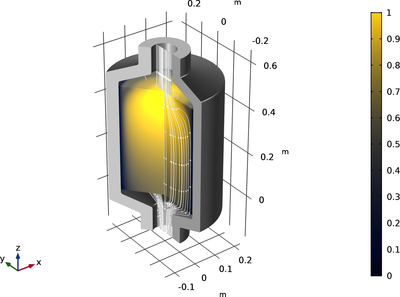
Thermal energy storage units are used to accumulate thermal energy from solar, geothermal, or waste heat sources. The simplest units are built from water tanks, often found in households, where the solar energy is stored as sensible heat. The thermal capacity of these tanks can be ... Read More


