
The Application Gallery features COMSOL Multiphysics® tutorial and demo app files pertinent to the electrical, structural, acoustics, fluid, heat, and chemical disciplines. You can use these examples as a starting point for your own simulation work by downloading the tutorial model or demo app file and its accompanying instructions.
Search for tutorials and apps relevant to your area of expertise via the Quick Search feature. Note that many of the examples featured here can also be accessed via the Application Libraries that are built into the COMSOL Multiphysics® software and available from the File menu.
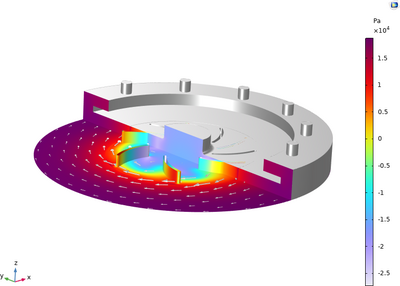
The present example simulates the steady-state flow in a radial pump using the mixing plane methodology. It solves for the averaged flow resulting from different blade positions of the rotor, thus circumventing the need to perform costly time-dependent simulations. Read More
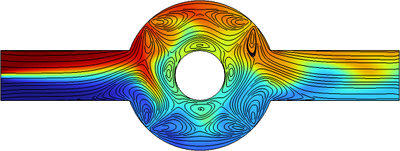
Microlaboratories for biochemical applications often require rapid mixing of different fluid streams. At the microscale, flow is usually highly ordered laminar flow, and the lack of turbulence makes diffusion the primary mechanism for mixing. While diffusional mixing of small ... Read More
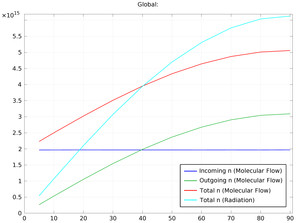
This model computes the particle flux, number density and pressure on the surface of a plate that rotates in a highly directional molecular flow. The results obtained are compared with those from other, approximate, techniques for computing molecular flows. Read More
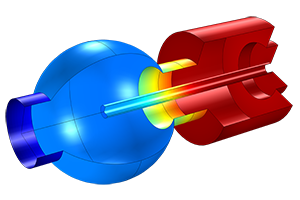
This model shows how to simulate the time-dependent adsorption and desorption of water in a vacuum system at low pressures. The water is introduced into the system when a gate valve to a load lock is opened and the subsequent migration and pumping of the water is modeled. Read More
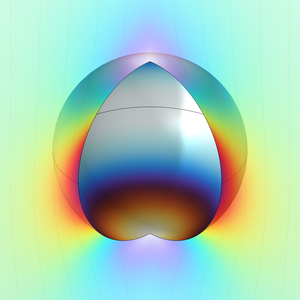
Electroporation is a technique where a localized electric field is used to generate nanometric pores in cell membranes, improving the cell permeability for ions and pharmaceuticals. This model shows the electroporation of a spherical cell by means of a nanosecond electric pulse. The ... Read More
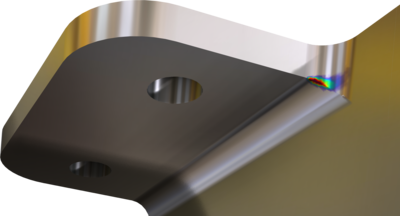
This example shows how to perform a fatigue analysis of a structure subjected to harmonic vibrations. The loading is applied at the attachments of the structure, and a frequency sweep is performed to compute the fatigue usage. Read More
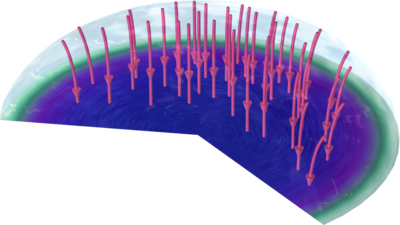
An Evans droplet experiment is a century-old corrosion experiment for demonstrating oxygen transport-limited corrosion. A droplet of water is placed on a metal surface, and over time the surface features differences in the radial direction of the surface in terms of amount of corroded ... Read More
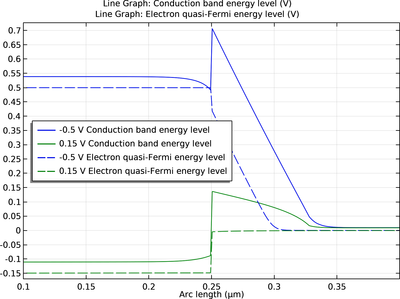
This benchmark model simulates a graded heterojunction using the thermionic emission formulation for the charge transfer over the junction. It shows the additional contribution to the current density from the quantum tunneling effect across the potential barrier, using the WKB ... Read More
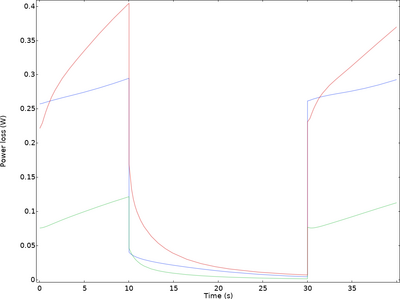
This example computes the power losses in a lithium-ion battery when exposed to high current pulses in a hybrid pulse power characterization (HPPC) test. Power loss contributions stemming from different phenomena are analyzed, as well as the total power losses pertaining to the ... Read More
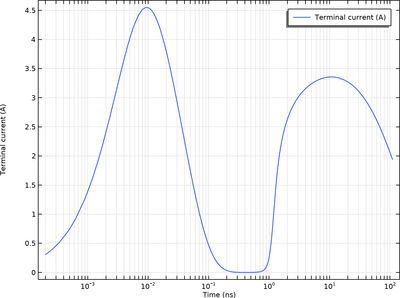
This model shows how to simulate the complex discharge physics behind the well-known electrostatic discharge (ESD). The model connects the Electrical Discharge interface with the Circuit interface to simulate how ESD current is generated when a human hand touches metal. Read More


