
The Application Gallery features COMSOL Multiphysics® tutorial and demo app files pertinent to the electrical, structural, acoustics, fluid, heat, and chemical disciplines. You can use these examples as a starting point for your own simulation work by downloading the tutorial model or demo app file and its accompanying instructions.
Search for tutorials and apps relevant to your area of expertise via the Quick Search feature. Note that many of the examples featured here can also be accessed via the Application Libraries that are built into the COMSOL Multiphysics® software and available from the File menu.

This model shows how to use the scattered field formulation to compute the transmission coefficient for impinging P and S plane elastic waves onto a finite size phononic crystal. The transmission tends to zero in the frequency range corresponding to P- and S-wave band gaps, as ... Read More
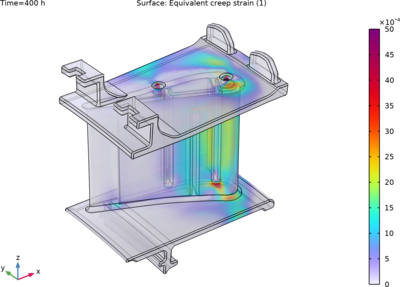
This example shows how to compute deformations caused by secondary creep in a turbine stator blade. The creep rate is highly influenced by temperature, and the deformation and stress relaxation is thus controlled by the temperature field. Read More
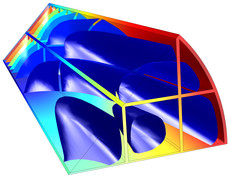
This suite of examples illustrate the modeling of selective NO reduction, that occurs as flue gases pass through the channels of a monolithic reactor in the exhaust system of a motored vehicle. The simulations are aimed at finding the optimal dosing of NH3, the reactant that serves as ... Read More
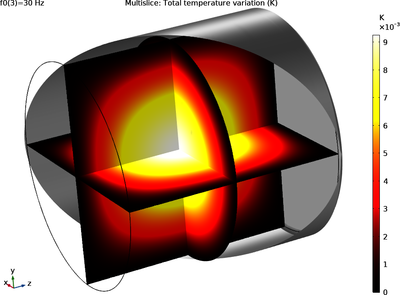
When high-fidelity measurement microphones are calibrated, a pressure reciprocity calibration method is used. During calibration, two microphones are connected at each end of a closed cylindrical cavity. For the calibration procedure, it is important to understand the acoustic field ... Read More
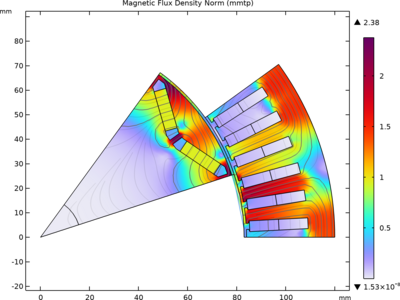
Obtaining the steady-state performance is an essential task for the electric motor designer. As with many electromagnetic devices, the steady-state condition of an electric motor is when electric and magnetic field variations have stabilized to periodic variations. That is when ... Read More
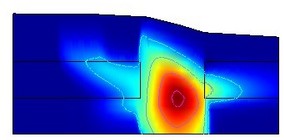
This model demonstrates the application of COMSOL Multiphysics to a benchmark case of steady-state subsurface fluid flow and transient solute transport along a vertical cross section in an unconfined aquifer. Because of profound geologic heterogeneity, the model must estimate solute ... Read More
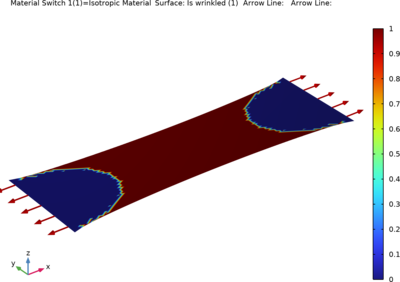
This example demonstrates the wrinkling phenomenon in a thin sheet stretched uniaxially. The modified membrane theory, which incorporates the wrinkling model, ensures noncompressive principal stresses in the wrinkled region. The analytical results are compared to the numerical results. Read More
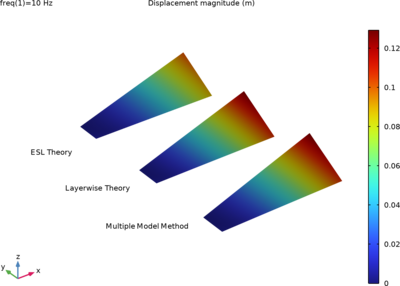
This example demonstrates the modeling of a sandwiched composite blade made up of carbon–epoxy, glass–vinylester, and PVC foam materials. Three different methods are used to model the sandwich composite structure: Layerwise theory, Equivalent Single Layer (ESL) theory, and a multiple ... Read More
This model verifies that the onset of streamer formation between two spheres separated by atmospheric pressure dry air at a distance of 2cm occurs at 51.8kV. The electrical breakdown is detected by integrating Townsend coefficients along the electric field lines between the two spheres. ... Read More
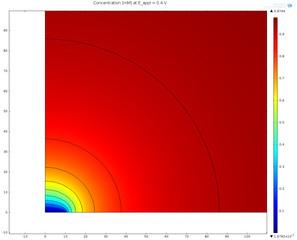
Voltammetry is modeled at a microelectrode of 10um radius. In this common analytical electrochemistry technique, the potential at a working electrode is swept up and down and the current is recorded. The current-voltage waveform ("voltammogram") gives information about the reactivity and ... Read More


