
The Application Gallery features COMSOL Multiphysics® tutorial and demo app files pertinent to the electrical, structural, acoustics, fluid, heat, and chemical disciplines. You can use these examples as a starting point for your own simulation work by downloading the tutorial model or demo app file and its accompanying instructions.
Search for tutorials and apps relevant to your area of expertise via the Quick Search feature. Note that many of the examples featured here can also be accessed via the Application Libraries that are built into the COMSOL Multiphysics® software and available from the File menu.
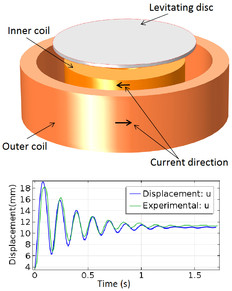
This model presents a solution to the Transient Electromagnetic Analysis Methods (TEAM) workshop problem 28, “An Electrodynamic Levitation Device”- a benchmark problem involving the dynamic coupling of electromagnetics and rigid body dynamics. An electrodynamic levitation force is ... Read More
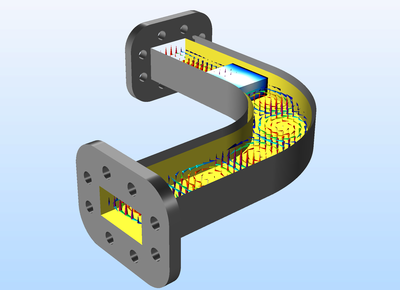
This is a model of an RF waveguide bend with a dielectric block inside. There are electromagnetic losses in the block as well as on the waveguide walls which cause the assembly to heat up over time. The material properties of the block are functions of temperature. The transient thermal ... Read More

The first part of the application computes the modes for a straight step index fiber made of silica glass. In the second part, a step index fiber bend with a 3 mm radius of curvature is analyzed with respect to propagating modes and radiation loss. It is shown how to find the power ... Read More
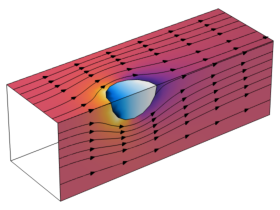
This model demonstrates the use of the Heat and Moisture Flow features for the simulation of superheated steam drying of a wood particle. A nonequilibrium formulation is used to compute the transport of the liquid water and vapor phases in the wood particle. Reference: Le, K. H., ... Read More
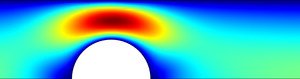
Many complex fluids of interest exhibit a combination of viscous and elastic behavior under strain. Examples of such fluids are polymer solutions and melts, oil, toothpaste, and clay, among many others. The Oldroyd-B fluid presents one of the simplest constitutive models capable of ... Read More
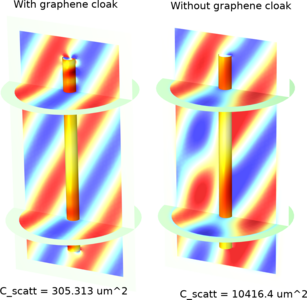
In this model, we introduce a cloaking method using an electrically tuned monolayer of graphene. We will show that when a cylindrical dielectric scatterer is covered in graphene, the scattering cross section is greatly reduced at the designated frequency, making it electromagnetically ... Read More
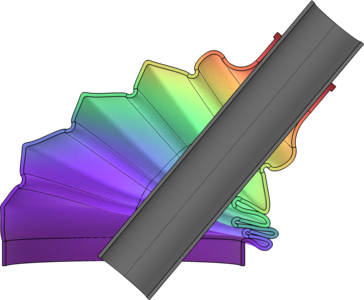
In this example, the deformation of a rubber boot seal connected to a rigid pipe is studied. As the pipe rotates and the seal deforms, the flanges of the seal self-intersect and it also come into contact with the pipe. Read More
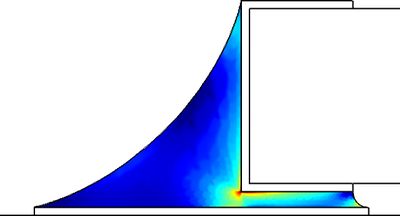
A surface mount resistor is subjected to thermal cycling. The difference in the thermal expansion of different materials will introduce stresses in the structure. The solder which connects the resistor with the printed circuit board is seen as the weakest link in the assembly. It ... Read More
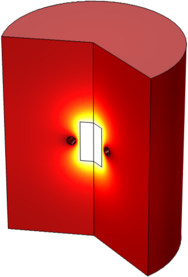
The induced currents in a copper cylinder produce heat that in turn change the electrical conductivity. This means that the field propagation has to be solved simultaneously with the heat transfer through the cylinder and surrounding system. This model shows this coupling between eddy ... Read More

In this model a Knowles ED23146 receiver (miniature loudspeaker) is connected to a test set-up consisting of a 50 mm (1 mm diameter) earmold tube and a so-called 0.4-cc coupler. The receiver is modeled using a lumped spice network and connected to the finite element domain at the tube ... Read More


