
The Application Gallery features COMSOL Multiphysics® tutorial and demo app files pertinent to the electrical, structural, acoustics, fluid, heat, and chemical disciplines. You can use these examples as a starting point for your own simulation work by downloading the tutorial model or demo app file and its accompanying instructions.
Search for tutorials and apps relevant to your area of expertise via the Quick Search feature. Note that many of the examples featured here can also be accessed via the Application Libraries that are built into the COMSOL Multiphysics® software and available from the File menu.
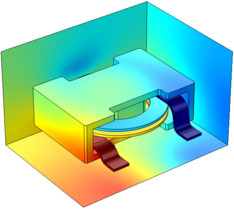
Power inductors are a central part of many low-frequency power applications. They are, for example, used in the switched power supply for the motherboard and all other components in a computer. Computer simulations are necessary in the design of such inductors. This model calculates the ... Read More
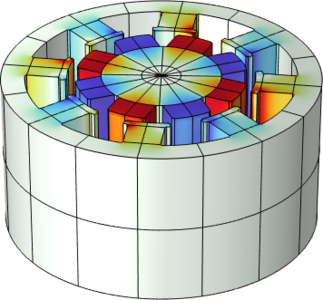
This application illustrates how to model an electric machine, such as a generator, motor, or drive, by exploiting its sector symmetry to reduce the size of the problem. The machine being studied is a simplified electric generator in 3D, based on the geometry used in the generator_2d ... Read More
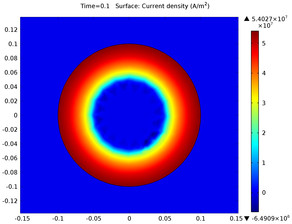
Superconducting materials have zero resistivity up to a certain critical current density, above which the resistivity increases rapidly. To model such a material, this example uses the Magnetic Field Formulation physics interface. The model was based on a suggestion by Dr. Roberto ... Read More
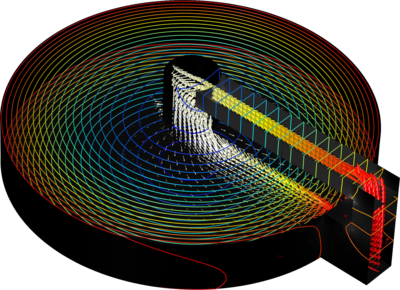
A homopolar generator is composed of an electrically conductive rotating disc placed in a uniform magnetic field that is perpendicular to the plane of rotation. The motion of the conductor through the static magnetic field induces Lorentz currents in the disc. By connecting the outside ... Read More
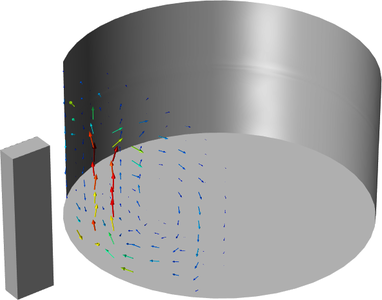
This is a tutorial how to set up electric machinery in 3D using a combination of the magnetic fields and magnetic fields no currents interfaces. Read More
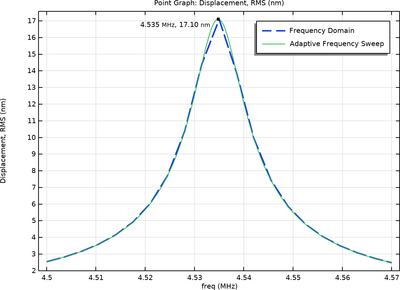
This tutorial shows how to model a miniaturized magnetostrictive antenna developed for use inside living cells. The stress in the antenna, the magnetic flux density, the current density, and the displacement of the tip of the device are investigated at the resonance frequency. Read More
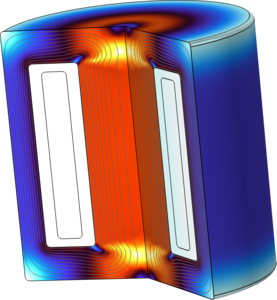
If an inductor's magnetic material is nonlinear, then the inductance depends on the current passing through it. This model consists of an inductor with a nonlinear magnetic core, where the small-signal inductance is simulated as a function of current. The model also investigates how ... Read More
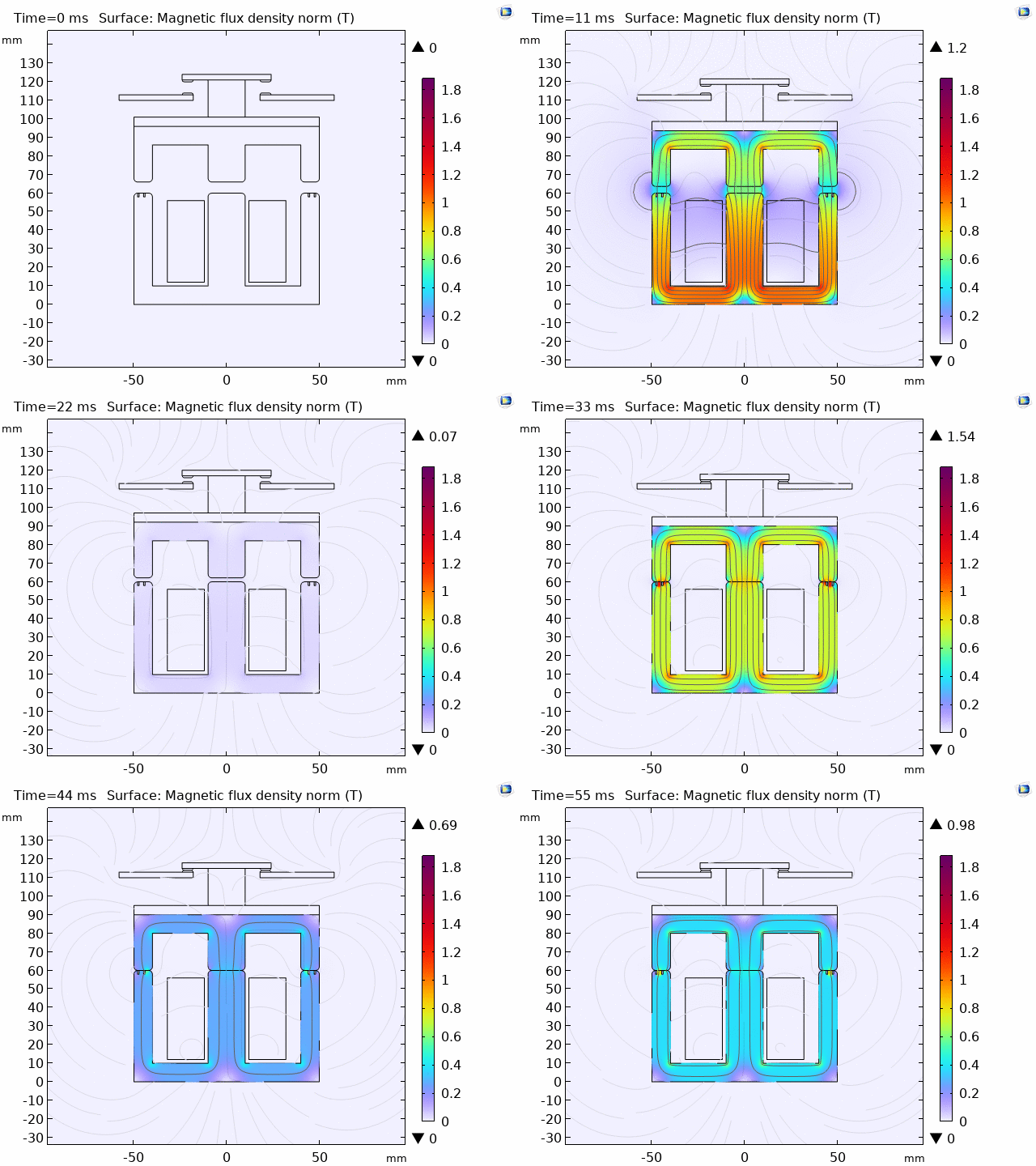
An AC contactor is a particular type of magnetic switch device, which is activated by a primary coil fed by an alternating current. Unlike DC switches, such devices can suffer from a tendency to reopen when the AC current crosses zero. The addition of a shading coil that supports ... Read More
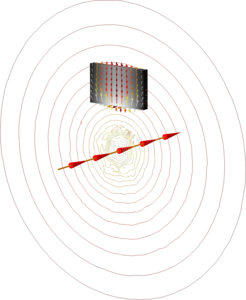
Induced eddy currents and associated thermal loads is of interest in many high power AC applications. This example is of general nature and illustrates some of the involved physics as well as suitable modeling techniques in the AC/DC Module. In this model a metallic plate is placed ... Read More
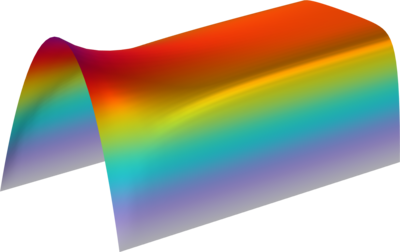
Classical MHD benchmark problem was solved analytically by J. Hartmann. He considered laminar incompressible flow between two planes (in planar duct) in transversal imposed magnetic field under next assumptions: * fully developed flow (far from inlet) * fluid properties are constant * ... Read More


