
The Application Gallery features COMSOL Multiphysics® tutorial and demo app files pertinent to the electrical, structural, acoustics, fluid, heat, and chemical disciplines. You can use these examples as a starting point for your own simulation work by downloading the tutorial model or demo app file and its accompanying instructions.
Search for tutorials and apps relevant to your area of expertise via the Quick Search feature. Note that many of the examples featured here can also be accessed via the Application Libraries that are built into the COMSOL Multiphysics® software and available from the File menu.
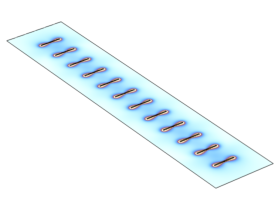
This example of a dipole antenna array demonstrates a cost-effective analysis using the Boundary Element Method (BEM). When dealing with a large array made of metallic radiators, the Finite Element Method (FEM) would necessitate greater computational resources. The simulation results ... Read More
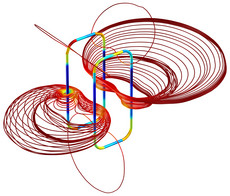
RFIDs are used in a multitude of applications such as tracking or identifying consumer products and their packaging. An RFID system consists of two main parts: A tag or transponder with a printed circuit-board (PCB) antenna A reader unit with a larger RF antennaThe reader antenna ... Read More
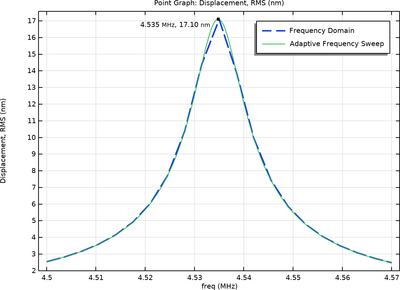
This tutorial shows how to model a miniaturized magnetostrictive antenna developed for use inside living cells. The stress in the antenna, the magnetic flux density, the current density, and the displacement of the tip of the device are investigated at the resonance frequency. Read More
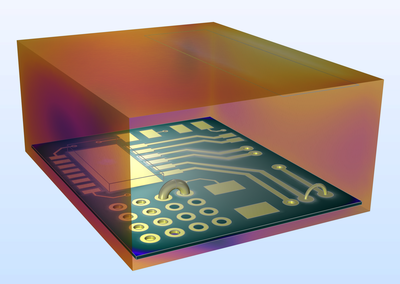
This model example shows how to simulate basic electromagnetic interference (EMI) and electromagnetic compatibility (EMC) behavior in a printed circuit board (PCB). The model contains two analyses to evaluate radiated emissions from PCB traces, crosstalk between adjacent microstrip ... Read More
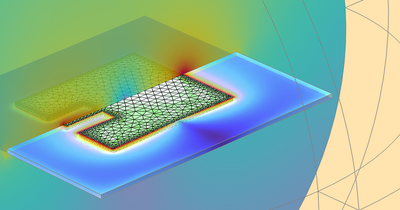
One of the ways we can simplify and reduce the size and computational complexity of a finite element model is by using any symmetries present in a model. In this entry, you can find three practical examples highlighting how to exploit symmetries in RF or wave optics modeling. They all ... Read More
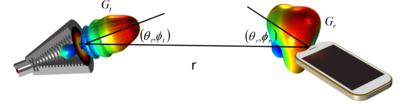
Multiscale modeling is a challenging issue in modern simulation. This occurs when there are vastly different scales in the same model. For example, your cell phone is approximately 10 cm, yet it receives GPS information from satellites 20,000 km away. In these models we examine several ... Read More
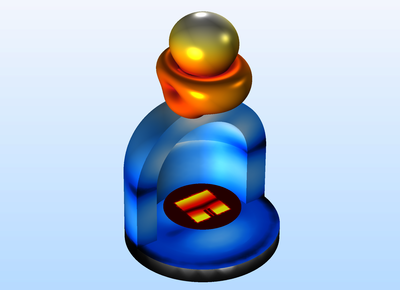
A radome minimizes losses and improves radiation characteristics of an antenna through its design. The structure can be optimized to minimize the transmission loss and also designed to improve radiation characteristics including antenna directivity and side lobes. Shown in the model is ... Read More
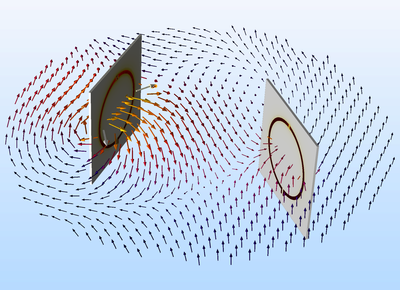
This model addresses the concept of wireless power transfer by studying the energy coupling between two circular loop antennas tuned for UHF RFID frequency whose size is reduced using chip inductors. The circular loop antenna provides inherent inductive coupling by its shape, and it can ... Read More
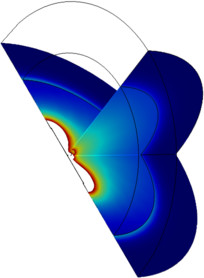
Feeding antennas with proper signals can be difficult. The signal is often described as a voltage, and voltages are not well defined in electromagnetic wave formulations. There are several tricks to model voltage generators in such situations, and one is the magnetic frill. This model ... Read More
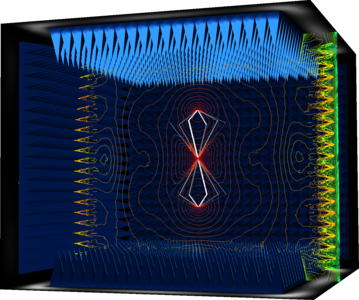
An anechoic chamber is used to measure antenna characterization, electromagnetic interference (EMI), and electromagnetic compatibility (EMC). Within the chamber are absorbers that are configured with an array of pyramidal objects that steer the propagating incident field onto their ... Read More


